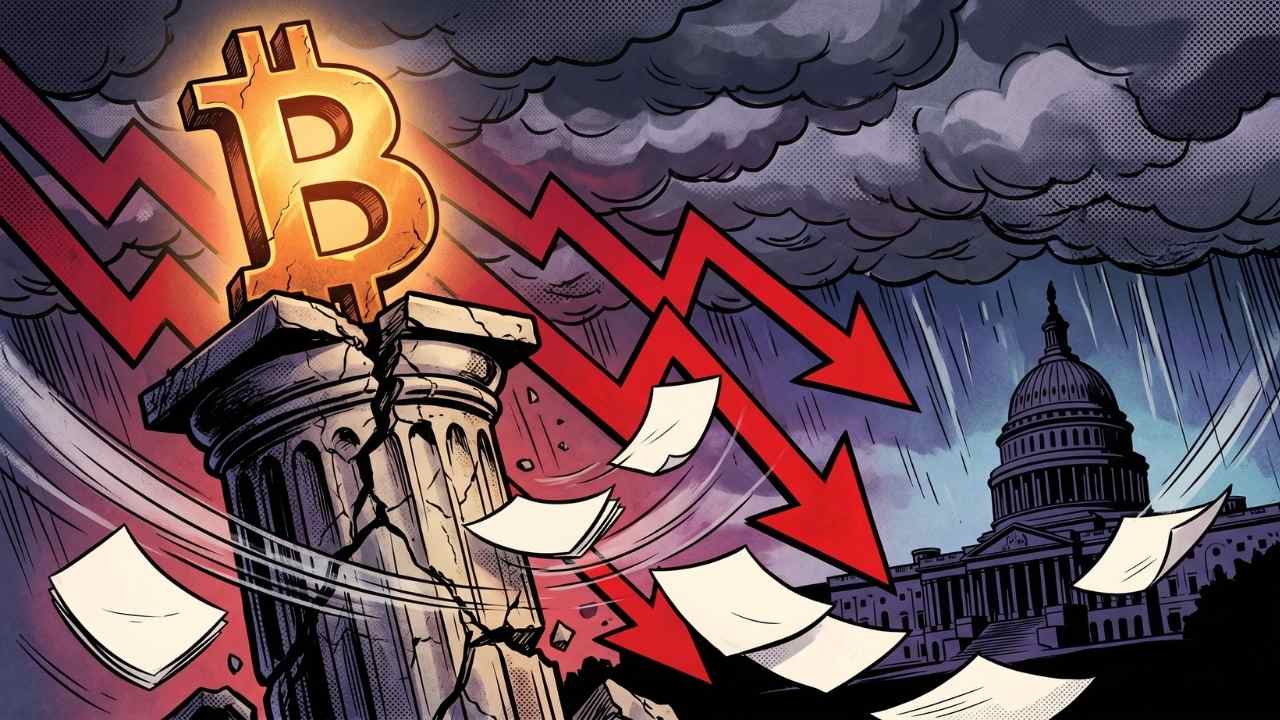
The proximity of the United States midterm elections revives debates regarding global asset volatility. A report from AMP Market Update indicates that stock markets drop seventeen percent on average during these political cycles. Historically financial markets experience severe tensions that disrupt digital assets.
The dominant market narrative links May with a mandatory seasonal capitulation for high-risk investments. Understanding this phenomenon is essential now that Federal Reserve liquidity exhibits signs of clear macroeconomic contraction, threatening the price stability of Bitcoin over the short term.
The traditional seasonal pattern known as “Sell in May” carries rigorous statistical precedent within legacy financial systems. According to data collected by Bloomberg Intelligence, regulatory political pressures preceding legislative votes in Washington typically accelerate capital outflows from major accumulation funds.
During midterm election periods, the implied volatility of equity indexes spikes notably between May and October. The behavior of cryptocurrency markets usually replicates these corrective developments due to an increasing correlation with traditional technology indices tracking performance on Wall Street.
This environment highlights the broader discourse regarding direct digital asset ownership versus complex derivative instruments. When evaluating institutional portfolios, market actors debate if is Bitcoin superior to ETFs as a strategic reserve asset capable of mitigating prolonged global macroeconomic uncertainty.
Liquidity Factors and Regulatory Pressure in May
The seasonal contraction of capital across open markets coincides with corporate tax compliance periods in North America. Historically, large corporate treasuries and institutional funds downsize exposure to high-volatility assets to lock in cash positions prior to the second half of the year.
However, historical data reveals important nuances regarding this supposed selling rule. A technical research document distributed by Bitcoin Suisse shows that average cryptocurrency returns during May do not consistently validate the classic axiom of completely liquidating asset holdings before the summer.
Despite political doubts, key on-chain metrics point to relative structural stability. Long-term holders maintain steady accumulation patterns, indicating that ongoing price fluctuations are driven by speculative trading strategies deployed by short-term market operators active on various digital derivative trading platforms.
Analyzing the counterpoint remains fundamental to establishing an objective analytical framework. The opposing view asserts that the legislative election cycle introduces long-term regulatory predictability. Promises of clearer operational guidelines usually attract significant institutional inflows once partisan primary elections wrap up completely.
This alternative perspective gains validity when observing the ongoing maturation of global market infrastructure. Regulated service providers decrease traditional systemic risks, mitigating the massive panic observed during previous political intervals where a lack of institutional custody magnified local political volatility.
Consequently, accelerated corporate adoption would completely invalidate the thesis of an imminent sell-off in May. Strategic balance sheet allocations by enterprises provide a robust price floor against unpredictable macroeconomic developments.
The implications of this cyclical behavior extend to the creation of new global financial products. The temporary correlation between congressional decisions and cryptoasset liquidity reshapes how multi-strategy hedge funds manage sovereign risk portfolios during intense American midterm election cycles.
Macroeconomic Trends and Cryptoasset Market Stability
Institutional asset flows demonstrate structural resilience against localized political anxiety. The stability of prominent stablecoins and consistent daily transactional volumes on settlement layers reflect sustained interest that operates independent of short-term price variations.
Furthermore, broader macroeconomic shifts introduce critical variables that compete with domestic political updates within the United States. Monetary policy choices enacted across European and East Asian central banks impact international liquidity, diluting the direct influence of the American legislative calendar on alternative financial markets.
Therefore, evaluating the current trading environment from an exclusively local viewpoint is completely inadequate. Financial analysts must carefully evaluate the interplay between global geopolitical transformations and native supply side variables within decentralized networks to accurately project capital movements.
Additionally, retail investor engagement has experienced a notable shift compared to past cycles of market volatility. Rather than liquidating asset holdings due to sudden fear, public metrics demonstrate a steady preference toward retaining supply-inelastic assets, effectively diminishing selling pressures in spot markets.
This quiet accumulation trend visibly undermines the standard narrative concerning major springtime capital liquidations. Ongoing market forces exhibit complex characteristics that actively challenge standard performance benchmarks historically documented across commodity listings and traditional stock exchanges.
Adjustments across the American statutory framework also redesign the operating parameters of specialized cryptocurrency funds. As federal watchdogs ease specific restrictive rules, fund managers uncover additional commercial reasons to sustain target allocations, ignoring brief negative pressures associated with legislative ballots.
Consequently, seasonal price volatility could reflect portfolio rebalancing rather than deep structural trend adjustments. Astute traders routinely capitalize on localized political uncertainty to optimize long-term spot market entries at highly advantageous execution prices.
This operational sophistication among market participants minimizes the likelihood of chaotic downside events. The modern digital asset landscape incorporates institutional hedging options and liquid derivative instruments that successfully absorb selling pressures, preserving the core financial health of primary blockchain network infrastructures.
In conclusion, the ties between legislative cycles and market returns involve intricate mechanics that resist simple linear predictions. The current macroeconomic backdrop provides a framework where digital scarcity features compete against fiat-driven liquidity factors over compressed horizons.
If macroeconomic readings from the Federal Reserve confirm persistent monetary liquidity restrictions during legislative primary votes, we will likely witness temporary Bitcoin market corrections, provided institutional allocation rates do not supply a dominant offsetting absorption force inside spot trading venues.
This article is for informational purposes only and does not constitute financial advice.