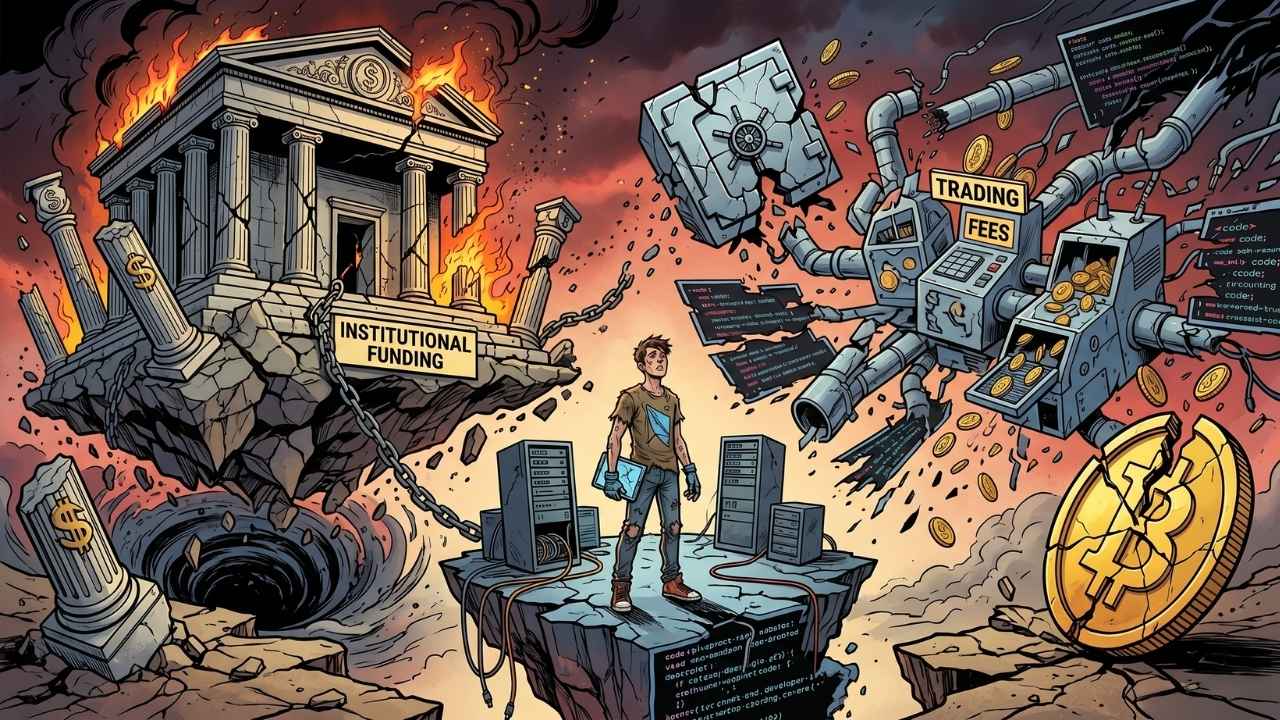
Confluent market conditions create a severe structural crossroad for Web3 teams. The sector experiences a drastic retreat in early-stage venture capital alongside a vertical drop in exchange fees. This macroeconomic squeeze represents a financial suffocation for crypto developers according to data published by the analytics team at Galaxy Research.
The dominant narrative assumed that transaction fees would compensate for the absence of continuous external funding. However, volume centralization in specific protocols forces a reassessment of decentralized infrastructure viability under current market conditions.
Private capital data reveals profound transformations. A comprehensive sectoral report by Silicon Valley Bank indicates that while gross capital deployment rose moderately, individual deal volume fell 33%. This trend showcases an extreme concentration of available resources into mature teams with proven tracking.
This dynamic sidelines early-stage pre-seed projects. Generalist investment funds have migrated their preferences toward artificial intelligence or demand immediate financial sustainability metrics, eliminating the speculative flexibility seen in previous innovation cycles.
The second funding pillar, transaction fees, faces a similar erosion process. Commercial volume consolidation toward vertically integrated platforms drains liquidity from independent market makers. This phenomenon accelerates a migration toward unified trading infrastructures, a shift detailed when evaluating how vertical trading integration centralizes fee revenues.
Concurrently, technological advancements designed to enhance scalability have radically altered organic application revenue. The massive implementation of modular architectures drove a drastic compression of protocol fees. Global industry studies compiled by Mordor Intelligence show that transaction costs on secondary networks decreased exponentially.
While this cost reduction benefits end users, it dismantles the economic model of base protocols. Lower fees mean fewer revenue streams directed to developer treasuries, neutralizing the primary engine of native self-sustainability.
Erosion of the Traditional Monetization Model
Proponents of modular architecture argue that lower fees will multiply active users over the long term. Under this optimistic view, a massive increase in total transaction volume will offset falling individual margins, ultimately stabilizing aggregate revenue streams for builders.
This premise holds validity when examining high-frequency sectors like micropayments and consumer applications. Affordable infrastructure unlocks business models that were previously cost-prohibitive due to severe network congestion on primary layer blockchains.
However, to invalidate the capital depletion thesis, commercial activity growth must be exponential and simultaneous with a reopening of private venture markets. If usage metrics surge but venture capital deployment remains completely absent, structural viability will remain heavily challenged.
Historically, technological innovation cycles have endured similar financial purges. During the dot-com crash, the sudden evaporation of speculative capital forced surviving enterprises to transition toward business models strictly supported by positive cash flows.
In crypto analysis, the expansive 2021 phase allowed sustaining applications through continuous governance token emissions. This strategy masked low underlying operational profitability. As global liquidity tightens, it clearly exposes a structural dependence on external capital to cover routine developer costs.
Development teams face an urgent necessity to restructure operational budgets. Staff downsizings, infrastructure consolidations, and postponing non-essential upgrades represent immediate tactical responses to the simultaneous shortage of traditional funding avenues.
Furthermore, governance token utility is facing direct scrutiny. Traditional value capture mechanisms prove insufficient when trading volume shifts to integrated execution layers. This reality forces a comprehensive redesign of internal economic systems within affected decentralized application protocols.
Strategic Reconfiguration of Web3 Infrastructure
Faced with traditional funding exhaustion, a clear trend toward highly optimized applications emerges. Builders are abandoning multipurpose deployments across fragmented networks to pursue specialized niches where value retention remains sustainable without external subsidies.
Integrating real-world assets and partnering with traditional financial institutions represent alternative avenues under exploration. These pathways demand strict regulatory compliance but secure stable capital inflows uncorrelated with the volatile retail trading volume of decentralized exchanges.
The direct consequence of this landscape will be market consolidation via mergers and acquisitions. Protocols with significant remaining treasuries will absorb technical teams possessing viable products but lacking the operational capital required to survive independently.
The pace of disruptive experimentation will slow down significantly in the short term. Infrastructure creators will prioritize code optimization and direct monetization over unproven experimental features, emphasizing financial survivability over aggressive user acquisition targets.
Foundations tied to major layer-one networks are temporarily assuming a compensatory role. Through targeted grant initiatives, they attempt to mitigate talent drains and maintain development activity within their respective technological ecosystems.
This reliance on institutional grants introduces centralization risks and distorts free-market incentives. A healthy network requires protocols to demonstrate financial autonomy through services that justify voluntary fee payments by active economic agents using the platform.
Resolving this internal liquidity crisis will determine the architectural design of next-generation decentralized applications. Rigorous analysis of on-chain metrics will guide necessary adjustments to balance blockspace supply and user demand effectively.
If international interest rates remain elevated and trading aggregator efficiency continues absorbing fee surpluses, new protocols will adopt hybrid architectures geared toward direct service monetization to prevent forced operational shutdowns over the upcoming two years.
This article is for informational purposes only and does not constitute financial advice.