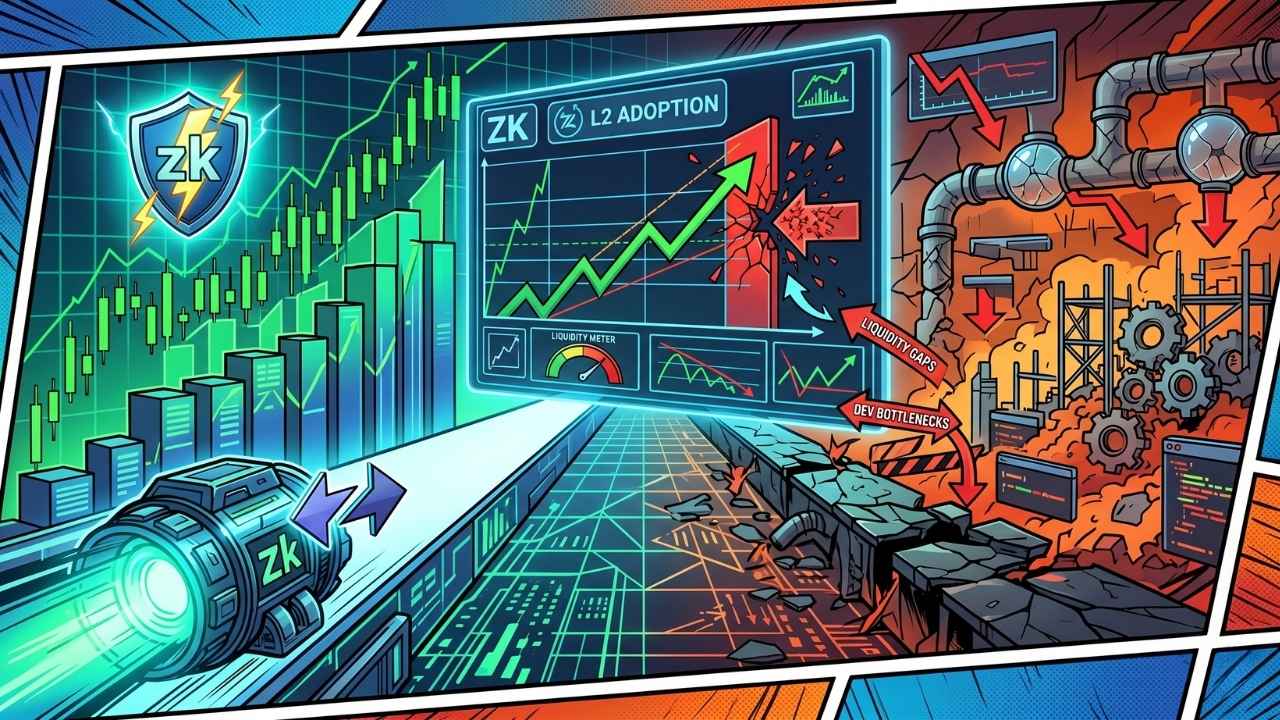
The architecture of zkSync represents an advanced technical limit through the use of cryptographic validity proofs. However, the gap between theoretical efficiency and the volume of capital processed indicates that the promise of zk-rollups faces critical implementation barriers that slow down its organic growth compared to less complex competing solutions.
The central thesis of this analysis argues that the technical superiority of zero-knowledge proofs is insufficient to displace the dominance of Optimistic Rollups if operational friction for developers is not resolved. We question the simplistic view that cryptographic finality alone guarantees the massive migration of protocols toward layer 2 networks that utilize the zk-SNARK protocol.
The technical weight of cryptographic validation
The scalability ecosystem on Ethereum has historically favored solutions with lower technical entry barriers. Zk-rollups offer almost immediate transaction finality by eliminating the seven-day dispute period. This advantage is documented in the transaction lifecycle by Matter Labs, where validity is confirmed through a mathematical proof.
Despite this benefit, proof generation requires significantly more computational capacity than simple sequential execution. Prover infrastructure must process complex data to generate the proof witness. This requirement raises initial operating costs for nodes, making an effective decentralization of validators difficult in the short term within the zkSync Era environment.
Compatibility with the Ethereum Virtual Machine remains the biggest obstacle to widespread adoption. Although zkSync uses an LLVM-based compiler to translate Solidity into a ZK-optimized bytecode, minor incompatibilities persist. Many developers find that adapting complex smart contracts requires additional security audits that are not necessary in networks with full EVM-level equivalence.
The compatibility paradox and capital fragmentation
The differential analysis reveals that zkSync operates under an institutional design paradox. By seeking extreme technical optimization, it sacrifices the simplicity that attracts institutional liquidity. Capital prefers predictable environments and mature tools. The maturity of the zkSync technology stack is still incipient when compared to the established ecosystem of Arbitrum or the Base network.
This fragmentation translates into dispersed liquidity that fails to concentrate to generate powerful network effects. The DeFi ecosystem requires fluid composability that is limited when debugging tools are scarce. According to the official description of scalability through rollups by the Ethereum Foundation, efficiency depends directly on harmonic integration with existing software.
Historically, we have observed that the best technology does not always dominate the market immediately. A clear example was the transition from Bitcoin to second-layer solutions where ease of use outweighed algorithmic purity. In the current cycle, user preference for low-cost transactions over instant cryptographic finality is a factor confirmed by market data.
Operational maturity versus mathematical theory
To understand the current position, it is necessary to look at real-time adoption data which show a stagnant market capitalization. While other networks have successfully attracted institutional volumes through direct incentives, zkSync relies almost exclusively on its technical value proposition. This strategy is risky in a market that values commercial traction over innovation that is purely academic.
Critics argue that zk-rollups are the final state of blockchain technology and that any delay is merely transitory. This stance holds validity if we consider that the security inherited from mathematical proofs is superior to the economic incentive model of fraud proofs. However, security is not the only factor determining the viability of a digital ecosystem.
If development tools do not reach functional parity with Optimistic solutions, zkSync could be relegated to a specialized niche. The complexity of the ZK-EVM types described by technical analysts suggests that reaching full equivalence is a process of years, not months. This time horizon favors competitors who are already capturing the value of current fees.
Liquidity challenges and the security counterpoint
It is important to recognize the argument of those who defend the superiority of zkSync based on capital efficiency. Since there is no seven-day withdrawal period, funds can move freely between layers. This dynamic flow is a structural competitive advantage for market makers who need to rotate assets with high frequency in decentralized exchange protocols.
Nonetheless, this freedom of movement has not translated into superior Total Value Locked. Users seem to accept the risk of dispute periods in exchange for a richer and more varied application ecosystem. The lack of exclusive high-impact applications on zkSync limits the interest of investors looking for yield opportunities not found on other networks.
The necessary counterpoint lies in long-term security. In a crisis of confidence scenario, users will migrate to networks where validity is guaranteed by mathematics and not by social monitoring of nodes. Under conditions of severe censorship attacks, the security proposal of zkSync becomes unassailable compared to models that depend on external observers to detect malicious behavior.
Perspectives on modular architecture and the ZK-Stack
The evolution toward a modular architecture could change the current network dynamics. The implementation of the technical stack architecture allows other companies to create their own custom chains using zkSync technology. This horizontal expansion strategy seeks to create a network of hyper-chains that share liquidity and validity proofs natively.
If this modular model succeeds in attracting large financial service providers, liquidity would flow naturally toward the zkSync core. The native interoperability between ZK-Stack based chains could solve the capital fragmentation problem mentioned earlier. However, this requires a level of technical and commercial coordination that is still in experimental stages of development.
The success of this initiative depends on the infrastructure being flexible enough for various corporate needs. The adoption of self-sovereign identity and privacy solutions within these specialized rollups could be the catalyst the technology needs. Without practical utility beyond simple asset transfers, the technology will remain an unfulfilled academic promise.
If the transaction volume on zkSync Era does not exceed the daily average of Optimistic networks by 30% over the next six months, the thesis that technical superiority dictates adoption will be invalidated. The retention of active developers after token launches will be the definitive indicator of the structural health of this scalability protocol.
This article is for informational purposes and does not constitute financial advice.