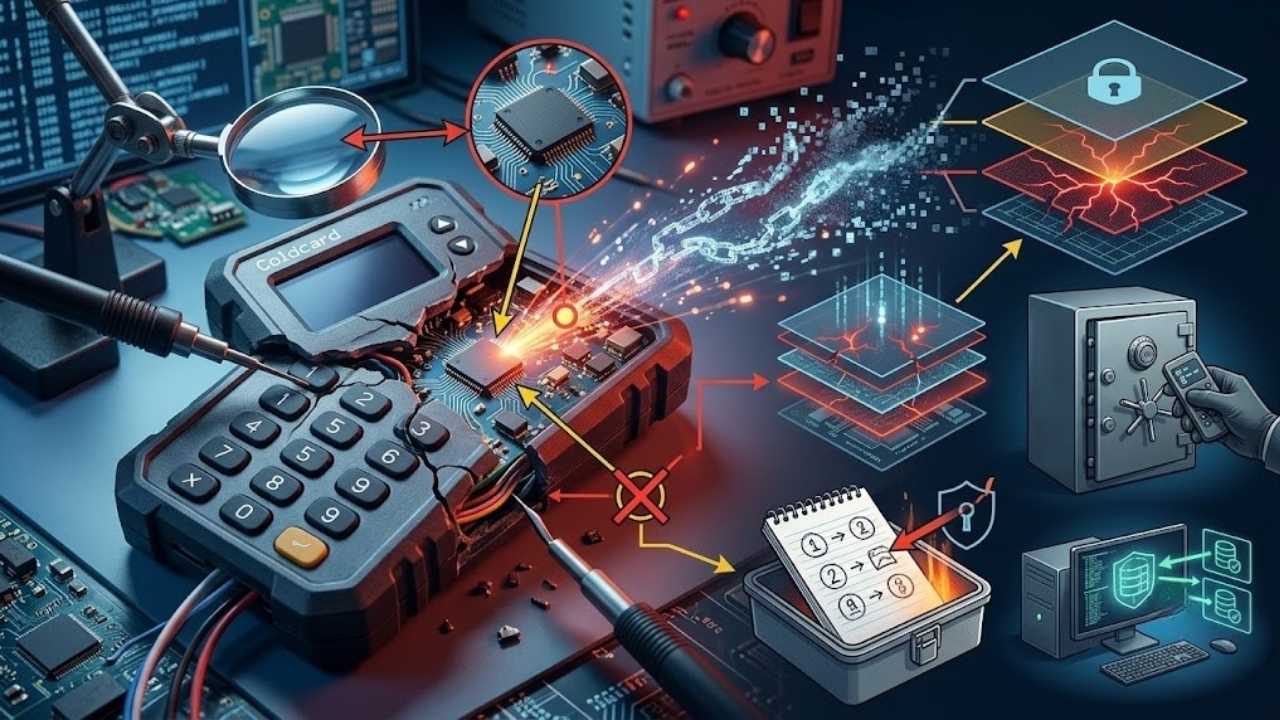
The cryptographic ecosystem assumes that disconnecting private keys from the internet guarantees absolute security. This dominant narrative establishes that specialized hardware is impregnable against any attack vector. However, the illusion of absolute security hides severe operational risks that investors completely ignore when managing large capital allocations.
The recent vulnerability analysis in leading devices like Coldcard dismantles this theoretical invulnerability. Understanding these flaws is vital while capital flows into physical custody, where critical human error consistently persists.
Hardware security architectures constantly face both physical and logical threats. Security researchers demonstrated how a fault injection attack can easily compromise the device’s secure element. Extensive documentation from the National Institute of Standards and Technology thoroughly details how physical alterations bypass the most advanced hardware defenses.
In the specific case of Coldcard, the detected vulnerabilities involved the manipulation of partially signed transactions. A sophisticated attacker could deceive the user into approving malicious outputs through an altered interface. Social engineering attack vectors successfully overcome the most robust cryptographic barriers in the current market.
The security of capital does not rely solely on the physical isolation of cryptographic keys. It depends heavily on the independent validation of each transaction on the device screen. The technical specifications documented in the Common Vulnerabilities and Exposures Registry demonstrate that firmware can be consistently deceived.
Historically, the biggest financial disasters in the sector did not occur due to fundamental cryptographic failures. During the failure of centralized platforms, poor key management was always the determining factor.
When comparing modern custody solutions with the early days of the network, the technical advancement is undeniable. However, the strict cybersecurity standards documented by the Center for Internet Security Controls establish that no single point of failure is acceptable in highly available critical financial systems.
The contrary vision firmly maintains that cold wallets remain the only viable and practical defense against remote attackers. They argue that physical exploits require direct and prolonged access to the device, an unlikely scenario for the average user. This defensive perspective has undeniable technical and statistical merit.
This defense is statistically valid; massive digital theft occurs predominantly in constantly connected online infrastructures. Nevertheless, ignoring underlying firmware vulnerabilities creates extremely dangerous blind spots for users. If a vendor distributes compromised updates, the physical barrier becomes completely useless against a silent logical attack.
The average user interacts with complex financial applications using hardware wallets to sign. When operating in DeFi platforms, smart contracts obfuscate transaction details, while the screen displays very limited information for verification.
Reevaluating personal custody architecture
To effectively mitigate these advanced attack vectors, personal custody must obligatorily evolve toward multi-signature configurations. Distributing the operational risk among different manufacturers neutralizes the specific vulnerabilities of any particular hardware model. The diversification of technical risk is fundamental to preserving accumulated capital over the long term.
Another essential security practice is the strict implementation of robust passphrases, known as the additional security factor. This secret word, if kept rigorously separate from the physical device, protects the funds even if the hardware is stolen and its internal chip is compromised using laboratory lasers.
Strict visual verification is mandatory before authorizing any definitive cryptographic signature. Never trust the graphical interface of the connected computer; malware routinely alters destination addresses. Validate exclusively on the isolated hardware.
When interacting directly with the blockchain architecture, advanced users must invariably run their own full nodes. This operational requirement guarantees that balance information transmitted to the cold wallet is not filtered, censored, or manipulated by malicious third-party servers. True financial sovereignty demands total control of personal infrastructure.
The human factor in cryptographic security
Excessive blind trust in military-grade technology clouds investors from addressing basic operational failures. Modern attackers dedicate significantly more resources to deceiving the human operator than to attempting to break elliptic curve encryption. Education on digital hygiene habits surpasses any silicon barrier currently available to retail consumers.
The documented Coldcard exploit clearly demonstrates that even the most respected manufacturers commit critical logical implementation errors. Independent auditing and open-source software are necessary defensive tools, but they do not provide absolute mathematical guarantees. Technical reports from the European Union Agency for Cybersecurity warn precisely about these inherent technological limitations.
Responsible custodians must proactively assume that their hardware will eventually be breached. Under this premise, the defense-in-depth strategy becomes an operational standard to physically separate long-term savings from daily operational capital.
Top-tier institutional custody solutions routinely apply these principles through fragmented authorization protocols and time-delayed security vaults. Individuals guarding significant financial value must systematically emulate these institutional-grade architectures at a personal scale. An isolated hardware device represents only one small component of the comprehensive and secure digital system.
If the economic incentives to breach hardware wallets increase proportionally with the total market capitalization, then we will observe supply chain attacks directed at manufacturers within two years, forcing a mandatory transition toward standardized multi-signature operational schemes for most users.
This article is for informational purposes and does not constitute financial advice.