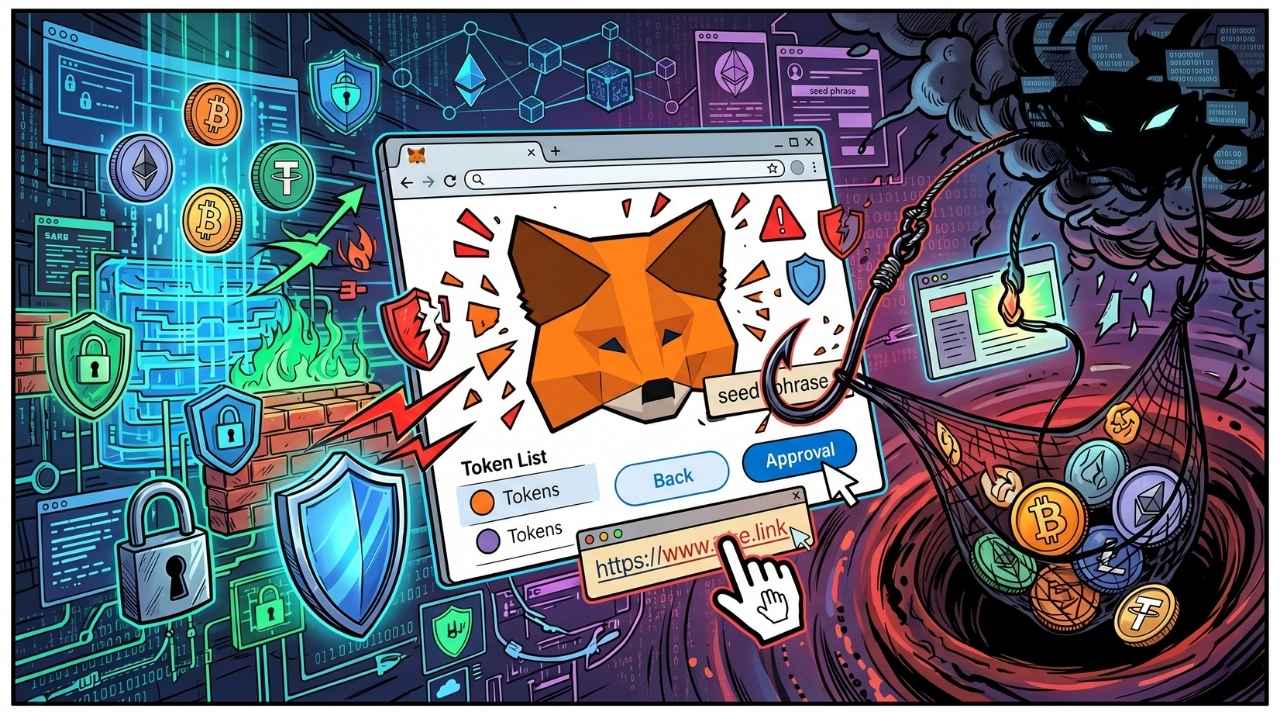
The vulnerability to phishing in MetaMask transcends mere negligence by the end user. Attack vectors exploit the complexity of current cryptographic signatures. The thesis holds that the interface must integrate mandatory and legible transaction simulation to mitigate financial losses within the decentralized digital environment.
The increase in attacks using wallet drainers during 2024 highlights structural deficiencies. According to the annual Chainalysis report for 2024, approval theft schemes dominate the ecosystem. It is urgent that wallet design eliminates the technical ambiguity that facilitates the deception of individual investors across the market.
Data from the FBI in its 2023 IC3 report confirms millions in losses linked to digital assets. The sophistication of phishing in MetaMask requires a coordinated technical response that does not depend exclusively on prior knowledge. Shared responsibility demands that the tool minimizes the margin for critical human error effectively.
The implementation of the EIP-712 standard allows for the visualization of structured data during transaction signing. However, many protocols omit this configuration, exposing users to dangerous blind signings. MetaMask must establish message legibility as a basic security requirement for operating within its native interface.
Inconsistencies in the validation architecture of MetaMask
The core of the problem lies in the architecture of traditional externally owned wallets. The transition toward account abstraction would allow for programmable rules that automatically block suspicious transactions. It is not just about educating the investor, but about building a technical infrastructure inherently resistant to mass deception.
By integrating real-time contract reputation filters, the wallet would act as a firewall. Currently, transaction confirmation is a binary process that lacks sufficient preventive context. A substantial improvement would involve the interface alerting users about interactions with malicious contracts previously identified by the global community.
The security of blockchain technology depends on the integrity of the user’s primary access point. If MetaMask does not toughen its visualization policies, the ecosystem will suffer constant capital flight. We must prioritize capital protection over unrestricted execution freedom in hostile and complex financial environments.
In the 2022 cycle, ice phishing attacks caused significant havoc within the community. Unlike then, today’s tools possess simulation capabilities that were previously non-existent. It is contradictory that the user experience still allows for full approval signatures without clear and disruptive visual warnings.
Recently, MetaMask Transaction Shield launches with a protection guarantee against specific losses. This service seeks to reduce the financial impact of involuntary errors through a subscription-based security layer. This measure acknowledges that current design is not sufficient for users managing high capital volumes.
Is self-custody incompatible with security automation?
From the perspective of decentralization, some self-custody advocates reject severe automatic restrictions on principle. They argue that individual sovereignty implies assuming total responsibility for every digital signature executed. Under this premise, any filter imposed by the wallet could be seen as a form of technical censorship limiting operational freedom.
However, protection against fraud does not invalidate sovereignty if implemented correctly. An alert system is not censorship, but a mechanism for informed consent based on verifiable data and facts. Ignoring flawed design under the pretext of freedom only perpetuates an insecure environment for mass adoption worldwide.
Reports from the FTC on scams involving digital assets show that social engineering remains persistent. Wallets must act as a proactive shield against these coordinated attacks. It is essential that address verification becomes a visually intuitive process to prevent identity theft in daily transactions.
Systemic vulnerability arises when technology advances faster than human comprehension capacity can adapt. MetaMask must lead the standardization of signing interfaces that are understandable for the non-technical public. Only by reducing the cognitive load during contract signing will real security be achieved for everyone.
Currently, the user assumes technical risks they do not understand when interacting with decentralized apps. The lack of clarity in smart contract functions allows attackers to hide malicious intentions behind complex code structures. A secure wallet must translate bytecode into readable actions before any execution occurs.
Institutional flow analysis suggests that security is the main obstacle to adoption today. Without an interface that protects the user from their own mistakes, institutional capital will hesitate to enter. Improving design is not an aesthetic choice but strategic for the survival of the digital sector.
Considering the volume of daily transactions, the acceptable margin of error must be near zero. Software updates must prioritize security patches over new secondary market features or tools. Trust in MetaMask is based on its ability to safeguard assets from external attacks at all times.
The integration of verified smart contract whitelists could be a viable solution. Although this introduces a degree of centralization, the security benefit would outweigh initial governance risks significantly. It is time to debate hybrid models that balance security with fundamental principles of technical decentralization.
If phishing losses decrease by twenty percent after implementing mandatory simulations, the thesis will be confirmed. Conversely, if the volume of incidents remains constant despite improvements, the failure is purely educational. The industry needs clear metrics to validate the effectiveness of user interface defenses definitively.
This article is for informational purposes and does not constitute financial advice.