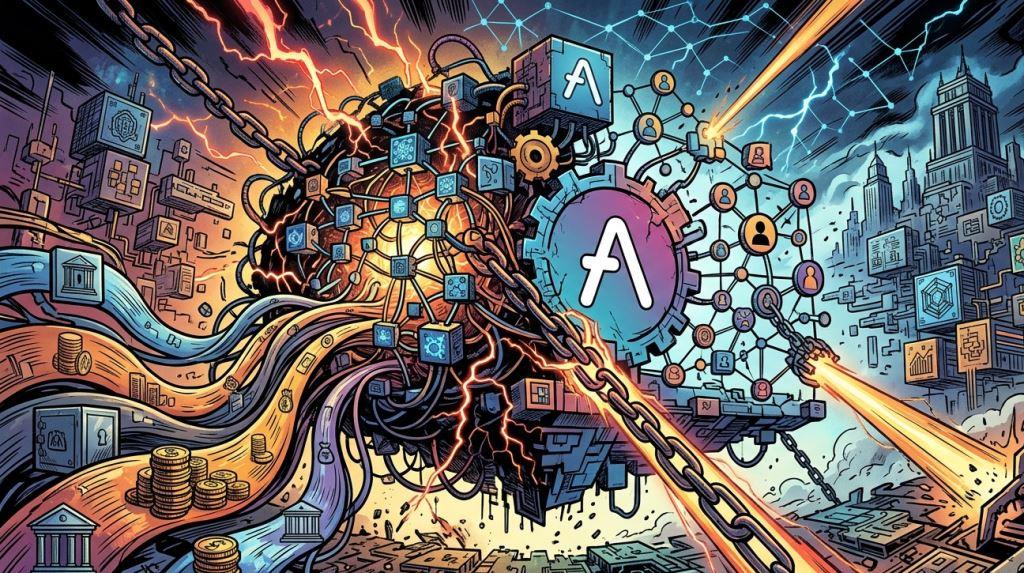
The technical decentralization of Aave is a mirage concealing an oligarchic power structure, where Aave governance remains in the hands of few actors. This reality is not a mere observation regarding token distribution, but a structural flaw that compromises the protocol’s resilience against systemic crises.
The dominant narrative maintains that Decentralized Finance (DeFi) eliminates single points of failure, yet the centralization of decision-making in voting processes suggests otherwise. As the ecosystem seeks to scale, the reliance on a small group of delegates creates an execution risk that the market has not yet correctly priced into its risk models.
Current consensus celebrates delegation models as a sign of institutional maturity. However, this efficiency is, in reality, a transfer of sovereignty from users toward entities with corporate interests. Participation in governance remains extremely low, with less than 3% of active addresses participating effectively in Aave Improvement Proposals (AIPs). This disconnection between the user base and the decision-making elite invalidates the promise of a democratic financial infrastructure. If actual control is not distributed, the term “decentralized” becomes a marketing label rather than a verifiable technical property.
The vulnerability of this model became evident when Aave registers 15 billion dollar withdrawals following the major Kelp DAO exploit in the first quarter of 2026. At that moment, the protocol’s responsiveness depended on an “Emergency Committee” with powers more reminiscent of a banking board of directors than immutable code. According to the v3 governance technical report, guardians can pause specific markets, a necessary safety feature that underscores the existence of centralized control switches within the system.
Despite these control gaps, institutional optimism persists. Recently, Aave founder Stani Kulechov announced that the platform anticipates a potential of up to 50 billion dollars for the DeFi economy. Nevertheless, scaling to such figures on a concentrated governance base is a dangerous experiment. The accumulation of voting power in the hands of venture capital firms and large custodians creates a permanent conflict of interest. When decisions regarding risk parameters or collateral directly affect the balance sheets of these large holders, the protocol’s impartiality vanishes.
The illusion of consensus and the systemic risk of mass delegation
The history of digital financial markets offers lessons that Aave governance seems to ignore. During the lending platform crisis in 2022, we saw how the lack of transparency in decision-making led to the collapse of entities that called themselves decentralized. In that cycle, the volume of assets under management (AUM) exceeded the capacity of governance frameworks to manage liquidity risk. In 2026, the situation is comparable: AAVE token concentration in ten primary wallets represents more than 40% of effective voting power, according to DeepDAO data. This asymmetry is identical to what preceded the governance crises of smaller protocols in previous years.
The fundamental difference today is the integration of real-world asset tokenization (RWA) and the GHO stablecoin. These elements introduce external dependencies that require constant supervision, which justifies, according to management, greater operational centralization. The Aave Tokenomics Whitepaper details the Safety Module, a backstop mechanism that depends on the will of large holders to be activated. If the economic incentive of these actors does not align with the protection of retail depositors during a “black swan” event, the protocol lacks real guarantees.
A recent report from the Bank for International Settlements (BIS) highlights that the illusion of decentralization in DeFi is a risk to global financial stability. The document notes that most protocols maintain administrative “backdoors” or governance structures that can be captured by specific interests. In Aave’s case, the influence of professional delegates has created a digital bureaucracy. These actors, while experts, prioritize protocol profitability over its long-term technical resilience, distorting the original function of smart contracts.
The strongest argument against this critique holds that centralization is a necessary evil for competitive agility. It is argued that pure decentralization, where every change requires weeks of voting from thousands of users, would prevent Aave from reacting to exploits or sharp macroeconomic shifts. In this scenario, delegation to experts ensures the protocol remains solvent. If institutional capital flows continue to enter, the operational efficiency provided by this “enlightened oligarchy” could be the factor that saves the protocol during an extreme liquidity crisis.
The validity of this stance depends entirely on the integrity of the delegates. However, if the Gini index of Aave governance does not show a downward trend over the next twelve months, the institutional capture thesis will be irrefutable. Centralization is not a transitory state toward efficiency, but a path of no return toward traditional financial intermediation under a new technological aesthetic. Trust is shifting from the code toward the people who control it, which is the antithesis of the original purpose of Ethereum and its applications.
If voting power concentration exceeds 51% in fewer than five entities by year-end, the governance capture hypothesis will be confirmed. Conversely, if the implementation of quadratic voting systems or incentives for small voters manages to dilute whale influence, Aave could regain its legitimacy as public infrastructure. The key metric will not be the token price, but the number of unique voters required to approve a change in GHO market risk parameters.
This article is for informational purposes and does not constitute financial advice.