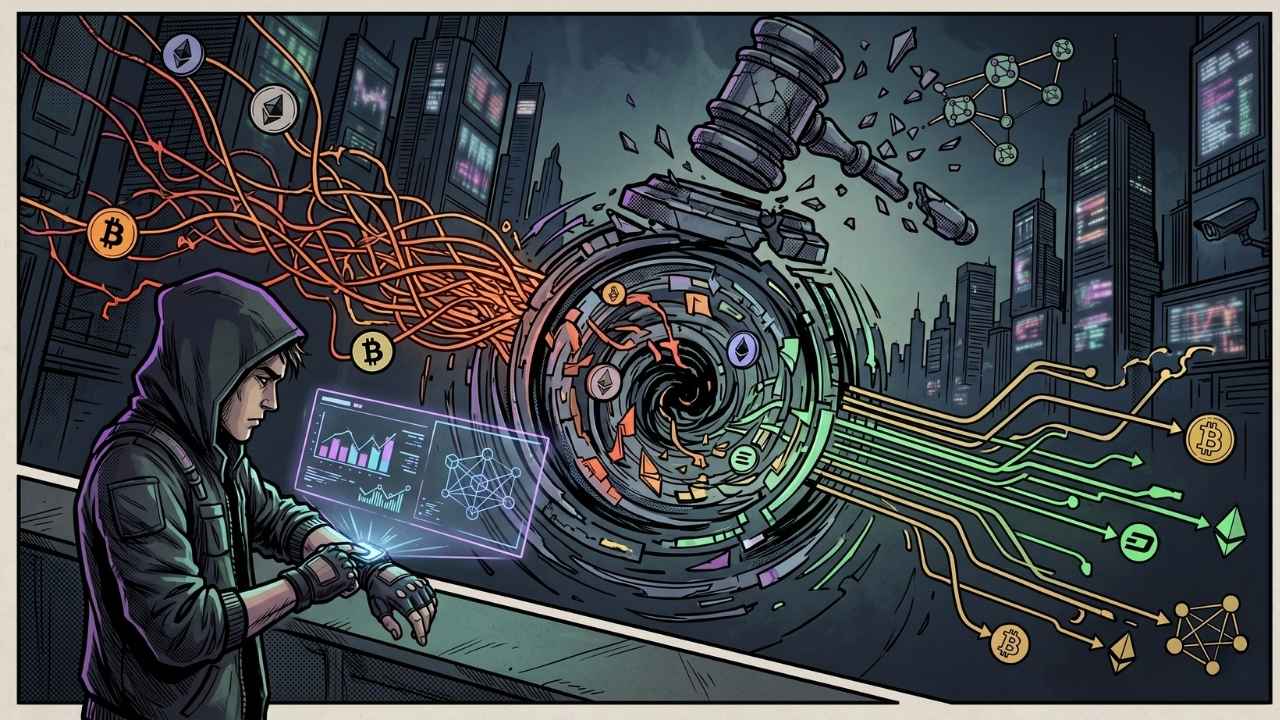
The existence of cryptocurrency mixers represents the last line of defense for financial privacy in a permanent digital surveillance environment. My thesis holds that these tools are not mere instruments of criminal obfuscation, but critical infrastructures to preserve the fungibility of money on public networks. The dominant narrative, driven by regulatory bodies, criminalizes technology for its possible illicit uses, ignoring that absolute transparency in financial transactions violates the fundamental rights of legitimate users.
This discussion gains critical relevance following the OFAC sanctions against decentralized protocols in August 2022, which marked a dangerous precedent for software development. Data from the Treasury Department indicates that tools like Tornado Cash processed transactions for more than 7 billion dollars, justifying restrictive measures under the argument of national security. However, technical analysis reveals that the total prohibition of these tools does not eliminate crime, but rather strips citizens of their right to privacy.
Privacy architecture and the right to fungibility
The core of the debate lies in the technical distinction between centralized mixers and protocols based on smart contracts. While custodial services operated under traditional trust structures, modern protocols use zero-knowledge proofs to guarantee privacy without yielding control of funds.
The forfeiture of 400 million dollars carried out by US authorities demonstrates that systemic risk is concentrated in human intermediaries, as detailed in this analysis of the Helix mixer. Furthermore, this event highlights the vulnerability of platforms that maintain centralized control of private keys instead of delegating them to immutable code.
The true differential innovation that the market has not fully assimilated is the concept of “Privacy Pools” or privacy pools with exclusion proofs. This interpretative framework proposes that the user can demonstrate, through advanced mathematics, that their funds do not come from identified illicit wallets. By integrating this compliance mechanism without revealing full identity, the false dichotomy between absolute privacy and total regulatory compliance is broken. This architecture allows the protocol to be a safe environment for institutional capital without compromising decentralization.
If we analyze the institutional flow, we observe that large entities require privacy to prevent their commercial strategies from being tracked in real time by competitors. Privacy services are evolving to meet this technical demand by separating the origin of the asset from its transactional history. This ability to maintain confidentiality in corporate balance sheets is what will allow the mass adoption of the technology in traditional financial sectors, where banking secrecy is a standard operating norm.
Regulatory evolution versus open source development
Historically, the confrontation between cryptography and the State is reminiscent of the encryption export wars of the 1990s. At that time, software was classified as ammunition to restrict its distribution, a logic that is applied today by sanctioning lines of code on a blockchain. The current structural difference is that privacy protocols are immutable; once deployed, there is no central entity that can “turn off” the service, forcing regulators to rethink their compliance strategies toward entry points.
The opposing side, represented by agencies such as the DOJ, argues that privacy by default facilitates terrorist financing and money laundering by state groups. A concrete example is the sentence against the operator of Darknet mixers, where it was shown that more than 300,000 transactions linked to illegal activities were processed. Under these conditions, it is understandable that the public safety narrative prevails, as illicit actors take advantage of the lack of filters in the transport layers.
This regulatory position is valid only if we assume that transparency is the supreme value, above personal security. However, in a world where data analysis allows the net worth of any user to be identified, these tools act as a necessary firewall. The protection against social engineering and extortion attacks is a secondary, but vital, benefit that regulators often omit, as described in the Helix case study.
If the volume of transactions in privacy protocols with exclusion proofs grows by 50% annually over the next two fiscal years, the criminal narrative will lose statistical weight against legitimate commercial use. The validation of this thesis will depend on the ecosystem managing to implement selective transparency standards natively in decentralized applications. If regulators accept proofs of innocence as a valid method, these systems will cease to be threats and be integrated as essential security layers in the financial infrastructure.
This article is for informational purposes and does not constitute financial advice.