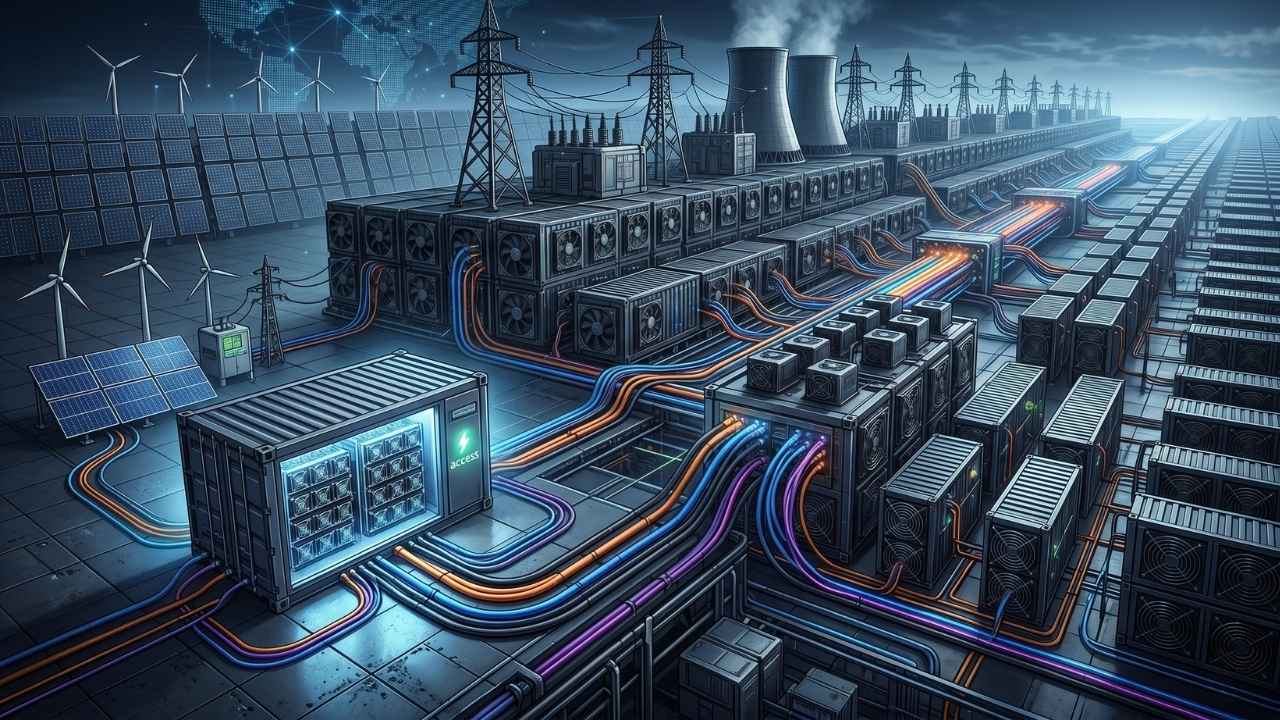
The Bitcoin mining industry is undergoing a structural metamorphosis toward extreme operational simplification. The “plug-and-play” mining concept is no longer limited to small home devices; it now encompasses massive modular infrastructures designed for immediate deployment. Modular mining transforms the industry by allowing entities without deep technical expertise to operate high-performance farms with minimal friction.
This trend responds to an efficiency narrative where deployment speed outweighs the importance of artisanal hardware knowledge. According to the official Canaan Inc. report on the Avalon A15 series, the 18.5 J/T energy optimization seeks to standardize institutional performance under simplified management models. This paradigm shift matters now due to the competition following the latest halving.
The plug-and-play model promises to lower entry barriers through pre-configured containers that integrate cooling, power supply, and connectivity. However, this advancement poses a technical paradox: while hardware is easier to use, scale costs become prohibitive. This reality suggests we are witnessing the massive rollout of modular mining infrastructure that prioritizes speed over technical customization.
To understand this phenomenon, we must observe current production data from industry giants. Bitdeer, in its March 2026 operations update, reported a significant increase in its installed capacity, reaching record metrics through proprietary standardized infrastructure. This exponential growth is possible thanks to modular systems that allow hundreds of megawatts to be energized in months, not years, displacing traditional data center construction.
Historically, mining shifted from home CPUs in 2009 to industrial ASIC farms in 2014. That transition eliminated the casual user but maintained a niche for specialized technicians who mastered ventilation and firmware. Today, modularity eliminates even that technical need, transforming hash rate into a financial product that is purchased “in a box” and plugged into the power grid.
Ease of use is a double-edged sword that directly impacts power distribution. The barriers to entry for retailers are no longer knowledge, but access to preferential energy contracts and capital to acquire industrial containers. This is reflected in the CBECI efficiency metrics, which show how network consumption is concentrated in inaccessible, latest-generation hardware.
The mirage of democratization and institutional control
The opposing view holds that hardware simplification, such as the Avalon Nano 3, truly empowers the individual. Being silent and aesthetic devices, they allow anyone to contribute to the hash rate from their home. This argument is valid if we consider that decentralization does not require everyone to be a large producer, but rather the existence of many independent connection points.
However, this perspective ignores that a home device’s contribution is marginal compared to today’s industrial scale. The real impact of plug-and-play occurs at the macro level, where energy companies can install mining units at stranded gas wells without hiring specialized engineers. Here, simplified mining technology acts as a catalyst for non-crypto capital to absorb network security in an accelerated manner.
The validity of the artisanal displacement thesis lies in comparative profitability. A miner using industrial modular solutions significantly reduces downtime due to integrated monitoring systems. In contrast, the independent operator faces higher operational costs per compute unit, which inevitably leads to global hash rate centralization in corporations with robust balance sheets and access to credit.
Analyzing infrastructure evolution, we see that mining data center design has converged toward the container standard. Companies like Bitdeer are dismantling old facilities to replace them with these rapid solutions, seeking operational agility that the artisanal model cannot match. Standardization removes the competitive advantage of the individual “technical creativity” that defined the past decade.
A factor that could invalidate the total centralization thesis would be the emergence of state subsidies for home mining. However, under Bitcoin’s current framework, the market exclusively rewards raw efficiency and scale. Plug-and-play is, in essence, the ultimate tool for institutional capital to win the efficiency race without undergoing the technical learning curve.
Therefore, access is not being democratized; it is being simplified for high-volume buyers. The risk is that the Bitcoin network ends up operated by a handful of infrastructure providers selling “mining as a service.” This would transform the ecosystem’s nature, moving from a network of volunteers and enthusiasts to critical infrastructure managed by corporate entities.
Economic implications of standardized mining
The transition toward modularity also redefines the hardware secondary market. Equipment that is not part of a plug-and-play ecosystem loses resale value faster, as new buyers prefer integrated solutions with factory warranties. Energy efficiency in mining then becomes a liquid financial asset, packaged in containers that can move geographically according to the cost per kilowatt-hour.
Mining is no longer a garage experiment but a branch of global energy infrastructure. The adoption of pre-configured solutions makes it easier for countries with electrical surpluses to enter the market sovereignly. This could, ironically, decentralize the hash rate geographically (more countries mining) while centralizing it operationally (fewer companies controlling the hardware management systems).
The real debate is not whether the technology is easy to use, but who has the capacity to connect it. Modularity reduces installation costs, but the acquisition cost of 18 J/T hardware remains an insurmountable barrier for most. The result is an ecosystem where technical ease masks a deepening economic exclusion marked by absolute professionalization.
In the near future, we will likely see the disappearance of custom-built mining farms in industrial buildings. The de facto standard will be the deployment of swappable modules that update like cloud server components. This “commoditization” of hash rate is the final step for Bitcoin to be fully integrated into traditional financial markets as a pure computing asset.
If the proportion of the hash rate generated by publicly traded companies exceeds 75% of the network total within the next eighteen months, it will be confirmed that plug-and-play ease primarily served for the institutional capture of the protocol, leaving artisanal mining as a romantic hobby with no real impact on network security or economics.
This article is for informational purposes and does not constitute financial advice. / This article is for informational purposes and does not constitute financial advice.