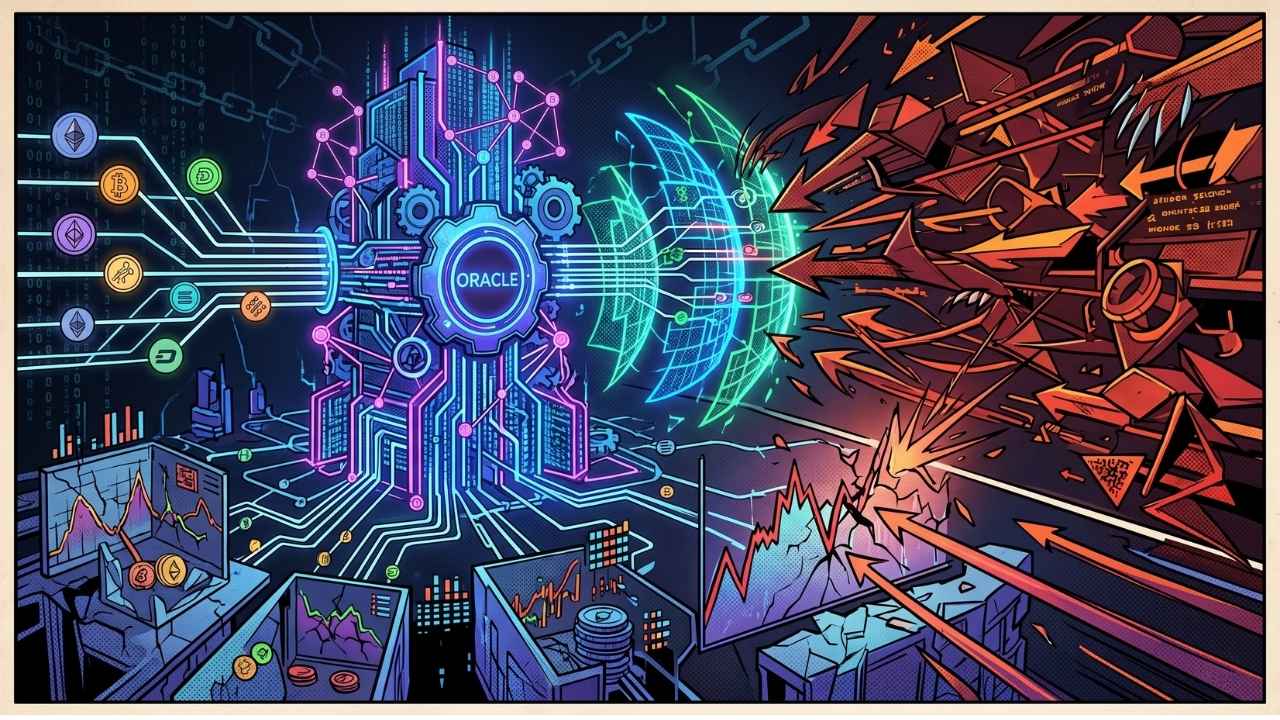
The oracle security represents today the most critical link for ensuring decentralized financial integrity. Although smart contracts are immutable, they depend on external information to function correctly. If the external data is manipulated by malicious actors, the entire system collapses without any immediate technical remedy for the users.
The increase in liquidity within Layer 2 solutions demands an informative precision without historical precedents. Currently, the oracle security determines the solvency of protocols that manage billions in capital. Without a robust and verifiable data infrastructure on-chain, the institutional growth of digital assets will come to a very sudden and sharp halt.
The Chainlink whitepaper details how decentralized node networks attempt to mitigate systemic failures. The aggregation of multiple external information sources seeks to eliminate single points of technical failure. However, redundancy does not always guarantee total immunity against coordinated manipulation attacks in markets with relatively low liquidity.
Lending protocols depend on exact prices to execute leveraged position liquidations fairly. An error in financial data transmission can cause million-dollar losses to unsuspecting investors. The technical fidelity of external information flows is the prerequisite for maintaining trust in any automated market within the current global digital ecosystem.
Data delivery models have evolved from periodic updates toward more efficient on-demand systems. These changes in price reporting architecture reduce operational costs for developers. Nevertheless, the response speed introduces new risk vectors related to network congestion and consensus latency that must be carefully managed by the protocol.Historical context shows that attackers prefer exploiting information failures rather than logical code errors. In 2022, the Mango Markets incident revealed critical vulnerabilities in fragmented liquidity management. The dependence on sources with low market depth allowed a massive drain of funds that seriously affected the decentralized protocol involved.
Unlike the 2016 Ethereum hack, current weaknesses lie in the semantics of data. The security of smart contract logic does not protect against false price premises. This technical distinction is fundamental to understanding the industry’s operational risks in the highly volatile global environment we face in markets today.
The technical dilemma between decentralization and absolute precision
Some institutional analysts argue that partial data centralization offers superior operational stability. They contend that centralized control allows halting suspicious operations manually in the face of detected anomalies. Under stable market conditions, this stance offers undeniable operational efficiency for financial intermediaries seeking to reduce constant technical friction.
However, the IOSCO report on financial risks warns about the fragility of internal governance. The central points of control create systemic risks that invalidate the decentralized value proposition. The concentration of power in single data providers jeopardizes the solvency of the entire open finance ecosystem worldwide.Implementing advanced technical solutions seeks to resolve this dilemma using rigorous statistical models. The Pyth documentation presents an approach based on precise confidence intervals for each price. This metric allows protocols to recognize market uncertainty before executing automatic actions that could result in unjustified capital losses.
Absolute transparency of these operations is the only verifiable defense mechanism for institutional investors. A reading of the blockchain suggests that continuous auditing of data flows is necessary. If providers do not demonstrate honesty through cryptographic proofs, trust in automated digital markets will erode very quickly during the next global financial crises.
The development of customizable hooks in Uniswap v4 offers an opportunity to strengthen each pool’s security. Developers can integrate specific oracles that respond to needs of particular liquidity. This technical protocol customization capability allows defining risk tolerance parameters much stricter than the current standards used across the industry.
Customizing verification as a defense against systemic failures
Oracle Extractable Value (OEV) has become a recurring technical debate. The data providers can influence transaction order to obtain additional benefits. This practice compromises the integrity of execution and increases costs for end users seeking absolute neutrality within the decentralized and global ecosystem of finance.
It is fundamental that the design of these systems moves from being secondary to an absolute security priority. The stability of digital derivatives markets depends on the robustness of externally supplied data. Without coordinated multi-source verification among independent actors, the systemic fragility of open finance will remain a very significant obstacle.
Real-world asset integration requires an infrastructure that is resistant to censorship and manipulation. The oracle networks must demonstrate technical solvency through the effective decentralization of their validator nodes. If data concentration persists in few actors, the risk of coordinated attacks by private entities will increase considerably soon.
Protocols that ignore the quality of their external sources are destined to suffer serious security incidents. The auditing of financial information flows must be as rigorous as the code itself. Only through adopting high transparency standards, the ecosystem will be able to resist the pressures of an increasingly complex macro environment.
The future of decentralization depends on the ability to solve the oracle trilemma successfully. The combination of low latency and high security is the ultimate goal of current developers. If the industry fails to reach a solid technical consensus, the promise of a financial system free of intermediaries will be unattainable.
If the price update delay exceeds thirty seconds during a market crash, insolvency will be unavoidable. This scenario would confirm that information speed is as vital as the truthfulness of the reports. The oracle security determines the systemic resilience of global finance against extreme volatility events that could occur today.
This article is for informational purposes and does not constitute financial advice.