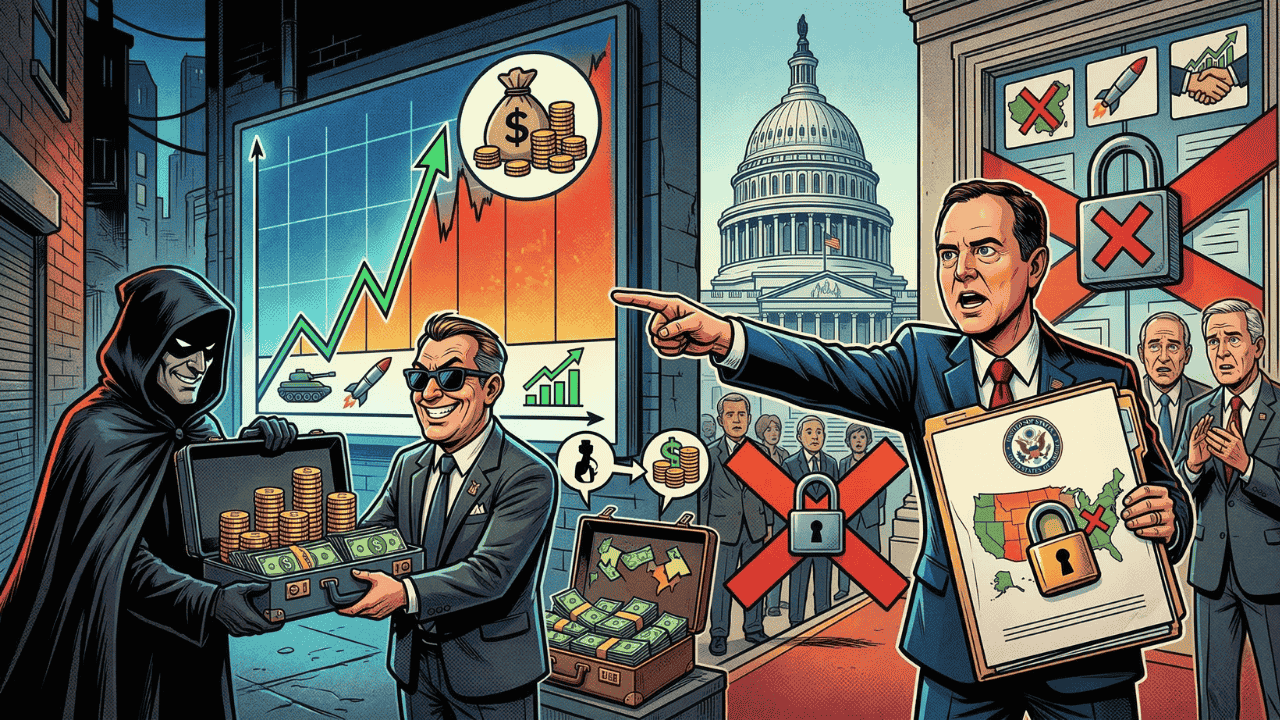
Democratic Senator Adam Schiff introduced the legislation called the DEATH BETS Act this Tuesday to explicitly ban contracts linked to war and military conflict, according to the official Senate statement. This proposal arises at a time when prediction markets face unprecedented scrutiny for possible cases of insider trading within digital platforms.
The regulation seeks to amend the Commodity Exchange Act so that the CFTC permanently blocks bets on terrorism or assassinations. The economic incentive for the misuse of classified information represents a direct threat to national security interests. Therefore, the legal framework intends to clean the sector of activities considered ethically reprehensible within the country.
The end of financial incentives based on global warlike conflicts
Primary data reveals that the trigger for this legislation was the unusual activity detected during recent military confrontations. Six digital wallets generated net profits of one million dollars by accurately predicting the strikes in Tehran with surgical precision. These movements, recorded just hours before the explosions, suggest privileged access to high-level strategic decisions within institutional circles.
A detailed analysis by the analysis firm on-chain Lookonchain confirms that a new account recently risked 32,900 dollars in a single bet. This pattern of aggressive betting on troop movements by Israeli and Iranian forces highlights the vulnerability of these systems to external manipulation by state actors. The lack of transparency in fund origin seriously complicates regulatory oversight.
The analysis of the draft bill presented reveals that these activities create perverse incentives for the leakage of military intelligence data. Historically, the effectiveness of cryptocurrency and decentralized protocols was defended as a collective intelligence tool superior to traditional polls. However, the 400,000 dollar profit obtained before the capture of Nicolás Maduro in Venezuela broke the consensus on the neutrality of these markets. The correlation between geopolitical events and massive bets is undeniable today.
Is it possible to regulate ethics within current decentralized finance?
Comparing with the 2020 and 2022 regulatory cycles, the CFTC has toughened its stance against the risk of manipulation. While in the past technological growth was prioritized, the current DEATH BETS Act prioritizes military integrity over financial innovation. This transition from self-regulation toward an explicit ban marks a definitive structural paradigm shift in the US.
Recent activity on the digital platform reveals a bet on the entry of US forces into Iran despite declining odds. This financial behavior, driven by tactical rumors or leaks, indicates a constant flow of capital toward scenarios of armed conflict. Market risk is thus transformed into a tangible geopolitical risk that is difficult to manage effectively.
Israeli authorities have already prosecuted individuals on suspicion of using military secrets for their own benefit. The existence of signs of using secret information for personal gain invalidates the premise of efficient and sovereign markets. Therefore, the verification of the use of government data for trading derivatives has accelerated this complex legislative process.
The text introduced by Schiff specifically prohibits references to terrorism, assassinations, or any similar warlike activity on regulated platforms. Currently, the measure has been referred to the Senate Agriculture Committee for immediate consideration by the legislators. This administrative step is essential to modify the current Commodity Exchange Act.
The structural impact will be definitive for the future of alternative finance in United States territory. The ability to filter contracts that violate national security without compromising technological decentralization is the greatest current challenge. Therefore, platforms must redesign their compliance algorithms to survive the new legal framework proposed by Washington.
The market awaits a clear answer on the viability of international event contracts under federal supervision. Monitoring the next legislative milestones in Congress will determine if electoral or economic events will remain the only legal refuge for these operators. Following the debates in the Agriculture Committee will be crucial for institutional investors.