
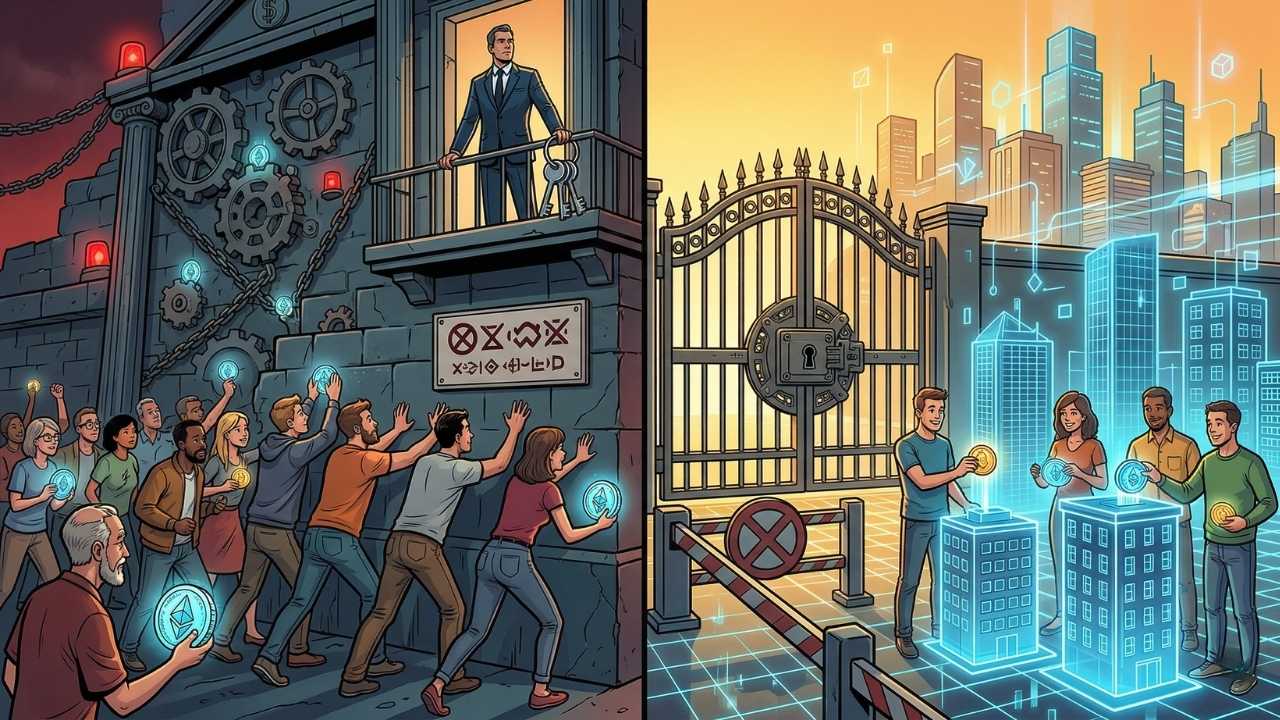
The dominant discourse argues that Real Estate tokenization democratizes property access for small investors. Everything indicates that this promise conceals a mechanism meticulously designed to provide liquidity to institutional portfolios, ultimately leaving the retail sector completely trapped in highly fragmented secondary markets.
Far from being a coincidence, large asset managers promote Real Estate tokenization under a philanthropic premise. However, the structural framework firmly reveals that creation of efficient secondary markets remains an exclusive privilege firmly reserved for large private funds and well-established corporate entities.
The Illusion of Fractionalization
Dividing properties into digital fragments theoretically reduces entry barriers. According to projections from the influential report issued by Citi Global Perspectives and Solutions, the digital asset market could reach up to five trillion dollars comfortably before the end of the current financial decade.
Under this prism, Real Estate tokenization appears to be a revolutionary tool. Nevertheless, acquiring a building fraction does not guarantee immediate liquidity. Trading volumes on regulated platforms clearly demonstrate that the lack of active buyers continuously stagnates the rotation of these specific digital assets.
The United States Securities and Exchange Commission maintains constant scrutiny. A detailed analysis of the SEC investor alert reports conclusively confirms that digital assets classified as unregistered securities offerings represent a substantial and constant risk for individuals operating with minimal investment capital.
Consequently, the small investor faces considerable operational roadblocks. While system architects loudly celebrate institutional adoption through rwa tokenization, retail users constantly deal with disproportionately high exit capital costs, thus evaporating the theoretical profitability originally promised in the initial commercial promotional brochures.
Echoes of Past Speculative Cycles
It is fundamental to analyze previous episodes of financial exuberance. During the initial coin offering fever in 2017, the DAO Report on digital assets established crucial jurisprudence by warning how unregulated technological financial innovation models end up disproportionately harming the least sophisticated market participants overall.
This historical scenario holds disturbing parallels with the present. Real Estate tokenization repeats the established pattern of offering asymmetric returns. When platforms face strict solvency crises, institutional investors manage to exit quickly, while retail capital remains locked inside completely inoperative smart contracts.
In other words, the current infrastructure benefits primary issuance but neglects the secondary market. Official reports from rating firms like S&P Global on decentralized finance systematically warn that the sector’s technological maturity level still does not guarantee solid legal and financial protection.
Counterparty risk is deliberately minimized in corporate promotional speeches. However, a rigorous analysis of global capital flows strongly suggests that decentralization is a complete facade within this specific sector. The true custodians of these real estate assets remain highly centralized traditional legal entities.
The Concentration of Real Estate Power
The technological platforms facilitating this process operate under strict frameworks. The development of closed banking networks, like the infrastructure documented by Onyx from J.P. Morgan, evidences that the true financial transaction volume occurs in private environments, far from retail small investor access.
Real Estate tokenization explicitly demands strict compliance with anti-money laundering and know-your-customer regulations. These necessary processes add significant friction, demonstrating that traditional administrative barriers remain unchanged, raising operational costs and severely discouraging the active participation of low-volume retail investment capital.
In parallel, tokenization does not alter the intrinsic nature of the property. An empty building generates no yield, regardless of the technology used. Declines in commercial valuations indicate that classic real estate risks continue affecting the promised dividends obtained through real estate yield farming.
Jurisdictional frictions enormously complicate capital recovery in standard bankruptcy cases. If an rwa tokenization platform completely collapses, cross-border international litigation ensures that legal fees will quickly absorb any remaining funds, leaving the retail investor without resources or financial compensations for their severe financial losses.
An Analysis From the Opposing Perspective
Those who fervently defend this modern model argue that technological maturation will quickly resolve the current illiquidity. It is feasible that, through the global standardization of protocols, small investors can financially benefit from an internationally diversified portfolio, thus reducing their exposure to strictly local economic crises.
Additionally, it is strongly proposed that future regulations will offer greater institutional clarity. If international regulatory bodies manage to establish common issuance standards, operational costs of asset structuring could drastically decrease. This would allow issuers to offer fairer product margins for standard retail capital.
Under this optimistic scenario, Real Estate tokenization would finally fulfill its intended democratizing promise. The smooth integration with regulated stable digital currencies would facilitate instantaneous financial settlements, completely eliminating costly intermediaries. This level of transactional efficiency could radically transform how new generations build wealth.
Nevertheless, relying fully on future global regulatory resolutions constitutes a highly risky long-term investment strategy. Until these comprehensive regulations come into force and demonstrate their practical legal effectiveness, the current financial system remains strategically designed to exclusively protect the interests of already established institutional capital.
Long-Term Perspectives and Market Validations
The democratization of the real estate sector through blockchain technology remains a purely experimental phase. If global regulators do not establish clear protection rules, severe information asymmetry will persist, consolidating tokenization as a simple administrative efficiency tool exclusive to high-level wealth asset management.
If institutional capital flows maintain a sustained exponential growth far above standard retail investments during the next two years, it will be confirmed that the system’s true primary objective was never true financial inclusion.

