
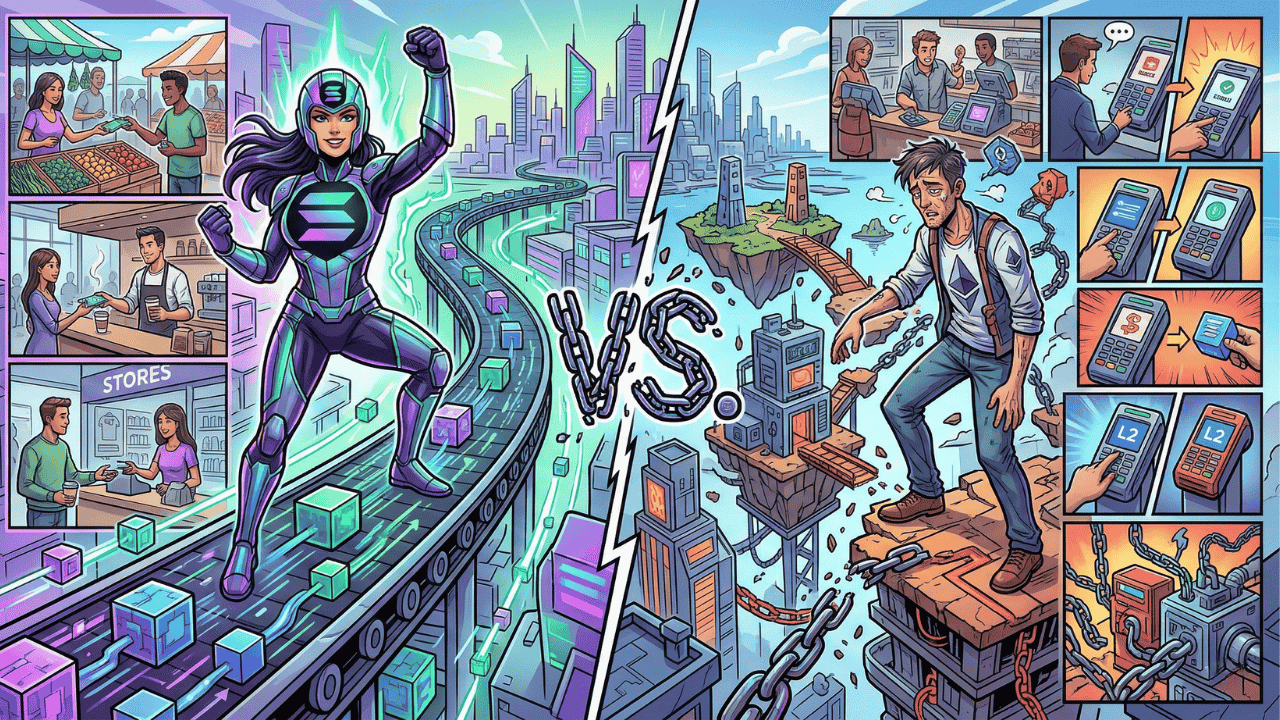
The global financial industry has stopped rewarding promises of future scalability to exclusively value immediate execution. Under this prism, Solana has emerged in this first quarter of 2026 as the definitive infrastructure for commerce, displacing Ethereum into a strictly institutional and heavy settlement niche.
The underlying reality suggests that Ethereum’s modular approach has created a fragmented user experience for the retail sector. While Solana allows for atomic settlements, the Vitalik Buterin ecosystem has lost its way in a tangle of disconnected layer-2 solutions that complicate mass adoption and interoperability.
Atomic Execution Supremacy vs. Modular Fragmentation
The payments market does not tolerate technical friction involved in bridging assets between different networks. Solana’s monolithic architecture allows a user to process their payment without worrying about liquidity. This operational simplicity is the key to its current victory in the e-commerce sector.
In other words, the network has managed to unify global liquidity into a single synchronous and efficient state. This competitive advantage has allowed Solana to capture a significant market share against its competitors. Technical efficiency is now a critical commercial necessity for any payment gateway.
The Institutional Axis: Solana as the New Global Settlement Rail
Far from being a coincidence, financial giants have selected Solana as their preferred settlement rail. The Visa expansion strategy using high-performance networks demonstrates that monolithic architecture is superior. This institutional validation is a historic milestone for the Solana network.
Concurrently, the implementation of assets like PayPal USD on efficient networks has shifted volume toward insignificant costs. The network processes transactions steadily with average fees below one cent. It is an unbeatable infrastructure for the development of institutional yield farming.
The Layer 2 Fallacy and the Average User Barrier
While Ethereum’s layer 2 networks have reduced costs, operational complexity remains prohibitive. The average user does not want to manage multiple wallets to interact with different payment protocols. This fragmentation weakens Ethereum’s thesis as a currency for everyday use in 2026.
Reality suggests that Ethereum has transformed into a highly secure B2B settlement network. However, for mass consumption, confirmation latency remains an insuperable obstacle. Solana offers an experience identical to traditional credit cards, eliminating any type of technical friction for the final consumer.
Performance Data: Leadership in the Stablecoin Economy
Verifiable data from this year ranks Solana first in real activity. The network has processed stablecoin transfer volumes that outperform any direct competitor. This metric reflects real and tangible adoption in physical stores and high-traffic digital platforms across the globe.
The implementation of the Firedancer client has guaranteed absolute stability for the commercial sector. This update allows the network to reach massive processing capacities without compromising security. Solana Foundation technical support confirms that system reliability is a priority for the sector.
Ethereum’s Value as a Safe Haven vs. Operational Agility
To maintain intellectual honesty, we must acknowledge that Ethereum maintains an advantage in asset custody. Its decentralized security makes it the preferred choice for financial institutions moving large capital. It is the safe haven for capital that does not require instant confirmation speed.
Nonetheless, this security comes at a price in terms of agility for the retail market. While Ethereum secures billions in value, its use as a medium of exchange is marginal. The network is digital gold, but Solana is the digital cash that the modern global economy demands.
The Future of Real-Time Global Settlement and Commerce
In conclusion, the race for payments has been won by the architecture that prioritized experience. If the adoption of rwa tokenization persists on Solana, the network will consolidate as the world standard. The current opportunity lies in understanding that invisible technology is what finally triumphs.
If payment volumes remain above current levels, dominance will be absolute. Solana has managed to make the use of digital assets feel like a traditional web application. The real adoption rally is just beginning in this new decentralized and globalized financial order.

