
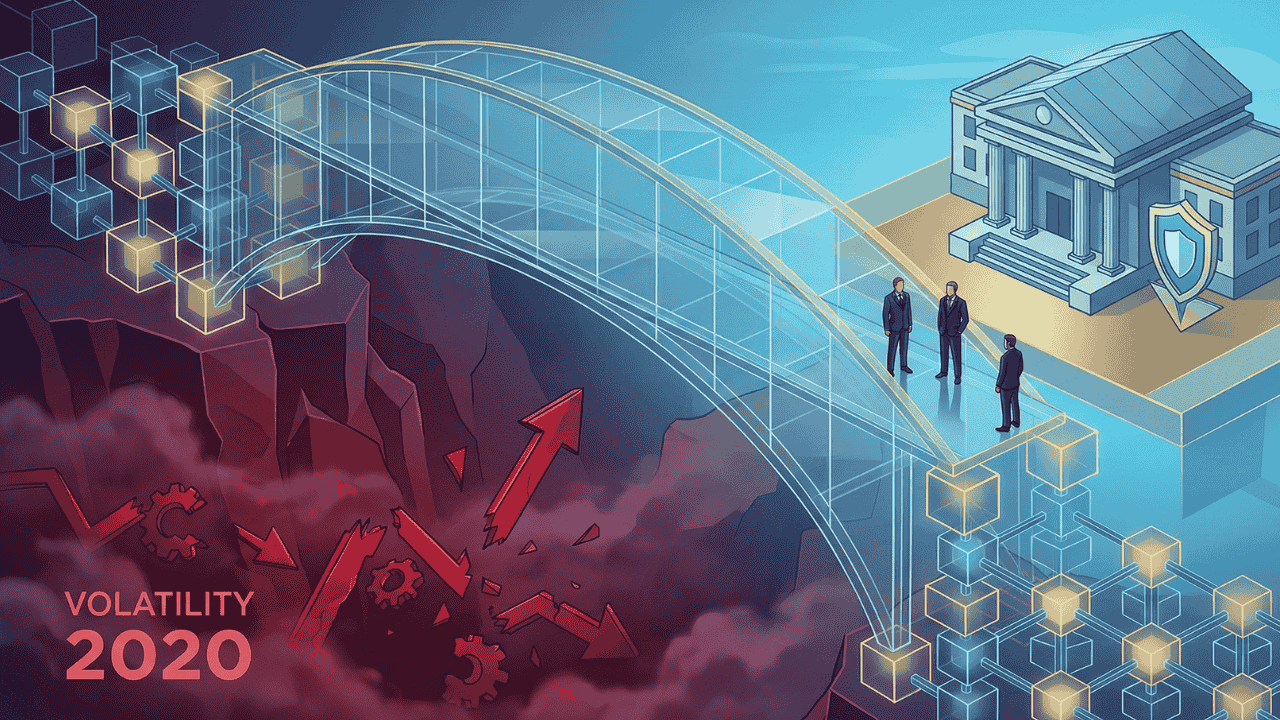
The prevailing narrative in 2020 positioned decentralized finance as a high-risk experiment, driven by unsustainable incentives. However, the underlying reality suggests that the ecosystem has transitioned toward a phase of industrial consolidation. Surviving protocols today prioritize technical solvency over explosive growth.
This maturity is not accidental, but a Darwinian response to past liquidity crises. Unlike the frenzy driven by the issuance of worthless tokens, the current cycle is founded on the generation of real cash flows. Stability, therefore, no longer depends on retail speculation.
Institutional capital has imposed audit standards that were nonexistent five years ago. Major asset managers do not interact with unverified code. From this perspective, the entry of regulated liquidity has forced a professionalization of software development in finance on a global scale.
The Institutionalization of On-Chain Liquidity
The composition of Total Value Locked (TVL) has changed radically since the last bull cycle. According to data from DeFiLlama, the dominance of stable assets and digital sovereign bonds has displaced volatile governance tokens. Liquidity is today less reactive to market panic.
This structural shift reduces the probability of algorithmic death spirals observed in the past. In previous cycles, a drop in the native token price drained protocol liquidity. Today, the underlying collateral is robust, composed largely of high-credit-quality assets.
The integration of institutional participants has created “permissioned” or hybrid pools for large capital. These structures allow regulated entities to operate in DeFi while complying with KYC/AML regulations. DeFi news constantly reports strategic alliances between traditional banking and protocols.
In other words, yield volatility has compressed, but principal security has increased. Institutional investors accept lower returns in exchange for a certainty of technical execution that the legacy banking system cannot offer.
Regulatory Frameworks: From Ban to Oversight
Current stability is also a product of regulatory clarity in key jurisdictions. The full implementation of frameworks like MiCA in Europe has eliminated the existential uncertainty hanging over the sector. The ESMA portal on crypto-assets details the capital and governance requirements demanded.
In 2020, regulatory risk was binary: total ban or chaotic absolute freedom. Today, regulation acts as a quality filter, eliminating malicious actors and unsubstantiated projects. Traditional financial institutions can now allocate capital with legal certainty, stabilizing flows.
Far from stifling innovation, these regulations have created firm ground for sustainable growth. Protocols that meet compliance standards attract the bulk of volume. Regulatory legitimacy is the asset most valuable in the current cycle.
Consequently, the risk of fraud in top-tier protocols has drastically decreased. Constant oversight and the demand for on-chain transparency force developers to maintain ethical standards. Legal security attracts permanent liquidity to these systems.
Cycle Comparison: 2022 vs. Today
It is imperative to contrast the current situation with the systemic collapse of 2022. Back then, hidden leverage and asset rehypothecation among centralized entities infected protocols. An analysis by the Bank for International Settlements (BIS) explains how excessive leverage amplified those losses.
Today, the separation between custody and execution is much sharper and functional. Current lending protocols have adjusted their risk parameters to be much more conservative. Automated risk management has learned from past cascading liquidations.
During the previous cycle, infrastructure was not prepared for the stress of extreme volatility. Network congestion prevented users from adding collateral in time. Recent upgrades have today ensured resilient processing capacity under maximum pressure.
The underlying reality is that the ecosystem has developed antibodies against financial fragility. Decentralized insurance mechanisms and safety funds are now industry standards. Resilience has been hardcoded directly into the architecture.
Persistence of Technical Risk and Centralization
Despite advances, intellectual honesty compels us to point out that DeFi is not exempt from risks. The complexity of smart contracts remains a critical attack vector. A bug in the code could trigger a technical black swan event.
Furthermore, reliance on scaling solutions introduces new points of centralization, such as sequencers. If these components fail or are censored, the promise of immutability is broken. Total decentralization remains an aspiration in the current infrastructure.
Under this scenario, code auditing is not infallible against new vectors. The interconnectivity of protocols means that the failure of a small one can affect a large one. The systemic risk of composability is inherent to the current modular design.
The Horizon of Total Integration
If the trend of institutional adoption continues with a solid growth rate, DeFi will cease to be “alternative”. It will become the backend technology for global finance. The distinction between traditional and decentralized finance will progressively fade.
Reality suggests that DeFi’s stability today is structural, not conjunctural. If regulators maintain an approach of technological neutrality, the migration of capital on-chain will be irreversible. We are witnessing the construction of a robust global financial system.

