
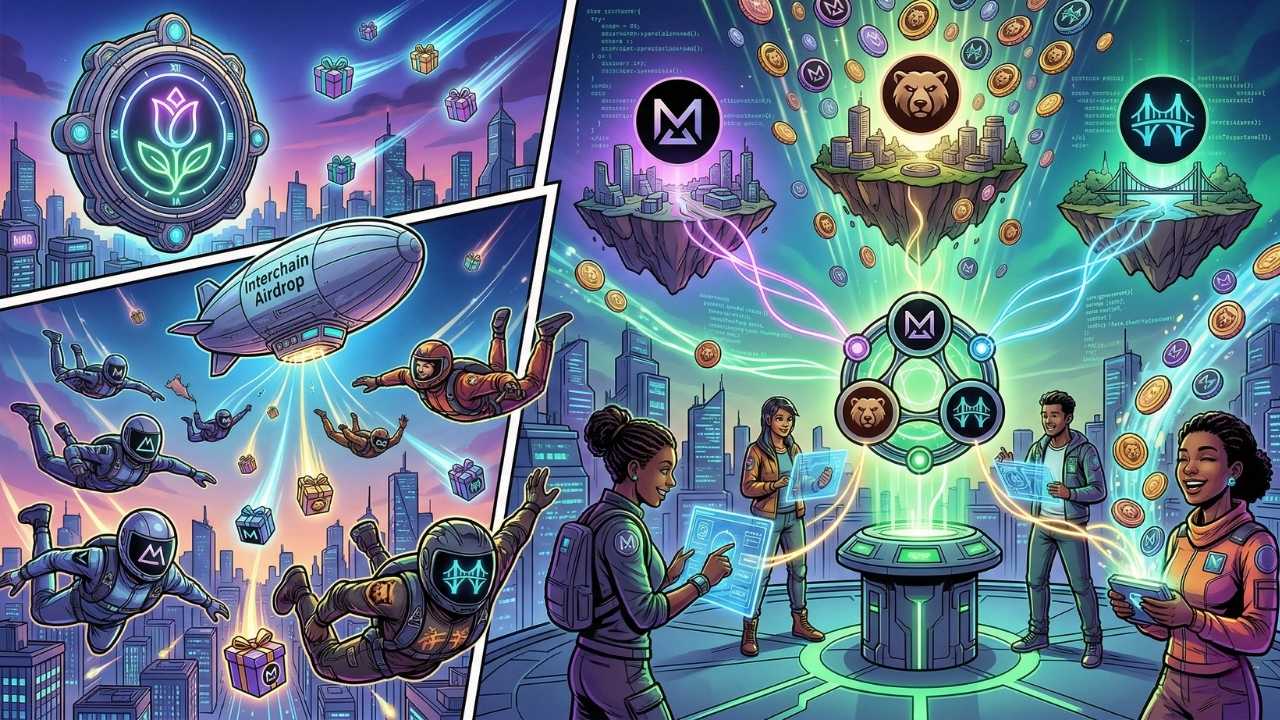
The digital asset industry is undergoing a structural transformation where free incentives have been replaced by technical alignment reward systems. The airdrops in April 2026 are not mere distribution events, but sophisticated mechanisms to filter out mercenary capital and attract sustainable institutional liquidity.
This new narrative challenges the traditional farming model based on artificial volume. Instead, current protocols prioritize the efficiency of deposited capital and interaction with verified smart contracts. The relevance of this transition lies in the maturity of an infrastructure that demands real governance commitments from its participants.
The parallel execution paradigm and the Monad ecosystem
Following its successful deployment, the Monad ecosystem has initiated a second phase of incentives focused on execution optimization. The airdrops in April 2026 within this network specifically reward users who provide liquidity in low-latency decentralized orderbook protocols.
Monad’s architecture allows for superior throughput that challenges the consensus of traditional virtual machines. Everything points to developers seeking to encourage the use of applications that exploit parallelization. Consequently, participation requires a technical understanding of workflows in high-performance networks.
In other words, the focus has shifted from the quantity of transactions to the quality of interaction. Users who maintain long-term staking positions in strategic validators are the primary beneficiaries. According to Monad’s technical documents, the network seeks to incentivize operational stability over pure speculation.
Berachain and the refinement of proof of liquidity
The recent update to the incentive mechanism in Berachain has marked a milestone in economic efficiency. During the airdrops in April 2026, the protocol has adjusted $BGT emissions to favor the real utility of assets. It is no longer enough to deposit static capital into vaults.
The underlying reality suggests that Berachain is filtering out actors who do not add value to the ecosystem. The proof of liquidity model now requires an active rotation of assets among the protocol’s native applications. This structural change seeks to mitigate the excessive inflation that plagued previous DeFi cycles.
Through this lens, participation this month requires the use of payment standards for ai agents. Data reported by Binance Square indicates that the inflation rate was reduced to strengthen the token’s value. This forces users to be much more selective with their deployment strategies.
Hyperlane and the expansion of modular interoperability
The Hyperlane protocol has begun its global expansion phase through a strategic token distribution. The airdrops in April 2026 from this platform are designed to incentivize the use of transfer routes between emerging layer 2 networks. Interoperability is now the central axis of growth.
Unlike other bridges, Hyperlane uses a modular security framework that allows developers to configure their own parameters. The adoption of this open framework is what the protocol aims to reward this month. The goal is to establish itself as the canonical infrastructure for asset movement.
At the same time, the unlock schedule suggests that the protocol seeks to balance circulating supply with real demand. According to data from Token Unlocks, a significant portion of the treasury will go to users with organic activity. This minimizes the impact of initial massive sell-offs.
Historical context of on-chain distributions
To understand current sophistication, it is imperative to remember the 2020 DeFi summer and the launch of Uniswap. That massive distribution proved that incentives could catapult initial adoption explosively. However, it also revealed the vulnerabilities of capital that leaves the protocol after obtaining the reward.
Later, in 2024, projects like Jito on Solana refined the process through stricter eligibility criteria. The airdrops in April 2026 are the result of years of experimentation with governance models. The industry has learned that end-user retention is more valuable than inorganic growth.
Even institutions like the SEC have issued guidance on the treatment of these assets, which has professionalized the sector. Far from being a coincidence, the convergence between regulation and technology has filtered out low-quality projects. Today, security and institutional backing are requirements for any launch.
Dilution risks and the saturation scenario
However, there is a critical current that warns about the saturation of the incentive model. Some analysts argue that airdrops in April 2026 could be diluting the long-term value of protocols. While they attract users, loyalty is often fleeting in highly competitive markets.
Under this scenario, the counterpoint suggests that the proliferation of layer 2 networks fragments global liquidity. The reality is that many projects will not survive without constant token subsidies. Therefore, the meritocracy thesis could be invalidated if the market enters a contraction phase.
This risk is real if institutional flows fail to absorb the new circulating supply. Many investors might choose assets with proven cash flows instead of speculative governance tokens. The sustainability of these ecosystems depends entirely on generating genuine revenue through network fees.
Projections for the end of the second quarter
The viability of the mentioned protocols will depend on their ability to transform incentivized liquidity into permanent adoption. If flows persist above five billion dollars during the next quarter, the market recovery thesis would be confirmed.
The integration of artificial intelligence in portfolio management will further automate the search for yields. Consequently, the airdrops in April 2026 will mark the beginning of an era where code, not emotion, dictates wealth distribution. Success lies in total alignment with the protocol.
In conclusion, active participation requires constant monitoring of changes in smart contracts. If daily usage metrics on Monad exceed two million transactions, the ecosystem’s value will solidify. The future of digital distribution belongs to those who provide real technical value.

