
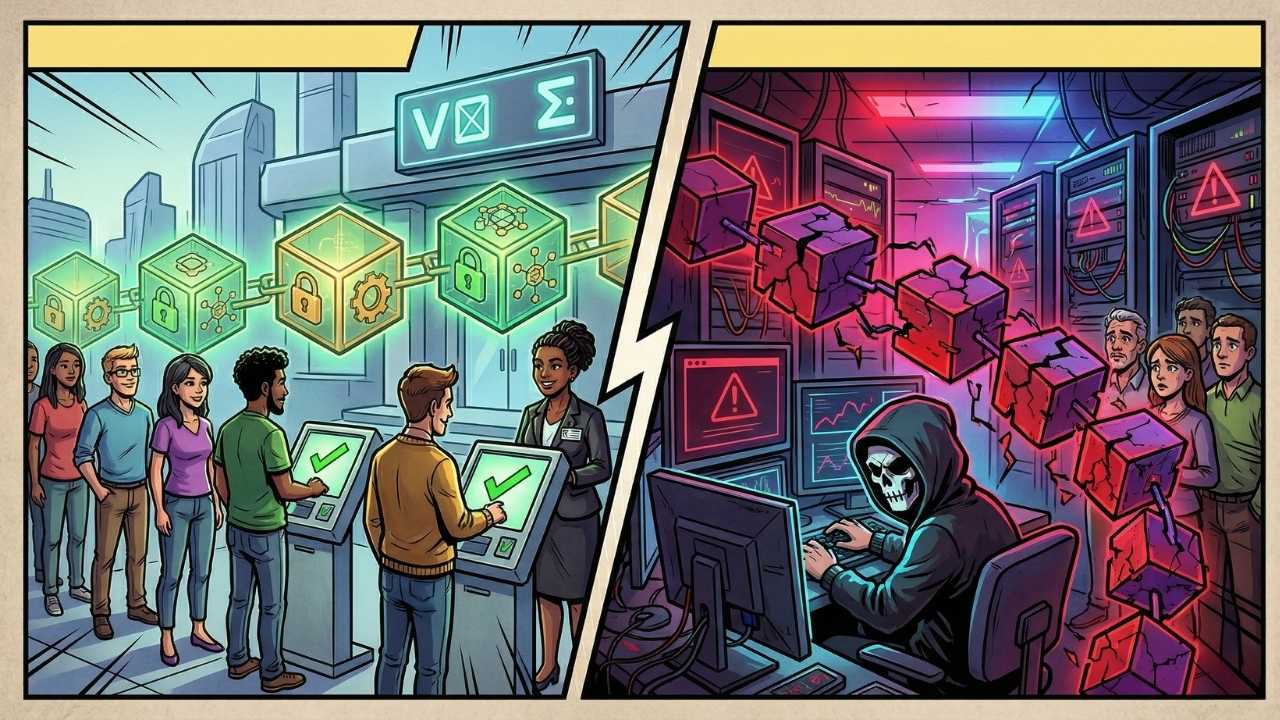
The implementation of blockchain in voting systems is presented today as a technical response to the growing erosion of trust in global democratic institutions. The debate does not only revolve around digital efficiency, but about the capacity to guarantee absolute and immutable transparency throughout the process.
Various international organizations and developers suggest that this technology could eradicate electoral fraud through real-time auditable records. However, the massive adoption of blockchain in voting systems faces structural challenges that go beyond simply coding a functional and secure smart contract for the general population.
Everything points to the fact that the architecture of distributed ledgers offers unprecedented resistance against post-hoc data manipulation. A technical report from the European Parliament on blockchain highlights that immutability is the central pillar for rebuilding legitimacy in electoral processes constantly under suspicion of human interference.
Such a technical scenario would allow each vote to become a unique transaction, verifiable by the citizen without compromising the secrecy of the ballot. Using blockchain in voting systems would allow a transition from a model of delegated trust to one of direct mathematical verification between the voter and the box.
The Mirage of Electoral Immutability
While the technical theory is promising, the practical application of blockchain in voting systems reveals critical gaps in end-device security. The integrity of the blockchain does not guarantee that the voter’s smartphone or computer has not been previously compromised by malicious external actors or sophisticated malware.
Far from being a coincidence, cybersecurity experts from MIT in their critical analysis warn that denial-of-service attacks could paralyze entire election days. Under this prism, extreme decentralization introduces attack vectors that current centralized systems manage to mitigate through physical presence and direct human observation.
Consequently, trust in the code must be backed by a certified hardware infrastructure accessible to all social strata and demographics. The adoption of blockchain in voting systems therefore requires a standardization of protocols that prevents the digital divide from becoming an unintended tool of political exclusion.
At the same time, the transparency of open-source code allows any independent entity to audit the functioning of the electoral software continuously and rigorously. This capacity for public auditing is what substantially differentiates blockchain news from the opaque counting systems that dominate much of the contemporary geopolitical landscape.
Cryptography Against Institutional Distrust
The use of advanced techniques such as zero-knowledge proofs allows for the validation of a vote’s validity in an anonymous manner. Under this scheme, the network confirms that the elector has the right to vote without ever revealing their personal identity or the chosen political option.
The implementation of blockchain in voting systems through these cryptographic tools would resolve the historical conflict between individual privacy and public transparency. According to the Cardano whitepaper on governance, these treasury and decision systems prove that it is feasible to coordinate thousands of participants safely and fully decentralized.
While it is true that the technology is robust, public perception regarding cryptographic complexity can generate an instinctive rejection in less technified sectors. The transition towards blockchain in voting systems must be accompanied by a pedagogical effort that simplifies the user interface without degrading the underlying protocol’s security.
In other words, the success of digital democracy does not depend solely on computing power or the efficiency of the algorithm used. The legitimacy of the electoral result resides in the collective understanding that the process has been fair, traceable, and technically impossible for a central authority to alter.
Previous Experiences and Analog Failure
Recent history shows significant modernization attempts that serve as a reference for evaluating the potential of current distributed ledger technology. A relevant event was the pilot program in West Virginia, detailed in the official state report, where a blockchain-based mobile application was used.
That experiment demonstrated that the participation of overseas voters increases considerably when geographical barriers and physical mail delays are removed. However, subsequent audits revealed vulnerabilities in data transmission that were not directly related to the recording on the blockchain itself but to the interface.
When comparing with past events, such as the vulnerabilities detected in conventional electronic voting machines reported by NIST in its technical study, it is clear that the problem is systemic. Traditional analog and electronic systems lack the disaster recovery capacity offered by a globally distributed and synchronized network of nodes.
Therefore, blockchain technology should not be seen as a total replacement, but as an additional security layer that strengthens existing processes. Integrating blockchain in voting systems could serve as an unalterable backup database that validates counts performed by traditional physical methods during the election day.
The Dilemma of Democratic Scalability
A fundamental point of conflict lies in the processing capacity of current networks versus national elections with millions of simultaneous votes. While layer 2 solutions have improved speed, the volume of data generated by a general election could saturate infrastructures that are insufficiently prepared for peak demand.
Opponents of the use of blockchain in voting systems argue that system complexity introduces unnecessary failure points in a process that should be simple. They contend that the risk of software errors outweighs the benefits of immutability, preferring the physical and tangible security of paper and the ballot box.
Under this scenario, a bug in the smart contract code could irreversibly invalidate thousands of votes without the possibility of an effective manual appeal. Technical evidence suggests that, unless there is absolute consensus on code security, large-scale deployment remains a high-risk gamble for any modern nation.
However, if innovation flows maintain their current pace, it is likely that these technical limitations will be resolved in the short term. The future of blockchain in voting systems depends on finding an exact balance between maximum technical security and maximum accessibility for the ordinary citizen.
If electoral participation stays below the critical threshold due to distrust during the next two cycles, the pressure to adopt cryptographic solutions will be unavoidable. Ultimately, the technology will only triumph if it proves more difficult to hack than the human will to manipulate political power.

