
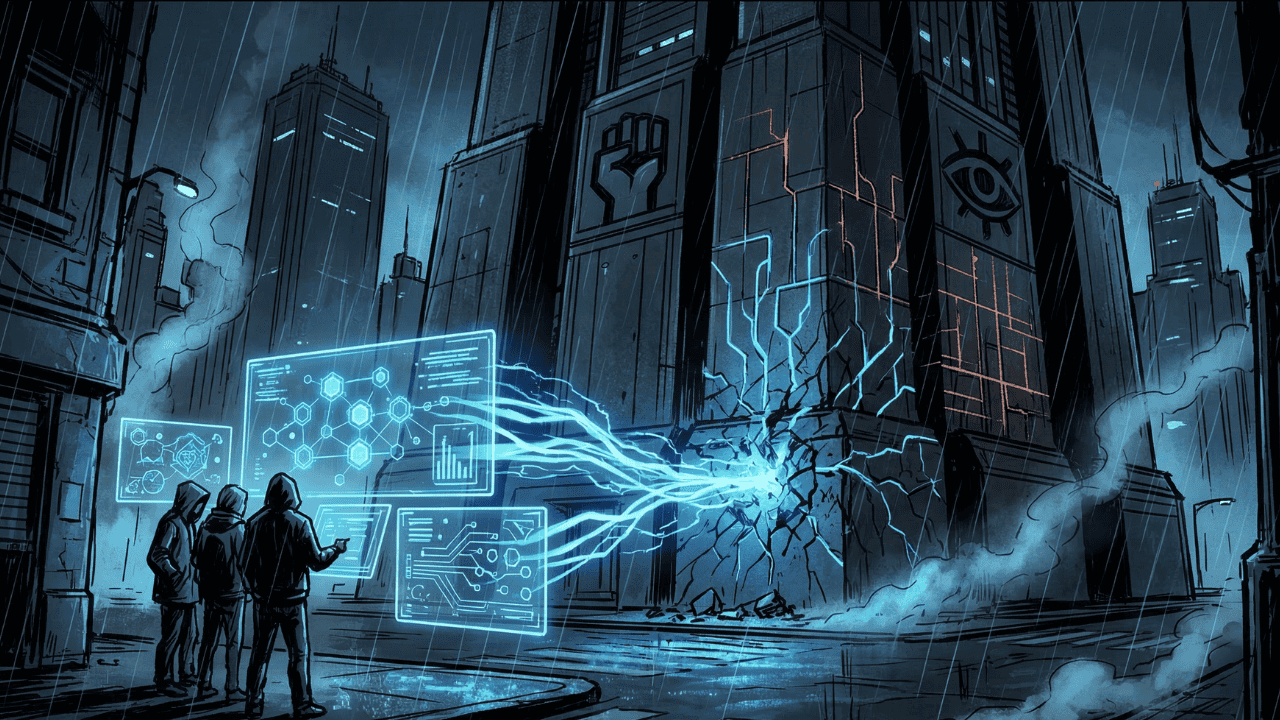
The crypto industry today moves between irrational euphoria and brutal purges of projects without support. In this scenario, AI tokens emerge as a structural response to extreme centralization. However, volatility has been ruthless, severely punishing the lack of products that are truly tangible in the current digital market.
This narrative faces an identity crisis after a period of massive correction. Many investors question whether decentralization adds real value to large-scale data processing. AI tokens must now prove that they can compete with tech giants that currently possess total control over the necessary hardware and infrastructure.
From the 2024 Mirage to 2026 Maturity
The underlying reality suggests that the market has matured after the initial collapse. It is a fact that AI tokens shed 75% in a single year, wiping out $53 billion in market capitalization. This purge was necessary to eliminate the excess of assets without utility in the sector.
In other words, the fall allowed projects with solid technical fundamentals to survive. Today’s AI tokens are not sustained only by promises, but by functional distributed computing networks. Market debugging has left room for a much smarter institutional accumulation and less emotional behavior currently among large global players.
Far from being a coincidence, this stabilization coincides with the development of decentralized infrastructures. The resilience of AI tokens in 2026 indicates that the demand for compute exceeds the traditional available supply. Consequently, the sector is migrating from pure speculation to real utility and verifiable network performance globally.
The Bittensor Model: Incentives for a Global Brain
Under this prism, the Bittensor protocol represents the spearhead of this technical evolution. Its incentive system rewards nodes for providing high-quality machine learning models. The design of its official network whitepaper establishes a framework where competition fosters algorithmic efficiency constantly and transparently for all participants.
At the same time, the network has expanded its capacity by launching subnets specialized in tasks. This organic growth suggests that AI tokens linked to incentive alignment networks possess greater resistance. Programmed scarcity and real usage are creating a much more robust price floor for long-term investors and developers.
However, the success of these systems depends exclusively on the quality of the generated output. If the network’s miners do not produce results that are competitive against closed models, the thesis would collapse. Technological competitiveness is the only bulwark against absolute irrelevance in this very dynamic and complex digital market.
The ASI Alliance and the Risk of Fragmentation
The creation of the Artificial Superintelligence Alliance sought to unify the ecosystem under one strong banner. This merger tried to consolidate liquidity and technical development on a massive scale without precedent. Nonetheless, the execution of this union has faced quite critical interoperability challenges during the most recent financial months.
Reality suggests that fragmentation remains the greatest enemy of effective decentralization. Although the project has tried to unify criteria, the departure of key partners raised doubts. AI tokens need a coherent governance structure to attract long-term capital in a sustainable and secure manner for institutional funds.
Furthermore, the integration of autonomous agents requires a much clearer global regulatory environment. Developers must navigate intellectual property laws that do not yet contemplate distributed systems. Without this clarity, AI tokens could be relegated to experimental niches without mass adoption in the real corporate and industrial sector.
Macro Correlation: The Effect of Physical Infrastructure
It is impossible to analyze this sector without observing the performance of global semiconductor markets. Manufacturers’ earnings reports act as a sentiment barometer for digital assets. According to Reuters on AI demand, the need for hardware remains the main driver of the industry in the modern technological world.
In other words, when the traditional tech sector breathes, AI digital assets expand. The correlation between GPU demand and AI tokens is now undeniable and persistent. This external dependence is a factor that investors must monitor with extreme vigilance and technical rigor to avoid systemic market risks.
While it is true that this link offers liquidity, it also exposes the sector to risks. A drop in corporate spending on traditional IA would inevitably drag down decentralized protocols. The narrative independence of these protocols is still a distant goal on the horizon of current financial and digital markets.
Regulatory Risks and the Valley of Death
Surveillance by the administration over digital assets has escalated notably on a global scale. The creation of specialized units, such as the SEC Crypto Task Force, puts under the magnifying glass how incentives are structured. Many AI tokens could be classified as securities if they fail to demonstrate operational decentralization completely.
There is a risk that regulators will consider that staking constitutes an investment contract. This legal interpretation would stifle innovation in key jurisdictions during the next financial quarters. Therefore, legal resilience will be as important as the computing power of the project’s underlying source code and network.
That said, the bullish thesis could be invalidated if the costs of decentralization exceed its benefits. If training a model on a distributed network is more expensive than in the cloud, the incentive disappears. AI tokens face the challenge of demonstrating economic efficiency against Amazon or Microsoft Azure right now.
If capital flows into these assets remain stable during the rest of 2026, the narrative will consolidate. Under this scenario, AI tokens would stop being extreme risk assets to become structural components of diversified portfolios for modern and institutional investors.

