
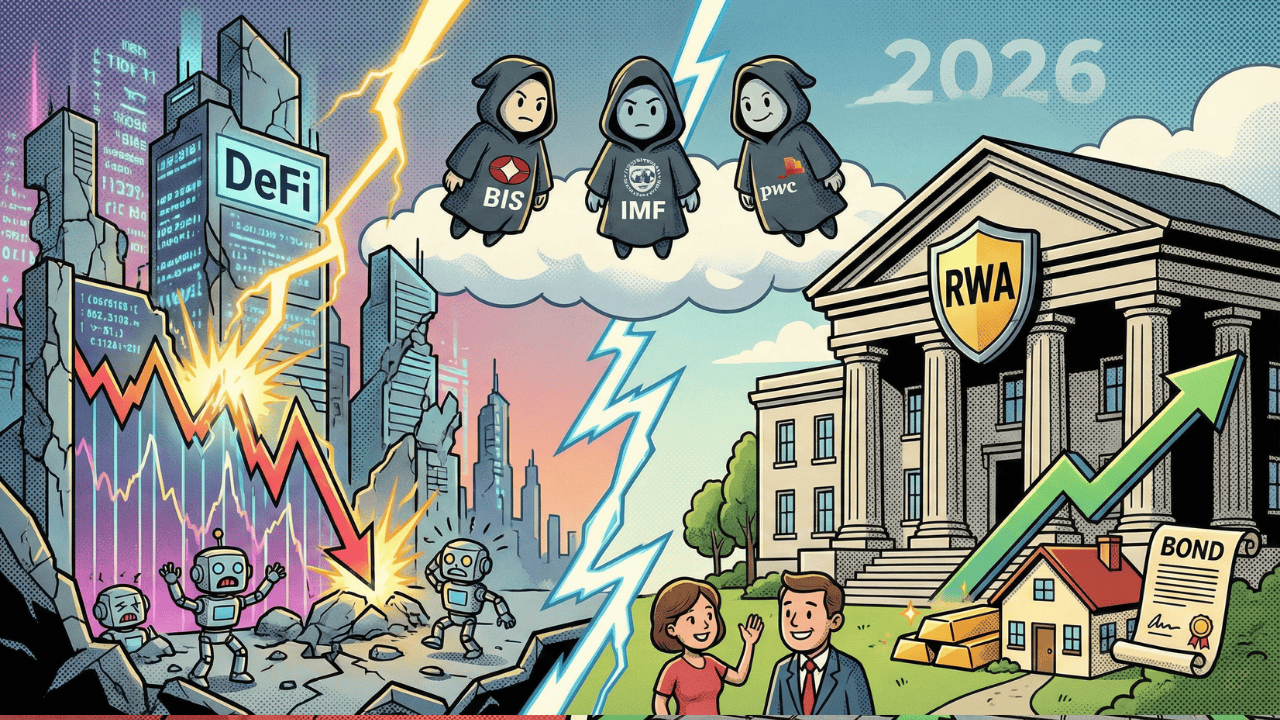
The great purge of ghost yields has concluded. If we look back to the chaos of the early decade, we will remember an era where food-themed protocols promised 1,000% annual returns based on the infinite issuance of utility-less tokens. In this 2026, the investor has matured through hard knocks, and the question is no longer how much I can earn, but exactly where the money comes from. The battle for cash-flow dominance is now being fought between Real World Asset (RWA) yields and native Decentralized Finance (DeFi) yields.
Sustainability is not a buzzword; it is the only lifejacket in a market that has learned to despise noise. While DeFi yield feeds on on-chain activity, RWA yield acts as a bridge importing value from the traditional economy. The source of flow determines not only profitability but the longevity of any serious portfolio today.
The Internal Engine: How DeFi Yield Survives
Native DeFi yield has undergone a necessary metamorphosis. We no longer rely on inflationary schemes to attract liquidity. In 2026, organic returns in decentralized protocols primarily come from three sources: exchange fees on decentralized exchanges, loan liquidations, and the capture of maximal extractable value (MEV). Real activity generates value, turning protocols into true digital service companies.
According to the Report on the Future of the Monetary System by the Bank for International Settlements (BIS), the programmability of these flows allows for an efficiency that traditional banking still envies. However, this yield is inherently cyclical. If trading volume drops, the yield evaporates. Sustainability here depends entirely on network adoption. If no one uses the bridge, there are no tolls to collect. Volume is king here, forcing investors to constantly move to find the networks with the most traction.
This model is extremely efficient at capitalizing on volatility. In periods of high activity, DeFi can easily outperform any traditional instrument. But that same strength is its weakness: in a sideways or bear market, yields typically compress to levels that barely cover the risk of interacting with smart contracts.
The External Refuge: The Stability of RWAs
On the other hand, Real World Assets have brought “financial gravity” to the crypto space. By tokenizing Treasury bills, corporate debt, or even real estate income, we are connecting the ecosystem with the productivity of the global economy. This yield is much more predictable because it doesn’t depend on whether someone buys or sells a monkey NFT, but on whether the U.S. government pays its debt or a tenant pays their rent. The physical economy backs every percentage point earned.
The International Monetary Fund (IMF) Global Financial Stability Report from late 2025 highlights that integrating these assets has reduced the extreme correlation that used to define cryptocurrencies. By importing external yields, digital portfolios now have a ballast that allows them to navigate storms without the value disintegrating. Genuine diversification occurs only when the origin of capital is not purely digital.
At this moment, tokenized Treasury bills offer a yield floor that acts as the “risk-free rate” of the crypto world. This has forced DeFi protocols to be more competitive and transparent. If a DeFi protocol cannot offer more than a tokenized Treasury bond, it is destined to disappear. The market demands a premium for technological risk, raising the quality standard of the entire industry.
Which One Wins the Longevity Race?
If we analyze the structure of both models, we see they are not necessarily enemies but tools for different scenarios. RWA yield is superior in terms of predictability. It is the foundation upon which long-term savings are built. According to the annual report on digital assets from PwC, 60% of the institutional capital that has entered the sector in 2026 has done so through products linked to physical assets. Institutional trust seeks assets that can be audited off-screen.
However, DeFi yield has a scalability that the physical world cannot match. Tokenizing a building or government debt involves legal processes, registries, and bureaucracy that slow down capital deployment. In DeFi, capital moves at the speed of light. Financial agility defines the advantage of native yields, allowing for arbitrage strategies and interest compounding that are impossible in the traditional system.
DeFi’s historical problem was its self-referentiality: digital money backed by more digital money. By introducing RWAs, we have broken that vicious cycle. Now, DeFi yield is often used to boost RWA yield through regulated leverage strategies. This symbiosis is possibly the most significant advancement of this year.
The Challenges No One Wants to Mention
It is vital to be honest: neither model is perfect. RWA yield reintroduces counterparty risk and jurisdictional risk. If the issuer of a tokenized bond has legal trouble in the physical world, your token could be worth zero even if the blockchain works perfectly. Legal risk is real and cannot be eliminated with code. The dependence on financial intermediaries to custody physical assets is the Achilles’ heel of this trend.
For its part, DeFi continues to fight against smart contract risk and oracle centralization. Although audits have drastically improved in 2026, the risk of a code error remains. Furthermore, much of current DeFi yield is concentrated in a few networks and protocols, creating systemic points of failure. Infrastructure remains quite young, and any technical failure can have massive repercussions on global liquidity.
In other words, sustainability is not a fixed state but a dynamic balance. RWA yield provides the necessary stability so the system doesn’t collapse, while DeFi provides the necessary innovation so the system doesn’t stagnate.
A Vision for the Remainder of the Year
Under this lens, the winning sustainability for this 2026 cycle is hybridization. The portfolios that are best resisting the current interest rate stabilization are those that maintain 70% in Real World Assets to secure the capital floor, and 30% in high-efficiency DeFi protocols to capture excess market returns.
The era of picking a side is over. The smart investor understands that RWA yield is the daily bread, while DeFi yield is the opportunity for exponential growth. The combination of both worlds is what has finally allowed digital assets to be considered a mature and trustworthy asset class for global savings.
Success in what remains of the decade will depend on our ability to verify the provenance of every cent. If the yield cannot be simply explained through economic activity or guaranteed debt, we are likely facing a mirage that will soon vanish. Total transparency now rules in this new financial order.

