
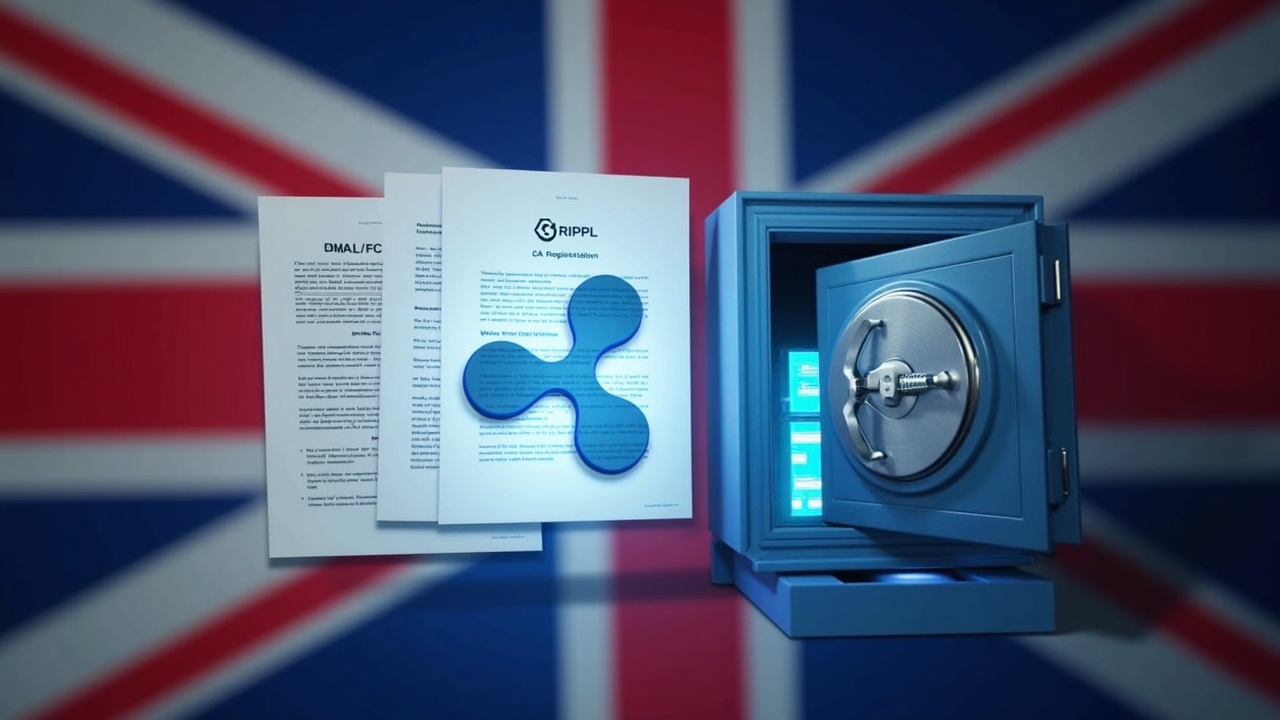
The cross-border payments company Ripple has achieved a fundamental regulatory breakthrough by obtaining its official registration with the British Financial Conduct Authority (FCA). This milestone allows its subsidiary, Ripple Markets UK Ltd., to carry out specific activities with digital assets under the strict supervision of the body.
The impact of Ripple’s registration with the FCA ensures that the firm fully complies with current anti-money laundering regulations. According to official spokesperson Jamie Crawley, this step positions the company within the country’s new financial framework.
This registration ensures that Ripple’s payment infrastructure respects the United Kingdom’s anti-terrorist financing laws. However, the approval does not yet grant full authorization for all traditional financial services. The company can now perform crypto-asset operations legally and transparently within the British territory.
Therefore, the regulatory recognition strengthens the confidence of institutional investors in the firm’s liquidity solutions. Likewise, this validation arrives at a time of great expansion for the digital payments sector.
Ripple uses blockchain technology and various digital assets to facilitate fast and low-cost international transfers. The registration in the authority’s official database confirms that the company has passed rigorous audit processes. In this way, the cross-border payments ecosystem receives a fundamental strategic boost for its growth in Europe.
It is also important to highlight that the United Kingdom seeks to become a global hub for technological innovation. For this reason, the impact of Ripple’s registration with the FCA is seen as a positive signal.
Toward a digital asset market fully integrated into the global financial infrastructure
The integration of financial technology companies into the British system responds to a national economic modernization strategy. British lawmakers are actively working to assimilate digital assets within existing property and trade laws.
For this reason, the United Kingdom’s regulatory environment now offers greater legal security for companies in the crypto sector. On the other hand, the recent signing of the GENIUS Act in the United States has accelerated these global regulatory clarity efforts. Hence, Ripple positions itself as a leader in regulatory compliance within the most important markets.
The impact of Ripple’s registration with the FCA also facilitates collaboration with local banks to develop efficient payment systems. During the last year, the adoption of stablecoins has grown exponentially in the world’s major developed economies.
The ability to operate under the regulator’s direct supervision significantly reduces operational risks for the firm’s commercial partners. In this way, the decentralized payment network can connect more easily to traditional financial rails. Likewise, it is expected that this registration will attract new institutional capital flows into Ripple’s ecosystem.
Will this be the definitive catalyst for the mass adoption of payments with Ripple?
Legal stability is the pillar upon which the trust of large international banks and investment funds is built. The impact of Ripple’s registration with the FCA allows the company’s technology to become a network standard. The financial sector expects greater agility in cross-border transfers thanks to these new legal approvals.
For this reason, the price of related assets could experience a positive revaluation in the face of reduced regulatory uncertainty. Therefore, analysts suggest that this is only the beginning of a much deeper adoption phase.
Cryptocurrencies are leaving the experimentation stage behind to become tools of real utility and strict compliance. The firm will continue to seek additional licenses to expand its offer of regulated financial products in other key jurisdictions this year.
The eyes of world regulators are now fixed on how these companies protect their end customers. In this way, Ripple’s success in the United Kingdom serves as a model for other projects seeking legitimacy. Undoubtedly, 2026 will be a decisive year for the consolidation of secure and fully transparent digital finance.

