
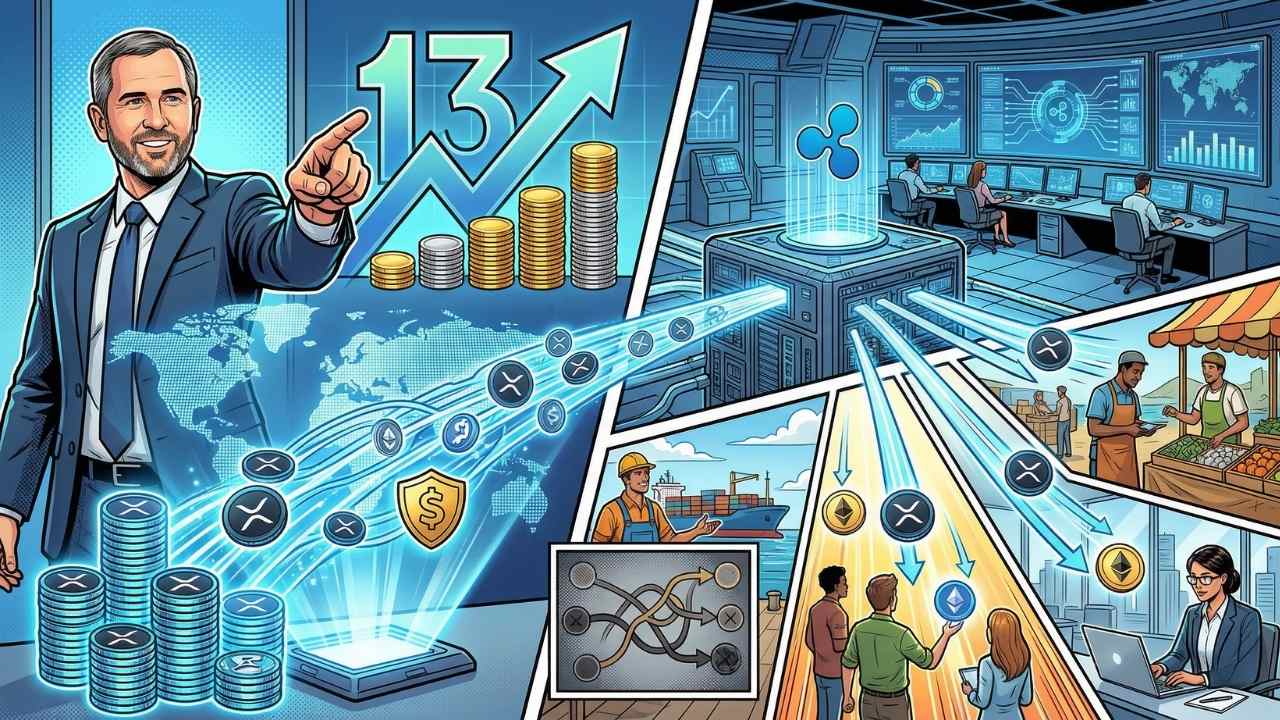
Brad Garlinghouse, CEO of Ripple, revealed during an interview with FOX Business a market opportunity valued at 13 trillion dollars for the digital asset XRP. According to the firm’s operational data following the acquisition of GTreasury last year, this massive volume of transactions has not yet fully migrated to the new on-chain settlement rails.
Ripple’s expansion strategy is based on the integration of traditional financial infrastructures with distributed ledger technology to optimize processes. Given that GTreasury manages unprecedented institutional capital flows, the transition toward digital assets represents an imminent paradigm shift. This movement seeks to optimize settlement speed, eliminating the frictions inherent in the conventional correspondent banking system that slows down global commerce.
The financial ecosystem has undergone a significant transformation since the volume of stablecoins reached 33 trillion dollars globally during the past annual fiscal year. Despite previous regulatory challenges, the clarity obtained after legal resolutions has positioned Ripple as an indisputable corporate leader. The company now seeks to capitalize on this massive liquidity through its cross-border payment infrastructure that promises to be highly efficient.
Institutional convergence redefines the intrinsic value of modern digital assets
Unlike the 2020 bull cycle, where speculation dominated the market, XRP acts today as the central liquidity bridge for real institutional operations. The technical maturity of the network allows transactions to be processed in seconds, drastically reducing operating costs for global corporate treasuries. This real utility differentiates the asset from other projects that lack a tangible and sustainable use case in the market.
The introduction of the RLUSD token responds to a strategic need to control liquidity flows that previously fueled external competitors within the financial ecosystem. Given that 20% of USDC flow originated from Ripple’s operations, creating its own stablecoin strengthens the company’s financial sovereignty. This product already boasts a market capitalization that currently exceeds 1.4 billion dollars, showing rapid adoption among users.
Detailed analysis of GTreasury’s infrastructure reveals that global payment processing demands a superior efficiency than what legacy systems offer today. By integrating Ripple’s technology, these transactions could be executed with total transparency and unprecedented real-time auditability. This technological advancement is frequently compared to the transformative impact that the launch of generative artificial intelligence had on the digital world.
Will the adoption of RLUSD finally drive the market valuation of XRP?
Historically, the correlation between treasury transactional volume and the demand for XRP as a reserve asset has been underestimated repeatedly by analysts. In 2022, the focus was centered exclusively on survival against the SEC, but the 2026 landscape shows a scenario of deep integration. The ability to absorb even a fraction of this 13 trillion market would generate significant organic buying pressure.
Global perception has rotated from extreme skepticism toward the acceptance of cryptocurrencies as the new financial operating system for high-performance global systems. High-level companies no longer question the viability of the technology, but rather seek robust protocols to implement immediate payment solutions. Ripple, through its distributed ledger, offers the scalability necessary to support these complex demands for corporate capital worldwide.
Under this new architecture, the “ChatGPT moment” concept for the industry suggests that blockchain will be the invisible base of every transaction. Garlinghouse emphasizes that the use of stablecoins as an entry point will facilitate the mass adoption of volatile but liquid digital assets. This technical synergy between RLUSD and the native asset of the Ripple Ledger redefines the current hierarchy of digital assets.
Looking ahead, the market must monitor the technical implementation of new payment corridors and the expansion of the market capitalization of the RLUSD stablecoin in various jurisdictions. The consolidation of XRP as the “North Star” of the corporate strategy suggests that its role will be fundamental in the interconnection of systems. Regulatory evolution in major markets will dictate the final pace of this multi-trillion dollar financial integration.

