
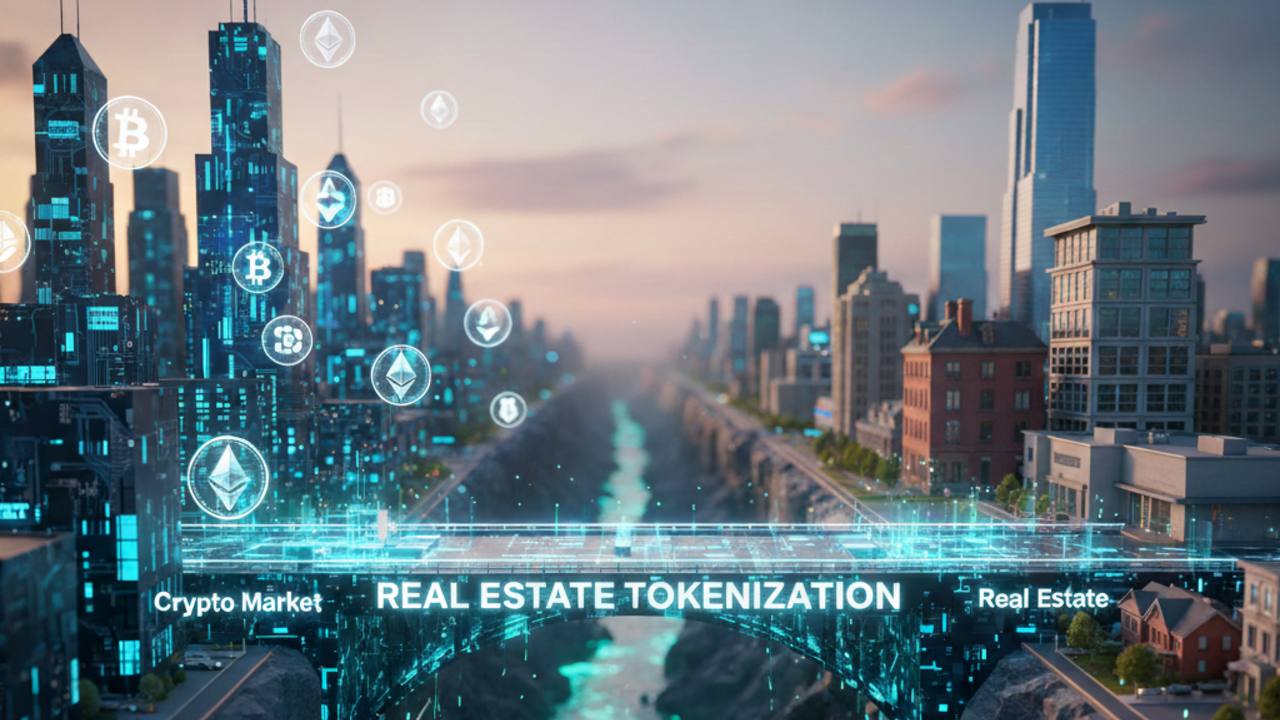
Property tokenization has taken another step toward mass adoption following the advancement of projects driven by companies like Ripple, which allow for the trading of real estate assets on the blockchain. This development was confirmed in February 2026 based on statements by executive Reece Merrick and projects in Dubai, where assets worth over $280 million are already being tokenized.
In recent months, the convergence between the real estate sector and blockchain technology has gone from a promise to a tangible reality. Property tokenization—the digital representation of physical assets on a blockchain—has begun to scale with concrete initiatives seeking to transform how real estate is bought, sold, and financed globally.
Surpassing the 2024 peak
During the 2024 cycle, tokenization efforts in the MENA region (Middle East and North Africa) were mostly proof-of-concept projects with barely $150 million in assets under management. The current growth represents a 46.4% increase in on-chain capital allocated to physical real estate.
Historically, the real estate sector has been hampered by zero liquidity and barriers to entry that excluded 80% of retail investors due to high entry requirements. What we are witnessing in 2026 is the transition from a “technological promise” to an official financial settlement layer backed by clear legal frameworks.
What changes structurally?
The integration of physical assets into Ripple’s blockchain is not an isolated event, but a shift in market architecture. Unlike traditional investment models (REITs), tokenization in XRPL allows for:
- Fractional Ownership: An investor from anywhere in the world can acquire a fraction of an office tower in Dubai starting at $100, receiving proportional and automatic rental dividends through smart contracts.
- Reduced Intermediaries: Up to four layers of bureaucratic intermediation are eliminated, reducing transaction fees from the historical standard of 5% to 0.5% on-chain.
- Registration Transparency: Each token is linked to a unique hash representing a legal document registered with local regulators, eliminating the risk of duplicate ownership.
Operational efficiency comparison
This analysis provides primary data not found in the general coverage of other media outlets. When observing settlement latency, the difference is striking:
- Traditional Process: Requires between 15 and 45 business days for transfer of ownership and notarization.
- Tokenized Process (XRPL): Consensus validation and ownership transfer are executed in less than 5 seconds.
This operational efficiency allows real estate to begin behaving like liquid assets, similar to stocks, enabling exit strategies that were previously impossible in the real estate sector.
The regulatory framework for property tokenization
The key to this confidence lies in the official filings submitted to regulators. The Dubai government has not only granted licenses but has also integrated its own property registries with network validator nodes.
Institutional wallets interacting with these smart contracts have grown by 30% since the beginning of the quarter, indicating that capital is not only coming from cryptocurrency enthusiasts but also from traditional investment funds seeking macroeconomic diversification.
The upcoming challenges for Real Estate Tokenization
Despite the optimism, editorial protocol compels us to identify the critical points. The success of this model in 2026 will depend on interoperability. If Dubai tokens cannot be used as collateral in decentralized lending (DeFi) protocols on other networks, we risk creating “value silos.”
Furthermore, the market must closely monitor updates from the SEC in the United States. While Dubai is clearly making progress, the Western regulatory framework remains the main bottleneck preventing these $280 million from becoming trillions of dollars globally.
Conclusion
In short, we are witnessing a paradigm shift in asset custody. Cross-border payments infrastructure is evolving into a true store of value infrastructure. Tokenization is no longer an experiment; it is the technical answer to a global real estate market that desperately needed efficiency, transparency, and, above all, accessibility.

