
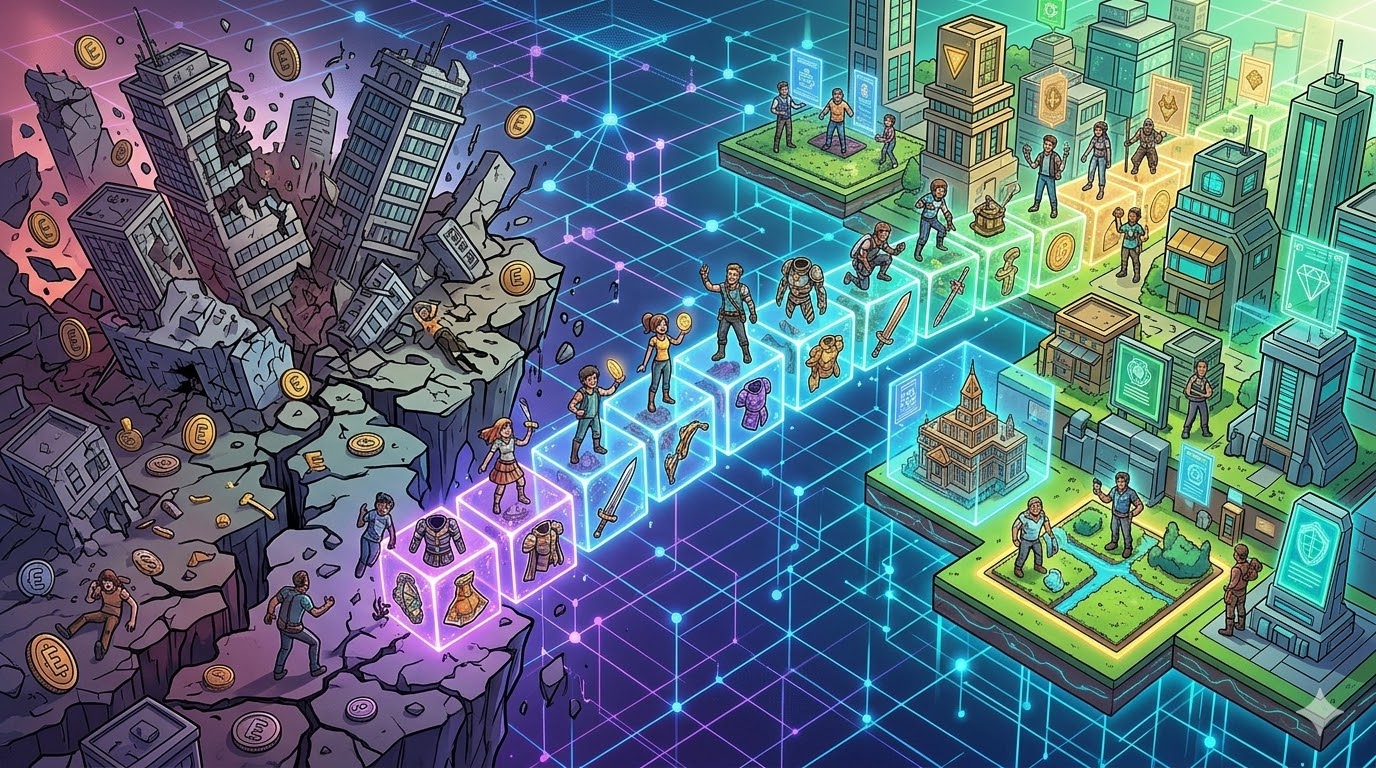
Everything points to the Play-to-earn model having definitively collapsed due to its intrinsic lack of sustainability over time. Financial incentives failed by ignoring that fun is the primary driver of human consumption. The underlying reality suggests that financial yield is no longer enough motivation for players.
Under this prism, the current ecosystem demands a transition toward systems where digital ownership is the center of the experience. While Play-to-earn promised constant income, technical reality proved that uncontrolled token issuance destroys long-term value for any digital project.
The Inevitable Fall of Empty Yield
The architecture of games that prioritized value extraction mainly attracted speculators rather than real players. The underlying reality suggests that when the token price drops, the user base disappears instantly. The market has identified this economic design structural failure as a systemic risk.
In other words, the economy of these titles depended exclusively on the permanent influx of new external capital. The Blockchain Game Alliance report confirms that interest in the pure extraction model has dropped drastically. Investors now seek sustainability and real user retention metrics.
Concurrently, the industry is migrating toward the concept of play-and-own, where digital assets have a functional purpose. As we previously analyzed, the success of Web3 gaming over the previous model marks a milestone in the sector’s evolution. Fun must always precede monetization efforts.
NFTs: From Speculation to Real Utility
The integration of NFTs in video games should not be interpreted as a tool to save traditional Play-to-earn. These assets must function as title deeds granting real rights over objects within virtual worlds. Everything points to the fact that digital ownership is necessary for the new economy.
DappRadar usage metrics demonstrate that titles offering real utility maintain much more stable communities. The underlying reality suggests that a digital object only has value if it is useful for the game. The market rejects empty assets without technical purpose or aesthetic value.
Consequently, NFTs allow for interoperability that was previously technologically impossible to achieve in closed silos. Players can move their achievements across different platforms, creating a shared value ecosystem. The industry moves toward universal digital ownership standards that empower the final consumer.
In other words, verifiable digital scarcity through smart contracts ensures that developers do not dilute the internal market. This operational transparency is fundamental to recovering the trust lost after the Play-to-earn collapse. The underlying reality suggests that technical trust is vital for attracting new institutional capital.
The Role of Major Corporations
Industry giants like Ubisoft and Sony are exploring how to integrate digital assets without alienating their traditional base. Ubisoft’s Quartz initiative was a pioneering experiment to measure mass market reaction. Everything points to adoption being slow but irreversible in the coming years.
The underlying reality suggests that AAA companies seek recurring revenue models based on regulated secondary trade. Sony’s digital asset patent filings confirm that next-generation consoles will be prepared for this shift. The industry is preparing for globally interconnected trade infrastructures.
While the Play-to-earn stigma persists, the formalization of NFT markets could clean up the sector’s image. Absolute traceability allows for fighting fraud and ensuring creators receive royalties for every transaction. Everything points to operational transparency reducing risks for all participants.
Concurrently, metadata standardization will allow assets to be recognized across multiple high-performance graphic engines. The underlying reality suggests that the true revolution is not money, but the portability of player effort. The market demands real and efficient technical interoperability solutions.
Stability through the Use of Stablecoins
A determining factor in avoiding extreme volatility is decoupling the game economy from speculative tokens. We observe that stablecoins are becoming the hidden engine to facilitate predictable transactions within virtual worlds. The underlying reality suggests that stability attracts the conventional user.
Using assets linked to fiat currencies allows players to understand the real value of their NFTs. Circle’s payment strategies for developers underscore the importance of a robust and scalable financial infrastructure. Everything points to stable payments being fundamental for commercial growth.
In other words, removing the friction of price fluctuation allows the focus to return to pure gameplay. The Play-to-earn model failed precisely because it forced the player to be an expert financial trader. The industry now prioritizes fluid and secure user experiences for everyone.
Under this prism, hybrid economies combining NFTs with stablecoins offer the best of both financial worlds. Players can own rare assets while trading in a stable and reliable unit of account. The underlying reality suggests that this configuration mitigates systemic economic collapse risk.
Cultural Barriers and Technical Challenges
Despite the progress, the resistance from the traditional gaming community remains a significant and complex obstacle. Many users associate any mention of NFTs with the scams observed during the Play-to-earn boom. The underlying reality suggests that education is a pending task for companies.
Consequently, the success of new models will depend on developers’ ability to hide technical complexity. If a player needs to understand what a wallet is to have fun, the product will fail commercially. Everything points to simplicity of use dictating mass market success.
In other words, detractors argue that monetizing every action destroys the immersion necessary for recreation. The underlying reality suggests that speculation can once again corrupt level and mission design. The industry must avoid falling back into extractive vices of the recent past.
Concurrently, global regulation on digital assets adds a layer of operational uncertainty for major international studios. Regulatory compliance could limit the freedom of NFT trade in certain important geographical jurisdictions. Everything points to legal frameworks defining clear limits for the sector.
The Verdict on Digital Sovereignty
Ultimately, the demise of the original Play-to-earn model is a necessary step toward the maturation of the digital entertainment sector. Blockchain technology must be a silent support that guarantees ownership rights without sacrificing game quality. The underlying reality suggests that the future belongs to play-and-own.
If institutional capital flows continue moving toward projects with technical utility, the industry will stabilize. NFTs have the potential to save the gaming economy only if used ethically. Everything points to the balance between fun and ownership being the key to success.
Consequently, we are witnessing the birth of a new form of interconnected and transparent cultural consumption. Digital player sovereignty is a demand that can no longer be ignored by corporations. The underlying reality suggests that digital assets are permanent and will transform the world of entertainment.

