
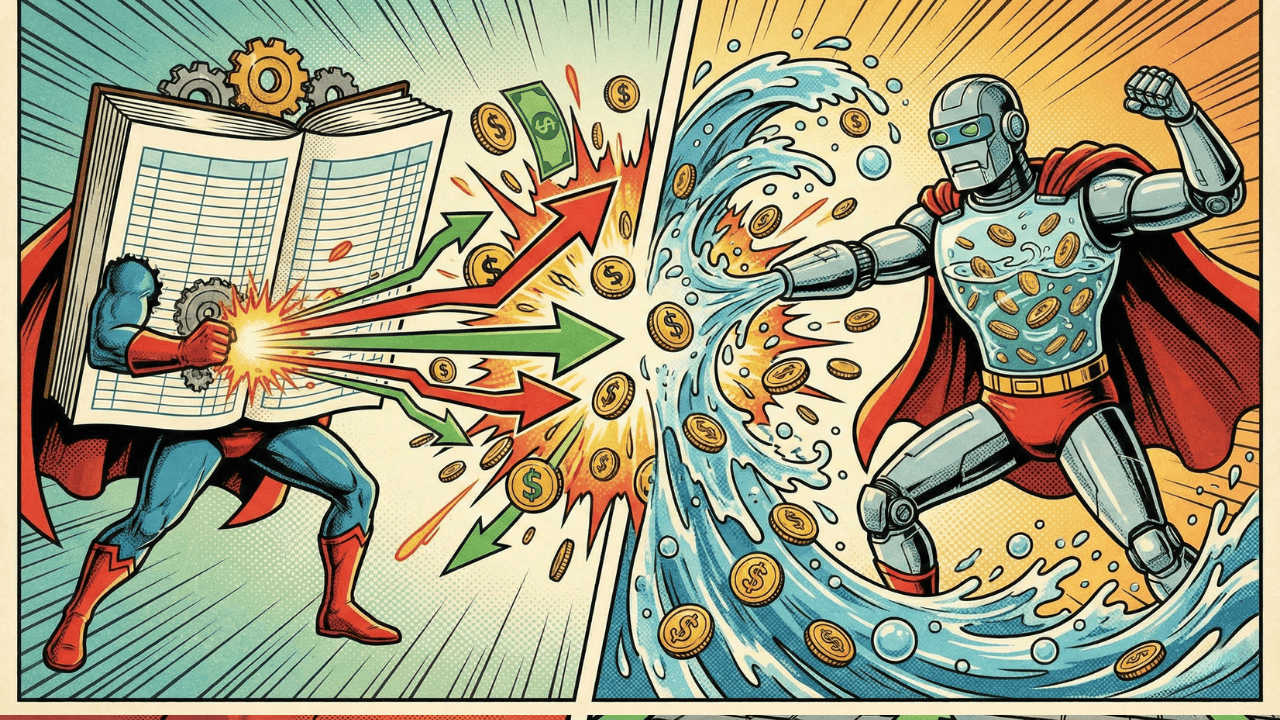
In 2026, the derivatives industry has not only matured but has become the true battleground for global liquidity. We are no longer in the days of crude experiments; today, moving billions of dollars in perpetual contracts requires surgical precision in 2026. The great doubt dividing financial architects is whether the Automated Market Maker (AMM) model—the engine that powered the birth of DeFi—can truly compete with the triumphant return of the Order book in decentralized environments.
Efficiency is non-negotiable when margins are thin. While AMMs allowed anyone to be a liquidity provider, the cost has been an efficiency against structural inefficiency that professional traders are no longer willing to tolerate. On the other hand, order books, previously limited by network slowness, have resurfaced thanks to new ultra-fast execution layers.
The battle is not just technical; it is a fight to define who offers the best price at the lowest possible cost. The AMM model was a stroke of design genius for an era of slow networks. By removing the need for active order matching, it allowed 24/7 trading without intermediaries. However, in 2026, the limits of this model are evident. The main problem is loss versus rebalancing (LVR), where passive liquidity providers end up being the “food” for sophisticated arbitrageurs.
The numbers tell us a cautionary tale. According to the FSB financial stability report from late 2025, value leakage in passive liquidity pools has grown by 30% annually. This means that while the system is robust, it is not necessarily profitable for those providing the capital. Constant value leakage occurs against high-frequency strategies that exploit every tiny price difference between markets.
For a derivatives AMM to be sustainable today, it has had to evolve into “concentrated liquidity” models or hybrid engines that try to mimic the efficiency of an order book. But at the end of the day, the AMM remains a “reactive” system, while the professional market demands “proactivity.” Latency is the silent enemy that often makes the pool model a second-tier option. Latency is the enemy of high-frequency traders.
What was once impossible on a blockchain is now the standard. Thanks to app-chain architectures and scaling solutions processing thousands of transactions per second, the Central Limit Order Book (CLOB) has returned to reclaim its throne. This is the model used by Wall Street, and for good reason: it allows market makers to place limit orders with pinpoint precision, reducing the spread almost to zero. Triumphant return of CLOB to DeFi platforms.
Under this lens, capital efficiency is orders of magnitude higher. A market maker in an order book can move their liquidity instantly to track the asset’s price—something that in a traditional AMM requires withdrawing and re-depositing funds. The Bank for International Settlements notes in its 2025 report that the migration toward decentralized order books has reduced execution costs for institutions by 45%. Reduction of institutional costs massively.
The order book is not just cheaper to operate; it is more transparent for the professional trader. You can see the market depth, understand where the “walls” are, and adjust your strategy accordingly. In an AMM, you are trading against a mathematical formula that is often inefficient during sharp volatility moves. Absolute control attracts capital seeking to manage risk with professional tools. Absolute control attracts Wall Street capital.
It’s not all black and white. There is a strong argument for model diversity. AMMs remain unbeatable for low-liquidity assets or nascent markets where there are no interested professional market makers. They function as a safety net, ensuring there is always a counterparty, however inefficient the price may be. Universal liquidity persists thanks to the simplicity of the code.
However, for major derivative pairs like BTC, ETH, or top tokenized assets (RWA), the scale tips heavily toward order books. The International Monetary Fund, in its recent 2026 digital market analysis, suggests that platform specialization is the key to systemic resilience. Platforms that try to do everything usually fail on both fronts. Digital market resilience through platform specialization.
In other words, the AMM is becoming the “general purpose” infrastructure for retail commerce, while the order book is the high-speed highway for institutional volume. This bifurcation is not a failure but a sign of maturity. The market has understood that there is no single solution for all liquidity problems. Specialization dictates the winners in the ecosystem.
One of the major concerns persisting in 2026 is how risks are managed in these vastly different models. In an AMM, risk is socialized: if the pool has bad debt due to a failed liquidation, all liquidity providers suffer. In an order book, risk is usually more segmented but critically depends on the matching engine and the platform’s insurance fund. Socialized versus segmented risk is the debate.
The challenge for decentralized order books is maintaining that decentralization. Many of these systems operate with off-chain matching engines to gain speed, introducing a trust point that many purists question. If the order engine stops or manipulates sequences, the blockchain advantage is lost. Real decentralization costs speed and technical efficiency.
Conversely, AMMs are “purely” on-chain by nature, making them more censorship-resistant but more vulnerable to arbitrageur attacks. This tension between security, speed, and cost is what will continue to define protocol upgrades through the rest of the year. Risk management rules above network architecture. What we are seeing in practice is a fusion of both worlds.
The most advanced protocols this year are implementing what they call “AMM-backed Order books.” This means an order book interface where, if no private order matches, an automated vault acts as the counterparty of last resort. If institutional capital flows continue to prefer order book platforms over the next months, we will see a massive consolidation of liquidity. Hybridization as future standard in derivatives.

