
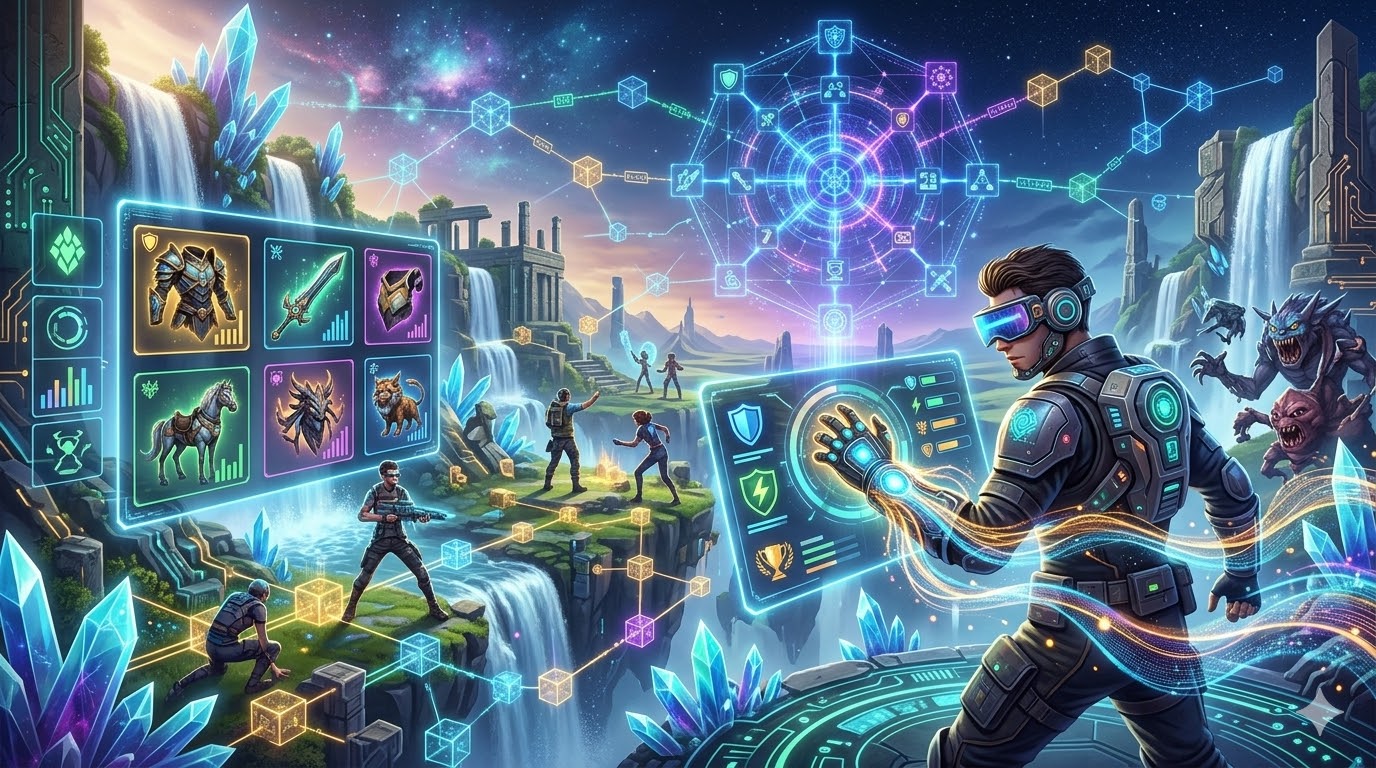
The video game industry is undergoing its most profound transformation since the invention of microtransactions. The underlying reality suggests that the extractive play-to-earn model, which dominated the initial narrative, has finally been displaced by ludic quality.
Under this prism, current relevance does not lie in how much money a player can earn, but in how sovereign asset ownership enhances the experience. Everything points to the market maturing into an ecosystem where technology is, finally, invisible.
The Sunset of the Extractive Model and the Return to Play
Far from being a coincidence, the collapse of the inflationary schemes of 2021 forced developers to rethink their strategy. The reality is that financial incentives cannot substitute for addictive and balanced gameplay that keeps players engaged.
In other words, games that focused solely on economic performance ended up as tedious digital jobs. Consequently, the Blockchain Game Alliance (BGA) reports a massive shift toward user-centered game design and engagement metrics.
While it is true that monetization remains present, the trend suggests that Web3 shifts from memecoins to machines. This implies that infrastructure now focuses on real economy processes integrated within the virtual worlds.
Invisible Integration of Technology in Game Development
The technical architecture of modern video games has taken a qualitative leap toward operational transparency. Platforms like the Game Engine Unity have integrated tools that allow managing digital assets without friction for the developer or the player.
At the same time, major corporations like Sony have explored systems for digital asset interoperability within their gaming ecosystems. This evolution allows objects obtained in one game to possess transversal value and utility across other virtual universes.
In other words, the player no longer needs to understand what a wallet or a private key is. The user experience has been simplified so much that stablecoins are the hidden engine of gaming economies, according to BGA reports.
From Speculative NFTs to Functional Asset Ownership
Under this prism, NFTs have ceased to be simple speculative images and have become functional tools. Smart contracts now allow for deep and evolutionary customization of each object, adapting to the player’s history and unique achievements.
Consequently, the rarity of a skin does not only depend on its algorithmic scarcity but on its feats. The underlying reality suggests that the market values the digital asset’s history more than its immediate resale price on the market.
In other words, ownership is secondary to the digital identity the player builds over time. Reports from the Ubisoft Strategic Innovation Lab highlight that long-term commitment is based on the emotional connection with achievements.
Interoperability and the Birth of the Living Metaverse
The vision of a fragmented and sterile metaverse has given way to worlds interconnected by necessity. The ability to move a sword or a ship between different titles is the true catalyst for retention of users in 2026.
Far from being a utopia, the standardization of protocols allows virtual worlds to breathe together. While it is true that each game maintains its artistic autonomy, the shared value layer creates an extremely robust global digital economy.
At the same time, the Epic Games Store policy regarding transparency in blockchain games has fostered healthy competition. This openness allows independent studios to innovate with community governance mechanisms without the fear of arbitrary censorship.
The Future: Fun as a Sovereign Asset in DeFi
The reality suggests that we will witness a total fusion between entertainment and low-impact decentralized finance. The success of Gaming Web3 will depend on the player not perceiving investment, but rather the deep gratification of their progress.
If the integration of decentralization tools continues at its current pace, the traditional “software rental” model will die. Conversely, if technical complexity persists, the sector could retreat toward closed systems that are far less democratic.
Ultimately, the real benefit of Gaming Web3 is the return of power to the creator and the user. As long as fun remains the primary driver, blockchain technology will be fuel for the next great global cultural revolution.
Next step: Would you like me to analyze the specific economic impact of the top 3 Web3 games slated for release in the second half of 2026?

