
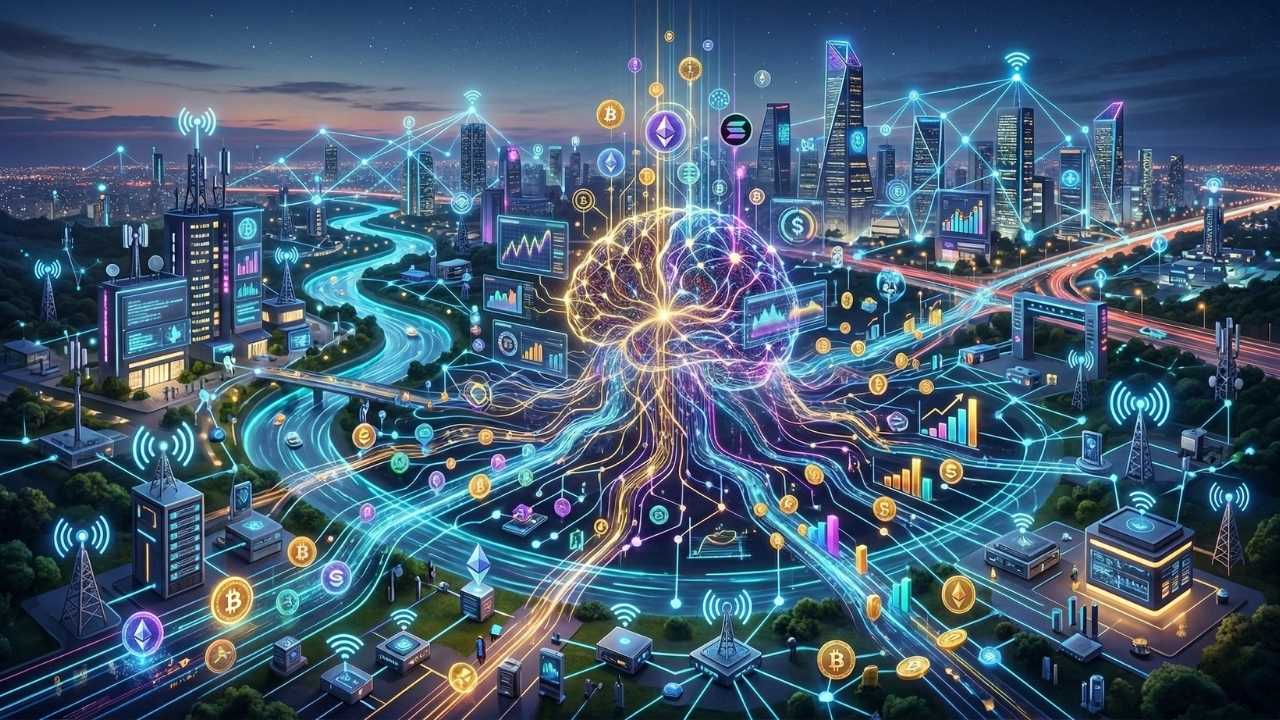
The integration of DePIN and AI represents a paradigm shift that goes beyond the simple issuance of assets without physical backing. This convergence proposes a utility model where physical infrastructure joins intelligent processing to redefine the sector’s value in the current financial landscape.
As the market matures, the focus is shifting from yield farming toward the provision of tangible resources. The rise of DePIN and AI responds to an unprecedented global demand for computing power and storage distributed across networks, which technology companies urgently require for their daily operations.
Capital Migration Toward Decentralized Computing
The financial architecture is mutating toward a model where hardware serves as the primary collateral. Everything points to the growth of DePIN and AI allowing the 10 billion dollar sector to consolidate through the tokenization of critical physical resources for the technological development taking place this year.
Under this prism, cloud computing is ceasing to be a monopoly of large centralized corporations. The combination of DePIN and AI facilitates that any hardware provider can monetize their excess capacity efficiently, eliminating unnecessary intermediaries and significantly reducing operational costs for all end users involved.
In other words, the decentralized financial ecosystem is finding its purpose beyond the exchange of digital tokens. The relevance of DePIN and AI lies in its ability to sustain the digital fabric through sensor networks, processors, and massive storage managed by open-source protocols.
Hardware Decentralization for Model Training
Training large-scale intelligence models requires power that few can afford individually. Consequently, DePIN and AI protocols are democratizing access to graphics processing units, allowing for an equitable distribution of power computational resources among diverse and verifiable global nodes within the network.
Far from being a coincidence, projects like the Render Network demonstrate that rendering and processing can be executed in a distributed manner. The symbiosis between DePIN and AI allows high-fidelity rendering to be accessible to independent developers worldwide without the usual geographic restrictions.
While it is true that latency remains a technical challenge, network optimizations are mitigating these issues. The DePIN and AI proposal utilizes consensus algorithms to guarantee data integrity, ensuring that processing results are accurate and resistant to censorship from any central authority.
From Traditional Mining to Computational Value Contribution
The concept of mining has evolved from simple cryptographic puzzle solving toward practical utility tasks. The DePIN and AI ecosystems incentivize participants to offer connectivity services or processing that feeds real-world applications in strategic sectors such as logistics or global transport.
The Bittensor whitepaper describes an intelligence market where the exchange of knowledge is the central axis. The DePIN and AI infrastructure allows different machine learning models to collaborate and compete simultaneously, raising the standard of efficiency in the production of intelligent responses.
At the same time, storage infrastructure like that proposed in the Filecoin technical document complements this advancement. The need for DePIN and AI to store vast training data sets finds in decentralization a barrier against information loss and the centralized control of global data.
The Risk of Centralization in Physical Infrastructure
History proves that systems depending on physical hardware face risks of geographic concentration. During 2017, Bitcoin mining suffered criticism for its centralization in specific regions, a phenomenon that DePIN and AI developers seek to avoid through strictly designed global distribution incentives.
In 2021, the rise of sensor networks showed that scalability depends on massive citizen participation. The IoTeX protocol illustrates how to connect the physical world with the digital, ensuring that DePIN and AI do not depend on a single point of failure.
Critics suggest that traditional corporations like AWS will always maintain a scale cost advantage. However, the structure of DePIN and AI eliminates corporate profit margins, allowing the final price to be determined solely by the actual supply and demand of available computational resources.
Scalability Projections for the DePIN and AI Ecosystem
The long-term viability of these projects depends on their ability to attract demand from outside the crypto sector. If the use of DePIN and AI captures just 5% of the global cloud computing market, capital flows will exceed any previous bull cycle recorded in history.
Different proposals, such as those detailed in the Akash Network whitepaper, propose decentralized clouds for application deployment. The growth of DePIN and AI will facilitate that infrastructure deployment is faster and cheaper than traditional methods of hiring physical servers in data centers.
If the energy efficiency of these processes improves by 20% annually, institutional adoption will be inevitable. The success of DePIN and AI will be measured by its ability to silently integrate into services that millions of people use daily without perceiving the underlying technology.
If processing demand flows remain above current levels for the next three quarters, technical consolidation is a fact. The analyzed technological intersection suggests that infrastructure will be the most valuable asset of the decade.

