
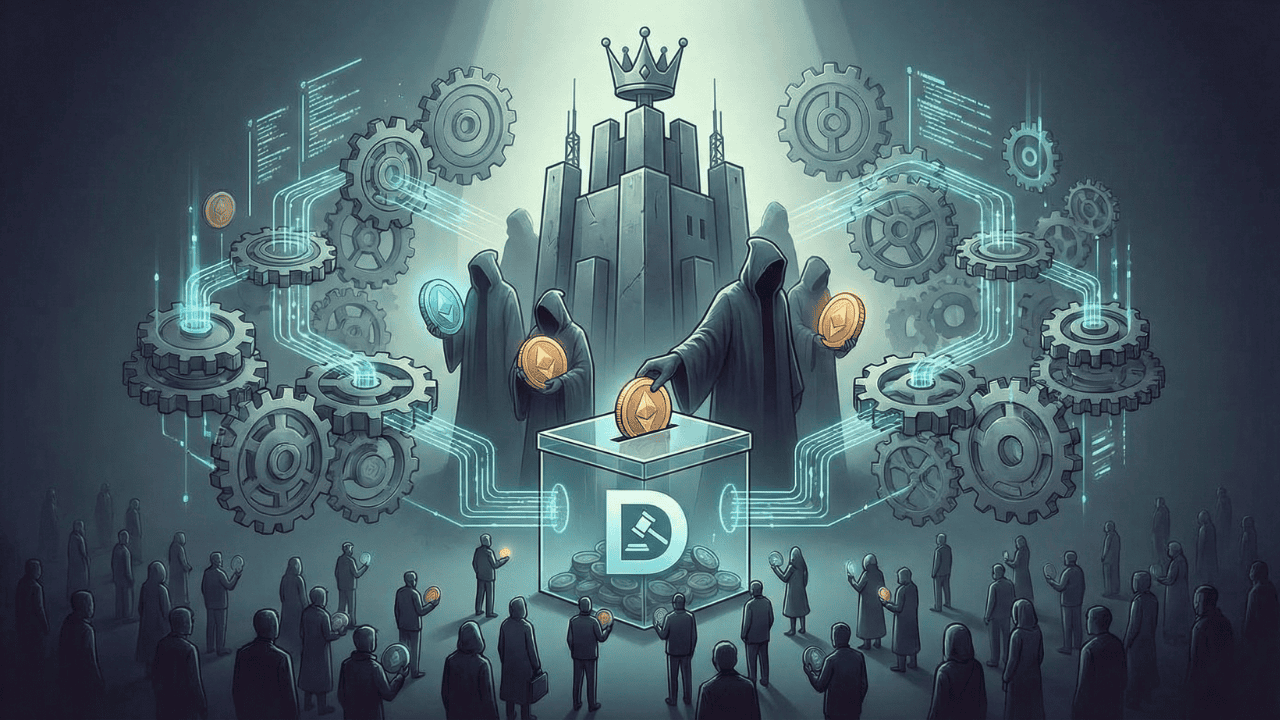
The foundational narrative of decentralized finance (DeFi) rests on the promise of unprecedented financial democratization. Under this lens, token-based governance was presented as the ultimate tool to transfer control of protocols from traditional boards to a global, dispersed community. However, the underlying reality suggests we are facing a transition of financial oligarchies toward a new form of technical plutocracy, where decentralization is, in many cases, a rhetorical resource rather than a functional operational architecture.
The current consensus celebrates the ability of any user to propose changes within an ecosystem but systematically ignores the capital entry barrier. While on-chain transparency allows for auditing every move, the “one token, one vote” structure has replicated the vices of traditional capital markets. Far from being a coincidence, this architecture encourages accumulation, allowing a handful of wallets—often linked to venture capital firms—to dictate the direction of projects managing billions of dollars in total value locked.
The Tyranny of Capital over Code
The validity of a governance system does not reside in the technical possibility of voting, but in the equitable distribution of influential capacity. Participation data in major protocols reveal an alarming gap. According to governance records on platforms like Tally or the Uniswap Governance dashboards, a minority of addresses control the vast majority of decision-making power. This concentration is not just a byproduct of the market, but an intrinsic feature of initial emission models, where founding teams and early-stage investors retain percentages that nullify any minority initiative.
The reality is that progressive decentralization often remains stuck in theory. When a protocol reaches critical maturity, the incentives to dilute control diminish, consolidating what some analysts call “governance theater.” In this scenario, proposals are approved with minimal quorums and derisory participation, leaving strategic decision-making in the hands of entities with enough liquidity to tip the scales. This raises a fundamental question: Can a system be considered decentralized where voting power is proportional to accumulated wealth?
The Weight of Institutional Investors and Protocol Capture
The massive entry of institutional capital has transformed the dynamics of Decentralized Autonomous Organizations (DAOs). If we observe governance flows in lending or exchange protocols, it is evident that venture capital firms act as the new central banks of DeFi. By holding large blocks of governance tokens, these entities can veto security updates or modify risk parameters according to their immediate financial interests. This governance capture by whales undermines the principle of censorship resistance, as the protocol becomes vulnerable to regulatory pressures exerted on those large holders.
In other words, current governance resembles a corporate structure of preferred shares more than a digital democracy. The concept of sufficient decentralization according to the SEC, mentioned in historical speeches on the nature of crypto-assets, seems increasingly distant from the operational praxis of leading protocols. If effective control resides in three or four decision nodes, the risk of collusion increases exponentially, invalidating the premise of a permissionless system robust against external or internal attacks.
Historical Evolution: From the DAO Hack to Voter Apathy
To understand the present, it is imperative to look back. In 2016, the event known as The DAO Hack marked a before and after in the perception of governance. That vulnerability was not just a code failure, but a failure in managing expectations about who should intervene when the system fails. Later, in the 2020 “DeFi summer,” we saw the rise of liquidity mining, which flooded the market with governance tokens distributed to users, but over time, those assets returned to the deepest liquidity centers through pure economic gravity.
Historically, systems that reward capital exclusively tend toward centralization. Comparing the current cycle with that of 2017, the sophistication of voting tools has improved, but real participation has decreased significantly in percentage terms. The apathy of the minor voter is not a lack of interest, but a rational response to the irrelevance of their actions against the massive positions of investment funds. Consequently, history teaches us that without identity resistance mechanisms or quadratic voting, technical decentralization is merely an ideological layer of varnish over a traditional financial base.
Plutocratic Efficiency vs. Atomized Democracy
However, an intellectually honest look requires considering the benefits of this power concentration. Proponents of current models argue that de facto centralization allows for more agile decision-making in times of crisis. A purely democratic and atomized system could suffer from decision paralysis that, in the volatile environment of finance, would be fatal. Large holders, having more skin in the game, are incentivized to ensure the long-term success of the protocol, as a poor decision would destroy the value of their own assets.
From this perspective, vote concentration is not a defect, but a feature that provides stability. If control were distributed among thousands of small users without technical or financial knowledge, the protocol could fall victim to populist narratives or low-cost economic governance attacks. In this scenario, the “participatory illusion” serves as a legitimizing mechanism, while strategic direction remains professionalized, ensuring that code updates and risk policies follow standards of rigor that a dispersed community could hardly maintain unanimously.
Toward a Redefinition of Decentralized Legitimacy
The survival of DeFi as an alternative to the traditional financial system depends on its ability to resolve the governance paradox. The underlying reality suggests that the current model is exhausted; continuing to insist that possession of an asset equals democratic representation is to ignore centuries of political and economic theory. It is imperative to explore mechanisms such as quadratic voting or soulbound tokens to separate, at least partially, decision-making power from capital accumulation.
If institutional capital flows continue to dominate 80% of the voting power for the next two years, the decentralization narrative will lose its traction with regulators and the general public. Conversely, if we manage to implement systems where technical merit and active participation weigh more than a wallet balance, DeFi could finally claim its status as a truly equitable financial infrastructure. Otherwise, we will have built the most sophisticated financial system in the world only to hand the keys back to the same usual actors.

