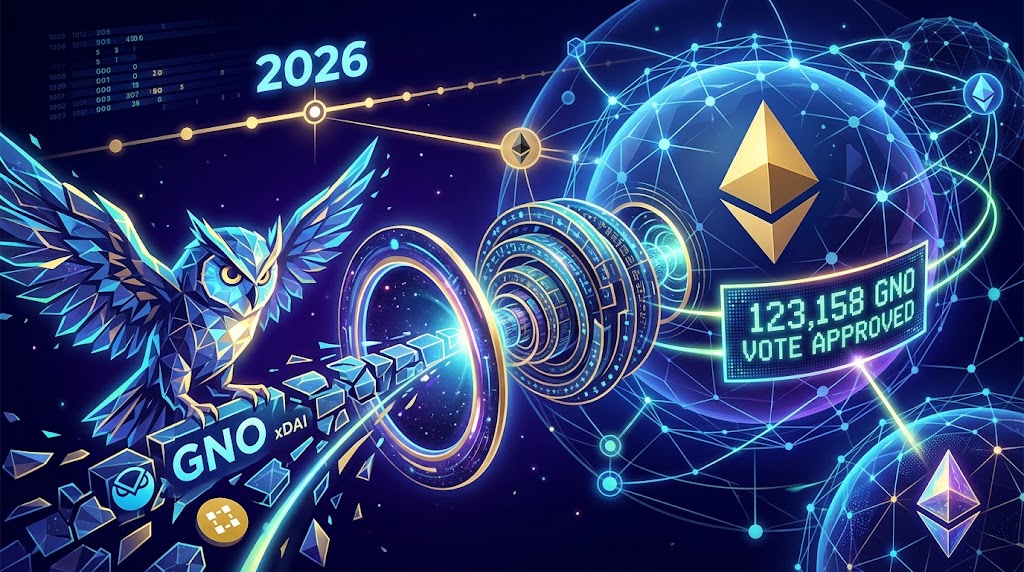
On August 20, 2026, the decentralized governance community GnosisDAO formally approved transitioning its standalone layer-1 network. The official decision was announced in a Gnosis Chain official post, confirming its upcoming migration into the Ethereum Economic Zone.
GnosisDAO has approved Gnosis Chain's transition from a standalone Layer 1 into a ZK-proven Ethereum Economic Zone rollup.
GIP-153 results: 123,158 for, 115 against, 151 abstaining, from 54 voters. Turnout was 123,425 against a quorum of 75,000. https://t.co/Pi18HOuE9G
— Gnosis (@gnosis_) August 19, 2026
The governance vote concluded with 123,158 GNO tokens in support, 115 votes against, and 151 abstentions across 54 participating entities. Total voter turnout reached 123,425 GNO, comfortably surpassing the required 75,000 token quorum threshold.
Under this architectural restructuring, Gnosis Chain validator set will be retired to settle transaction state directly on Ethereum. The network will officially transition into a layer-2 rollup verified by zero-knowledge cryptographic proofs.
Technical integration and synchronous smart contract execution
Detailed parameters of this migration were outlined within the GIP-153 governance proposal. The technical roadmap targets an initial deployment between late 2026 and early 2027, contingent upon technological readiness.
The upgrade will enable native smart contracts to call Ethereum and process execution results within the same transaction. This synchronous composability grants direct access to base-layer liquidity within an environment optimized for decentralized applications.
Current layer-2 networks lack this synchronous execution capability, forcing decentralized applications to rely on multi-step bridging mechanisms. The new framework allows contracts on different rollups to interact atomically without multi-block latency or third-party relayers.
The Ethereum Economic Zone architecture is developed jointly by Gnosis and ZisK, backed by Ethereum Foundation funding. The initiative intends to solve ecosystem fragmentation caused by isolated rollups that separate liquidity, users, and infrastructure across disparate ledgers.
Despite transitioning into a zero-knowledge rollup, Gnosis Chain will retain its existing decentralized applications, user account balances, and xDAI as the native gas token. Developers and end users will not need to execute manual asset migrations.
Security considerations and reduced cross-chain bridge dependency
Eliminating external bridging mechanisms addresses structural vulnerabilities across decentralized protocols. Previously, infrastructure security incidents such as the Gnosis Pay delay module exploit highlighted the operational risks inherent in complex smart contract modules and multi-layer asset routing.
Ethereum co-founder Vitalik Buterin warned on February 3, 2026, about security risks stemming from centralized sequencers and trusted bridging systems. Buterin stated that the original vision for layer-2 networks required fundamental revisions to maintain base-layer security.
Data from tracking platform L2Beat shows that 22 rollups secure 27.82 billion dollars, while the total value secured across all scaling protocols, including validiums and optimiums, stands at 34.88 billion dollars.
Geoffrey Kendrick, global head of digital assets research at Standard Chartered, noted in a May 28 report that the EEZ will reduce bridge reliance, substantially improving asset usability across Ethereum Virtual Machine networks.
Kendrick explained that synchronous interoperability enables smart contracts on different participating networks to interact atomically within a single transaction, significantly reducing security exposure to compromised liquidity pools and smart contract vulnerabilities.
Production rollout of Gnosis Chain as the flagship EEZ instance depends on ZisK cryptographic technology readiness and rigorous security audits before its targeted deployment in late 2026 or early 2027.
Once deployed, the network will serve as a testing benchmark for the broader Ethereum ecosystem, demonstrating whether zero-knowledge rollups can effectively eliminate execution fragmentation without sacrificing transaction speed or increasing operational costs.
This article is for informational purposes only and does not constitute financial advice.