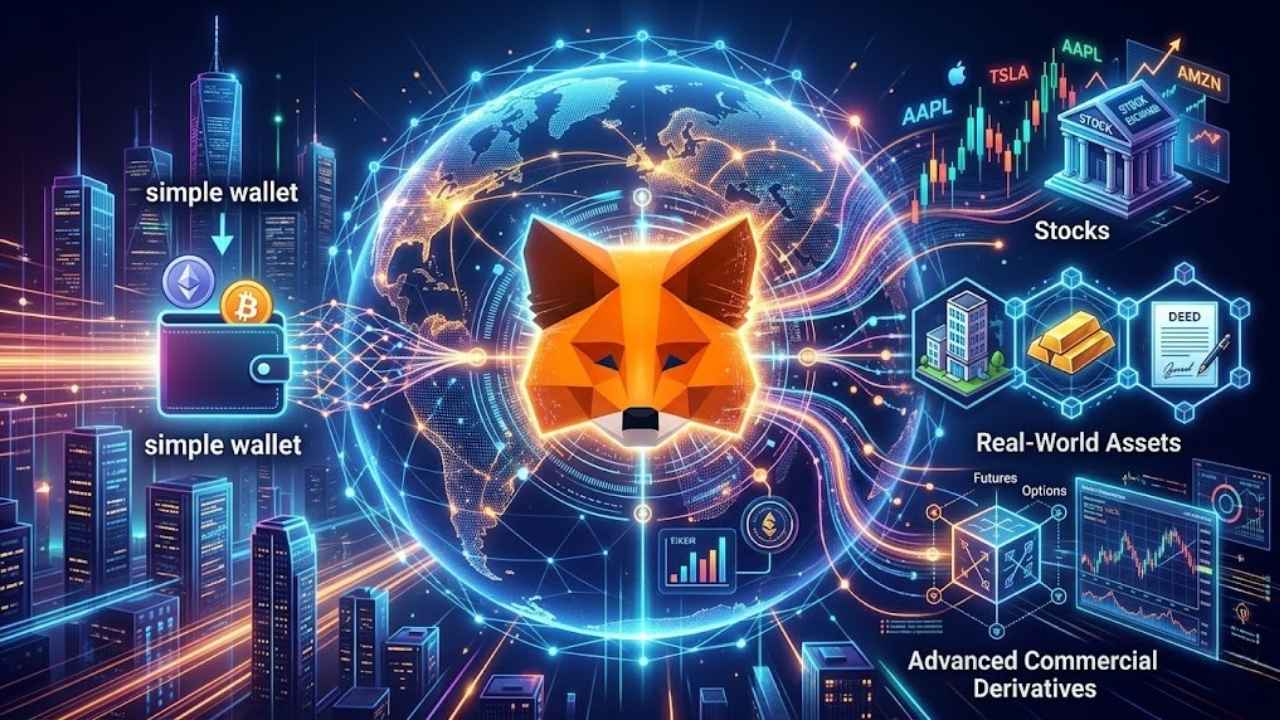
During the last decade, the dominant narrative labeled crypto wallets as simple storage tools for tokens and digital collectibles. However, current infrastructure shows a radical metamorphosis. MetaMask leads this structural transition, rapidly evolving into a truly unified global financial interface.
Understanding this evolution is critical today because it definitively blurs the technological boundary between decentralized markets and traditional institutional finance. This transition forces banking giants to reconsider their operational strategies, as users now demand to operate without intermediaries or borders within a single digital environment.
The capacity to execute complex financial operations while maintaining self-custody forever redefines counterparty risk. Modern users reject the walled gardens of the traditional system, preferring transparent ecosystems that offer total control, continuous access, and immediate frictionless settlement.
This paradigm shift is supported by operational milestones recently documented by the application’s core developers. An official report covering real-world asset tokens details that users can explore hundreds of tokenized American equities, commodities, and exchange-traded funds without ever leaving the platform interface.
This direct integration effectively bypasses the complex, bureaucratic, and extremely slow registration processes traditionally imposed by international brokerage firms. Global operators now access American stock market liquidity leveraging high-performance decentralized blockchain networks with minimal commercial friction across the board.
The profound depth of this new service offering rapidly extends to the execution of highly sophisticated derivative contracts. Technical documentation detailing new support for perpetual contracts and financial derivatives demonstrates that traders can now open advanced leveraged long or short market positions securely.
The final settlement of these accumulated trading profits occurs directly in digital dollars from almost any operational jurisdiction permitted internationally. This technological advancement vastly democratizes access to advanced hedging tools that were traditionally restricted to hedge funds and specialized corporate institutional accounts.
In previous decades, global investors strictly required multiple centralized intermediaries to diversify their asset portfolios efficiently: a commercial bank for fiat capital, a licensed broker for corporate equities, and a centralized exchange for the digital assets of the new economy. Today, this operational fragmentation is entirely and painfully obsolete.
The modern digital architecture closely emulates the massive market consolidation that electronic commerce platforms experienced at the beginning of the century. Modern financial tools are successfully concentrating total global liquidity and speculative instruments within a single, truly globalized, and strictly neutral unified access point.
This massive expansion of the operational portfolio toward traditional global markets would not be remotely possible without high-caliber institutional strategic partnerships. This is precisely why MetaMask integrates tokenized US stocks through specialized liquidity providers, allowing operators to swiftly rotate capital from volatile assets toward safe traditional havens.
The immense magnitude of this structural market transformation is directly reflected in the growing adoption of these atomic settlement technologies. Updated corporate data officially presented through the Consensys ecosystem and Trustware infrastructure validates that the decentralized platform currently serves over one hundred million active global users.
These staggering adoption metrics firmly consolidate the software application as the most widely utilized non-custodial financial consumer platform worldwide. Surpassing one hundred million active users represents a fundamental inflection point where broad interconnected infrastructure begins to aggressively compete against the commercial interbank settlement system.
The Risk of Consolidating the Interface
Despite the glaring operational benefits of this immense commercial consolidation, the contrarian view strongly warns against a highly dangerous level of technological dependence. Critics logically argue that concentrating broad access to multiple global markets through a single primary interface inherently creates a single point of failure.
If the underlying software infrastructure suffers a prolonged and critical service interruption, millions of active retail users would be temporarily locked out and highly vulnerable. They could not swiftly manage their financial risk exposure, adjust leveraged trading positions, or move funds toward safe havens during high macroeconomic volatility.
This highly cautious perspective remains completely valid when objectively considering the profound technical complexity of the smart contracts deeply involved in these interconnected financial settlements. The absolute reliance on external price oracles and cross-chain liquidity bridges introduces severe systemic risks that retail investors rarely comprehend entirely in practice.
However, the structural insecurity thesis would completely lose its functional validity if the underlying network architecture successfully decentralizes its routing points and drastically reduces reliance on single specialized service providers. If scalable zero-knowledge cryptographic proofs are broadly implemented, the technical censorship risk would vanish almost entirely from the trading environment.
A New Operational Paradigm
The rapid maturation of these advanced financial tools actively progresses to democratize global capital access in a profound, irreversible, and unprecedented manner. Citizens of emerging economies now possess the valuable capacity to effectively protect their wealth by acquiring small fractions of global stock market indices seamlessly, bypassing local banking restrictions.
These robust technological integrations finally allow a remote worker in the southern hemisphere to interact under the exact same structural conditions and technical advantages as massive Wall Street hedge funds. Absolute financial equality of opportunity ceases to be a theoretical utopian dream to become mathematically verifiable public open-source code.
Retained capital efficiency is vastly maximized when modern cryptographic protocols aggressively eliminate the outdated settlement times previously required by conventional stock exchanges. A rigorous technical analysis covering the booming real-world asset market reveals that the total institutional value distributed in this specific category recently surpassed thirty-one billion liquid dollars.
This extraordinary and sustained market growth is directly driven by the advanced new algorithmic capacity to flawlessly execute instant, atomic financial settlements exactly twenty-four hours a day. Global financial markets simply no longer close on Friday afternoons, radically transforming massive-scale international institutional liquidity management worldwide.
If the sustained commercial adoption of tokenized real-world assets maintains its current aggressive growth rate and key international regulatory jurisdictions approve friendly legal frameworks, then unified decentralized financial interfaces will capture over twenty percent of traditional retail trading volume before the definitive closure of the current decade.
This article is for informational purposes only and does not constitute financial advice.