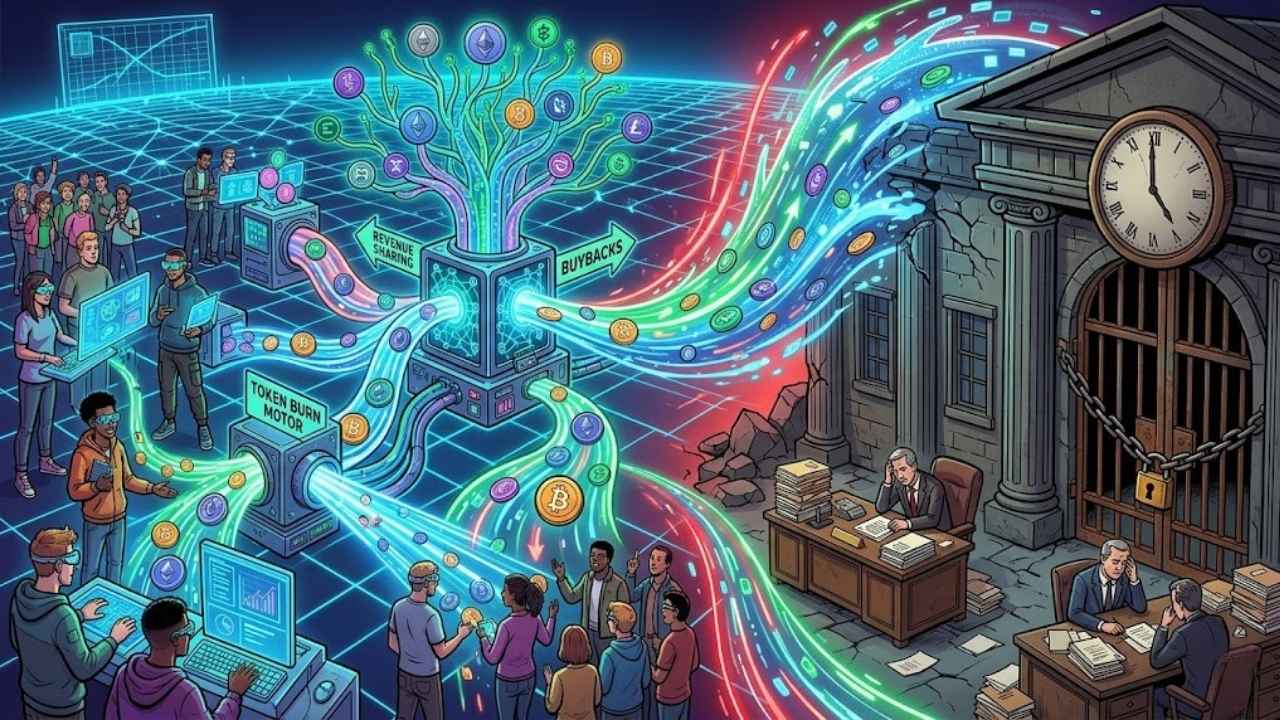
The cryptocurrency market is abandoning empty speculation to adopt real value mechanics. Against the dominant narrative focusing on exchange-traded funds, the true transformation happens on-chain. The DefiLlama decentralized volume reports show that digital asset protocols are integrating traditional financial structures to retain capital.
This transition matters now because users demand tangible yields. The initial enthusiasm for governance rights without economic value has completely vanished. Investors demand consistent cash flows to sustain long-term valuations and effectively prevent aggressive dilution of the underlying protocol tokens over extended periods.
A clear case is the decentralized finance ecosystem, where platforms like Hyperliquid lead the evolution. Their economic model distributes trading fees directly to participants. According to the official Hyperliquid development documentation, liquidity providers capture the value generated organically by platform operations.
The implementation of token buybacks and revenue distribution completely changes the paradigm. Protocols no longer depend on temporary inflationary emissions, but utilize real capital to appropriately reward truly active and loyal users within their specific decentralized networks and expanding financial ecosystems.
By observing the evolution of decentralized exchanges, we notice fundamental operational maturation. Institutional investors evaluate these platforms using standardized and precise financial metrics. A recent analysis on institutional adoption demonstrates that sustainable profitability acts as the primary catalyst for retaining corporate capital.
Buyback mechanics reduce circulating supply and increase asset scarcity. This design accurately mimics corporate stock buyback programs, establishing a fundamentally grounded valuation floor. Scarcity drives structural financial stability against unpredictable macroeconomic fluctuations and broader market liquidity contractions effectively.
Empirical data supports this migration towards economically sustainable models. On-chain revenue metrics show a direct correlation between fee distribution and prolonged user retention. Advanced analytical records demonstrate that these specific protocols maintain superior operational volumes during severe and prolonged market contractions.
Adopting these schemes radically transforms the relationship between the user and the platform. Direct economic incentives align the interests of all participants, creating a much more robust and highly resilient financial ecosystem capable of withstanding intense external pressure and sustained volatility.
The debate over real token value
The transition toward profit distribution faces significant regulatory friction today. The contrary vision argues that granting dividends automatically classifies these assets as traditional financial securities. Regulation threatens modern economic design of any projects that decide to distribute passive tokenized rents to active holders.
This counterpoint remains valid given historical scrutiny over investment schemes. The SEC framework for digital assets explicitly states that the expectation of profits derived from third-party efforts is decisive for strictly applying traditional securities laws to decentralized blockchain networks.
If financial authorities definitively decide to classify these novel models as regulated instruments, the accelerated adoption thesis would be invalidated. Platforms would have to restrict retail access, severely limiting global liquidity and fragmenting decentralized markets according to various local operative jurisdictions globally.
Developers face the complex dilemma of maximizing economic incentives without crossing legal lines. Current on-chain regulatory compliance strategies seek to clearly separate voting rights from direct economic rewards.
Despite significant ongoing regulatory risks, open liquidity continues to actively reward profitable protocols. Capital allocators deliberately prefer to assume legal uncertainty in exchange for transparent yields, systematically discarding projects that issue utility tokens merely to finance their internal operations opaquely.
Toward a sustainable economic model
The sector’s maturation demands abandoning empty technological promises. Commercial success proves that efficient execution outweighs the media impact of exchange-traded funds. Performance heavily outweighs pure speculation in this definitive institutional phase, marking a clear turning point for the industry.
Traditional economics has thoroughly documented the benefits of reducing circulating supply. The NBER study on corporate buybacks details how decreasing outstanding shares fundamentally improves valuation metrics, an empirical economic principle that decentralized digital asset protocols now apply highly successfully today.
Integrating these mechanisms purges the ecosystem of highly inefficient participants. Projects unable to generate cash flow will disappear. Capital will flow exclusively toward architectures offering verifiable returns and total alignment between active users and core software network operators.
The profound implications of this structural shift will permanently redefine digital asset design. It is no longer enough to publish technical innovation; founders must build profitable businesses early. Profitability is the only valid moat against ruthless market competition and broader institutional investor apathy.
The current liquidity cycle demands strict fiscal discipline. Protocols that implement constant buybacks strengthen their operational treasuries and guarantee long-term survival, operating completely independently of the general direction of the broader cryptocurrency market on a truly massive global macroeconomic scale.
The transparency offered by public accounting on decentralized networks facilitates this rigorous validation. Analysts can audit protocol revenues in real time, effectively eliminating the information asymmetry that for decades has affected traditional financial markets and all legacy corporate reporting institutions.
This constant verification forces developer teams to maintain absolute excellence. Operational transparency guarantees user trust, creating a powerful cycle where value distribution attracts greater liquidity and inherently generates truly organic and economically sustainable structural growth across all participating financial networks.
If decentralized exchanges applying novel revenue-sharing models manage to sustain more than forty percent of institutional commercial volume for twelve continuous months, the main governance protocols will be absolutely forced to restructure their tokenomics by incorporating automated open-market buybacks immediately.
This article is for informational purposes and does not constitute financial advice.