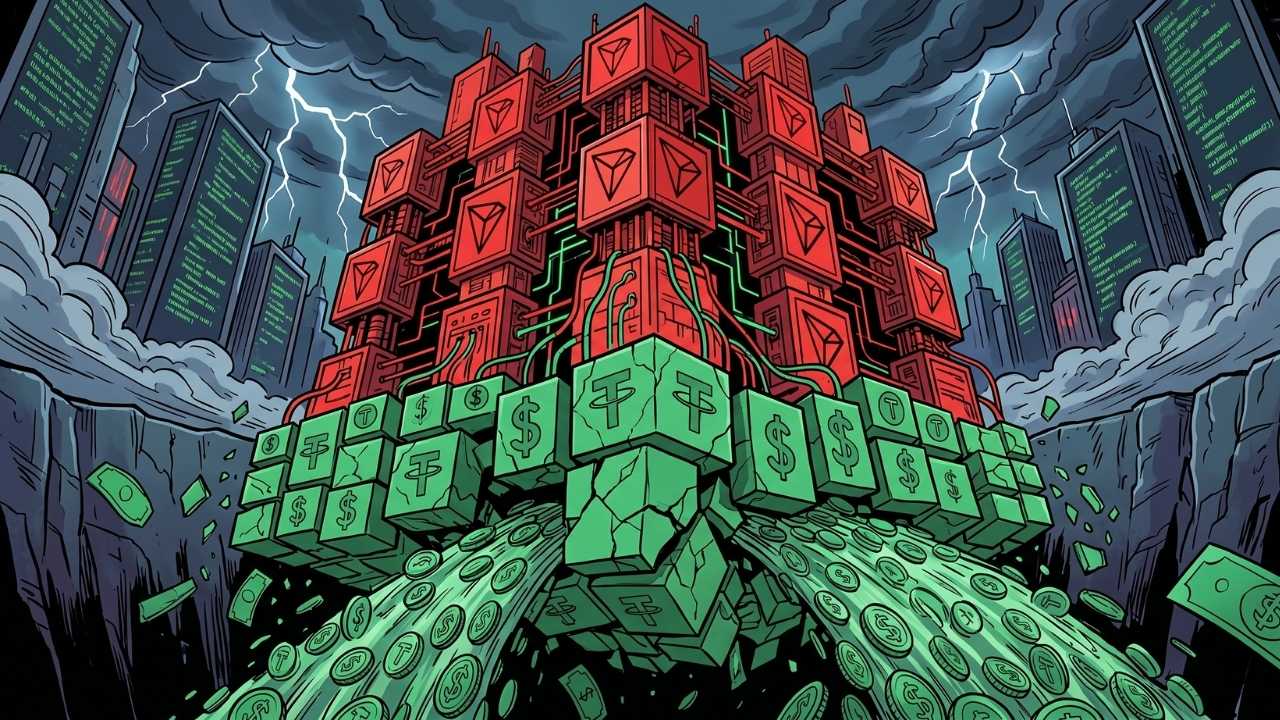
The viability of TRON as a foundational layer network depends on its almost exclusive function as a settlement channel for USDT. While the dominant narrative highlights high operational profitability, technical reality proves that TRON acts as a liquidity vehicle for external fiat issuance.With the rapid expansion of stablecoins across global markets and intense regulatory scrutiny, understanding this technical reliance defines the actual risk profile of the entire underlying network ecosystem.
If the stablecoin issuer decided to shift primary settlements toward alternative networks featuring lower latency and an institutional focus, the economic volume of the blockchain would experience a severe contraction almost instantaneously.
Over fifty percent of the global supply of the leading stablecoin operates securely on this specific infrastructure. The official balances documented on the official Tether transparency page register tens of billions of dollars authorized strictly through the TRC-20 technical token standard.
This vast concentration of fiat-backed digital money establishes a clear separation from other decentralized platforms. The protocol sustains internal economics by consuming computing resources generated exclusively by individuals who transfer funds across international borders every single day.
Evolution of digital fiat rails
During previous bullish market cycles, the Ethereum infrastructure hosted almost the entirety of global stablecoin commerce. However, execution fees rapidly exceeded tolerable limits for retail operations, forcing users to seek viable, low-cost settlement alternatives immediately for low-denomination digital payments.
TRON captured this unmet market demand by guaranteeing inexpensive and instantaneous financial settlements. The network rapidly consolidated its position as the default payment rail in emerging economies, where individuals prioritize efficient value transfer over the absolute purity of architectural node decentralization.
The global traction of the underlying asset thoroughly supports the massive adoption of this network. Recent operational data detailing how Tether tops 500 million users clearly highlights the central role of swift value transmission in protecting capital against severe inflation within local financial markets.
The practical utility of the Asian ecosystem is fundamentally reduced to the continuous international relocation of digital dollars. Decentralized financial applications and independent lending protocols host a minuscule fraction of the total native liquidity compared to continuous cross-border retail remittances.
Institutional research reports clearly affirm this established operational trend. A detailed assessment covering sector projections inside the Messari official outlook document strictly categorizes digital dollars on this blockchain as a genuine top-tier product within the broader international digital asset market.
A competitive risk assessment argues that this high concentration of operations does not represent a design flaw, but rather an insurmountable structural advantage. The defensive position asserts that the market values cheap transfers far above the development of complex algorithmic smart contracts.
This counterpoint retains significant analytical validity over the short-term landscape. End users face considerable technical friction when attempting to migrate funds toward second-layer networks, preferring the proven familiarity and immediate execution speed of the current established technological environment for their daily operations.
Nevertheless, this apparent strength would dissipate rapidly if the centralized issuer applied preventive blocks due to legal demands. Freezing addresses would demonstrate that the network lacks inherent retention and investors would abandon the validator nodes immediately to protect their liquid digital capital.
International scrutiny and operational dynamics
The deflationary dynamic of the native cryptocurrency relies heavily on the constant consumption of computational network resources. Without the traffic generated by transferring dollar-equivalent balances, the incentive structure for validators would face a severe financial failure in a very short timeframe.
Regulatory pressures on these specific transactions escalate continuously on a global scale. The detailed United Nations Office on Drugs and Crime report outlines the employment of the network within underground banking systems to process opaque capital flows across multiple Southeast Asian territories.
The consequences of these immense value flows force international regulators to intervene directly at fiat access points. Government agencies demand strict surveillance over the architecture, elevating the probability of transaction censorship executed directly through the underlying stablecoin smart contracts.
The financial conglomerate behind the currency also seeks to mitigate its own structural exposures. This diversified approach is verified when the Tether Gold market cap hited 3.3 billion, expanding the issuer’s frontiers toward the digital representation of physically backed precious commodities across the digital landscape.
Institutional adoption of alternative networks exerts direct pressure on the predominant market share. Performance-oriented chains actively implement direct fee subsidies to capture the cross-border retail remittances that currently sustain the entire transactional volume of the existing foundational operational protocol.
Account abstraction across alternative platforms promises to facilitate fluid interaction with underlying technical systems. When mobile wallets offer free international payments without requiring gas tokens to cover network fees, merchants will seamlessly switch execution environments to obtain greater business profitability.
If second-layer ecosystems manage to maintain zero execution costs and scale their throughput sustainably over the coming months, then the stablecoin transfer volume on the current chain will experience a statistically measurable and sustained outflow of fiat-backed digital liquidity.
The decision of the retail market to conserve liquid capital within a specific network will strictly respond to operational financial margins. True cost savings dominate mainstream adoption, completely discarding any long-term ideological commitment to the foundational digital infrastructure protocol.
The system architecture requires a permanent flow of transfers to subsidize block rewards effectively. Any disruption in activity related to digital dollars represents a systemic financial shock that severely tests the comprehensive resilience of the entire main blockchain network.
This article is for informational purposes and does not constitute financial advice.