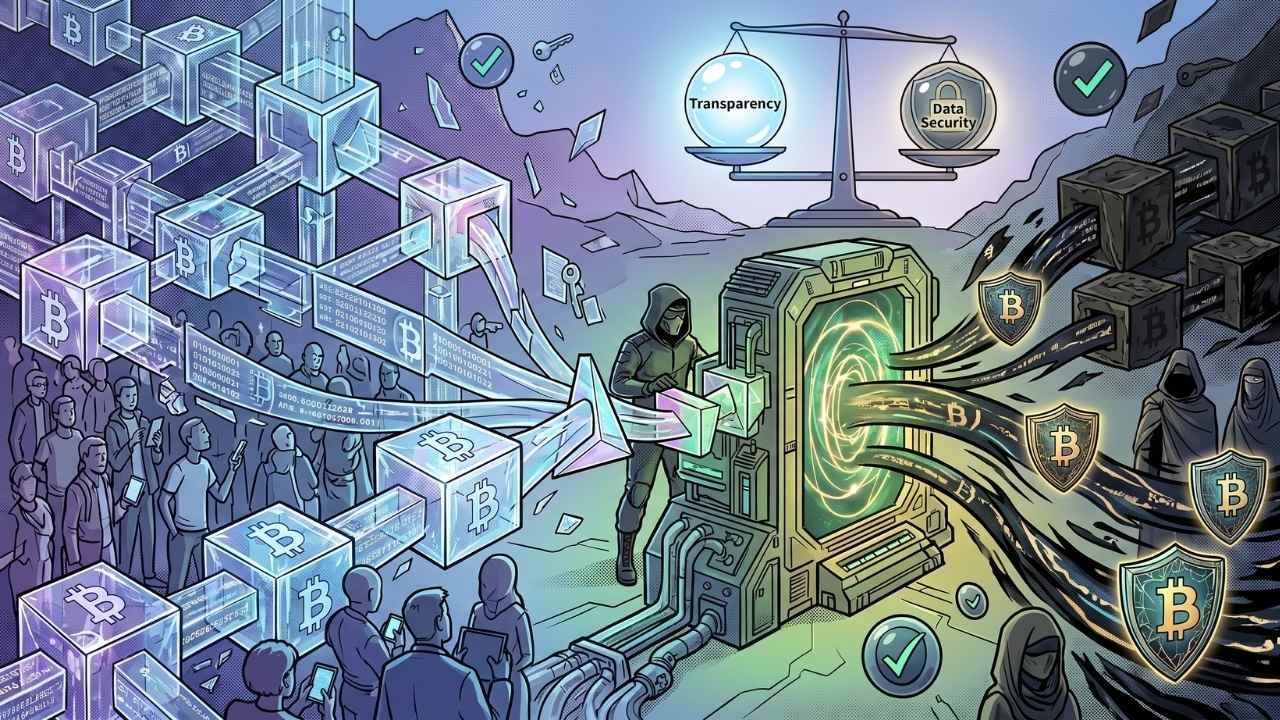
The integration of Zero-Knowledge (ZK) technologies into Bitcoin via Layer 2 solutions marks a technical paradigm shift. The concept of Shielded Bitcoin emerges not as an aesthetic option, but as a privacidad como derecho financiero fundamental (privacy as a fundamental financial right) within an ecosystem that currently exposes every capital movement publicly.
This advancement is vital because the absolute transparency of the main network limits Bitcoin’s use for corporate and salary operations. According to the Bitcoin Whitepaper, anonymity was supposed to be maintained by breaking the flow of information, a goal that current chain analysis tools have almost completely neutralized.
The dominant narrative has shifted from viewing privacy as a suspicion to understanding it as an infrastructure necessity. The development of fraud hegemony and the optimistic model demonstrates that it is possible to verify transactions without revealing sensitive user data or investment strategies, favoring the ZK approach for security.
Shielded Bitcoin allows users to “shield” their BTC in encrypted execution environments. These systems operate on the security of the main network but hide balances and recipients through cryptographic proofs. This solves the problem of fungibility, where certain coins are rejected due to their previous transactional history.
The importance of this movement lies in the protection of corporate data. No corporation can operate on a network where its suppliers and payrolls are public. The Financial Action Task Force report recognizes that data protection is a legitimate component of modern and digital financial systems.
Historically, privacy in Bitcoin depended on mixers and CoinJoins, which are inefficient and costly. These methods have been targeted by regulators due to their use by illicit actors. However, Shielded Bitcoin proposes a estandarización de las pruebas ZK (standardization of ZK proofs) that allows for regulatory compliance through selective proofs.
By using zero-knowledge proofs, the user can demonstrate that their funds are lawful without revealing their entire financial history. This balance is what differentiates new Layer 2 proposals from the total anonymity methods of the past. The technology enables an unprecedented soberanía digital en redes públicas (digital sovereignty in public networks).
Projects like Citrea are driving this vision by allowing Bitcoin to be the settlement layer for encrypted rollups. The Citrea Whitepaper details how Bitcoin’s infrastructure can support validity proofs without changes to the main network’s base code, utilizing the existing block space.
Despite the benefits, the opposing view holds that on-chain privacy will facilitate large-scale money laundering. They argue that regulators could ban access to these Layer 2s, forcing exchanges not to accept “Shielded Bitcoin.” This stance is valid given the current regulatory environment worldwide.
This prohibition thesis would be invalidated if “view keys” mechanisms become standard. These allow users to share their data only with specific auditors or authorities. In this way, privacy is the default state, but transparency is optional and controlled by the owner of the assets.
Data suggests the demand for privacy is real. The Chainalysis Crypto Crime Report indicates that while illicit use exists, the total volume of transactions seeking privacy for personal safety has grown steadily. Public exposure is a physical and digital attack vector.
Implementing these technologies is not trivial. It requires intensive computation to generate cryptographic proofs on mobile devices or limited hardware. Nonetheless, the evolución técnica de los rollups (technical evolution of rollups) is drastically reducing these computation times, making the process almost imperceptible to the end user.
Comparatively, traditional banking offers a level of privacy that Bitcoin, in its current state, does not possess. A bank does not publish its clients’ bank statements on a global bulletin board. Shielded Bitcoin seeks to replicate banking confidentiality while maintaining decentralization and removing the custodial intermediary.
The integration of ZK-SNARKs directly on Bitcoin through Layer 2 protocols allows the main network to act only as a security judge. Transactional data is compressed and encrypted, optimizing the use of block space. This improves scalability and confidentiality simultaneously and efficiently for all participants.
If Bitcoin’s main network remains as a layer of total transparency, its fate is to be a passive institutional reserve of value. To become a global payment system, it must adopt a robust privacy layer. The resistencia a la censura transaccional (resistance to transactional censorship) depends directly on funds being indistinguishable.
The fragmentation of liquidity among different Layer 2 solutions is a latent risk. If there are multiple versions of Shielded Bitcoin that are not interoperable, the user experience will degrade significantly. The consolidation of cryptographic standards will be the determining factor for the success of these initiatives.
Current development suggests that the block size debate has been superseded by the debate over the type of data in the block. Shielded Bitcoin represents the maturity of the network, moving from a price discovery phase to a phase of real and private financial utility.
The adoption of these tools will be gradual. It will first come from advanced users and “whales” looking to protect their movements from front-running bots. Subsequently, simplified interfaces will allow the average user to use shielded Bitcoin without knowing the cryptographic complexity occurring beneath the surface.
In conclusion, the return of privacy to Bitcoin through zero-knowledge technologies is a technical response to an environment of increasing surveillance. It is not about hiding crimes, but about protecting the integrity of capital and the personal security of the network’s participants.
If the volume of transactions on ZK-supported Layer 2s exceeds 20% of total Bitcoin transactions in the next three years, the network will consolidate its position as primary financial infrastructure, forcing global regulatory frameworks to differentiate between technical privacy and intentional criminal anonymity.
This article is for informational purposes and does not constitute financial advice.