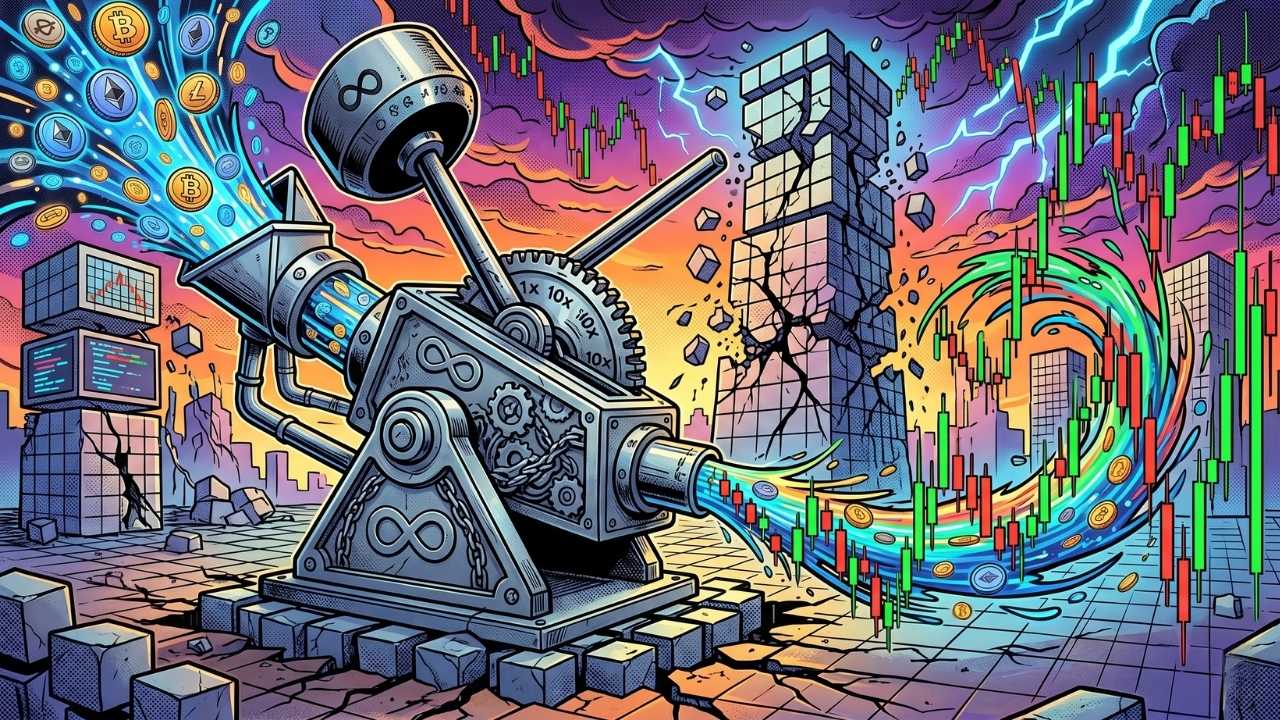
Perpetual futures have established themselves as the predominant derivative instrument in the crypto-asset market, facilitating unprecedented liquidity and global access. This financial structure allows continuous exposure without expiration, redefining operational efficiency while introducing deep systemic risks through massive leverage and funding dependence.
The architecture of perpetuals prioritizes immediate accessibility, but its reliance on the funding rate mechanism creates a structural fragility that incentivizes aggressive risk-taking behavior during high volatility. According to the foundational BitMEX guide on perpetual contracts, this design avoids the constant rollover of trading positions.
Since their commercial introduction in 2016, perpetual futures have absorbed most of the trading volume on both centralized and decentralized exchanges. This massive adoption is due to their ability to offer leverage up to 100x without the logistical hurdles of traditional futures contracts with expiration dates.
The explosive growth of open interest has transformed the ecosystem, allowing the financial leverage guide to be consulted by millions of users seeking to maximize returns with limited capital. However, this democratization of access brings an inherent vulnerability that global regulators have begun to observe with increasing technical concern.
To understand the systemic impact, it is crucial to analyze the funding rate mechanism, which ensures convergence between the perpetual price and the spot price. When the market is predominantly bullish, buyers pay sellers, creating a direct incentive to maintain a healthy commercial balance.
Nevertheless, this dynamic can become perverse. During euphoric phases, high funding rates force traders to maintain expensive positions, increasing the likelihood of forced selling. Data from the Bank for International Settlements on DeFi leverage suggests that average leverage in these environments often exceeds traditional safety levels.
Operational efficiency is undeniable: perpetuals allow immediate risk transfer and continuous 24/7 price discovery. This feature is vital for the maturation of digital assets as an institutional investment class, as it offers sophisticated hedging tools for global portfolio managers.
Despite these benefits, efficiency fosters systemic risks when combined with automated liquidation infrastructure. Unlike traditional financial markets, where circuit breakers exist, in the crypto market, liquidations occur algorithmically and in cascades, accelerating sudden price drops.
Recent history provides clear examples of this phenomenon. In massive deleveraging events, such as those observed in March 2020 or after the FTX collapse, forced liquidations of perpetual futures acted as fuel for extreme volatility, erasing billions of dollars in minutes.
This behavior is analyzed in depth in various academic investigations. A study on the microstructure of perpetual futures markets highlights that the feedback between prices and trader positions creates a high-frequency system prone to violent and unpredictable disruptions.
The necessary counterpoint to this view is that perpetuals have solved the problem of liquidity fragmentation. By concentrating volume in a single instrument without a closing date, market depth is generated, benefiting even those investors who trade exclusively in the spot market.
Furthermore, proponents of this structure argue that exchange insurance funds act as an effective safety net. These funds are designed to absorb losses from positions that cannot be closed in time, preventing bad debt from affecting the platform’s overall solvency.
This view is valid under normal market conditions but may be insufficient in the face of massive external shocks. If the insurance fund is depleted, the system resorts to auto-deleveraging, which penalizes profitable traders and generates widespread distrust in the system’s integrity.
On the other hand, the IOSCO report on crypto-asset trading platforms underscores the lack of transparency in managing these risks. Opacity regarding the real size of hidden leverage in underlying accounts makes it difficult to accurately assess the risk of contagion.
It is imperative to implement risk management strategies that are more robust and do not rely exclusively on algorithmic execution speed. Moving toward smarter margin models and diversified collateral requirements could mitigate some of the most pernicious effects of cascading liquidations.
The technical evolution of perpetuals suggests we will continue to see greater integration between traditional finance and crypto. However, the sustainability of this growth depends on finding a balance between trading freedom and protecting the stability of the entire market.
If the current trend of hyper-leverage persists without adequate collateral risk oversight, perpetual futures will likely face more severe regulatory restrictions in major jurisdictions. This scenario would force protocols to drastically reduce the leverage limits allowed for trading.
In a context where volatility is intrinsic, the use of perpetual contracts will remain a double-edged sword for global markets. The sector’s maturity will be measured by its ability to internalize the negative externalities that excessive leverage imposes on the most vulnerable participants.
This article is for informational purposes and does not constitute financial advice.