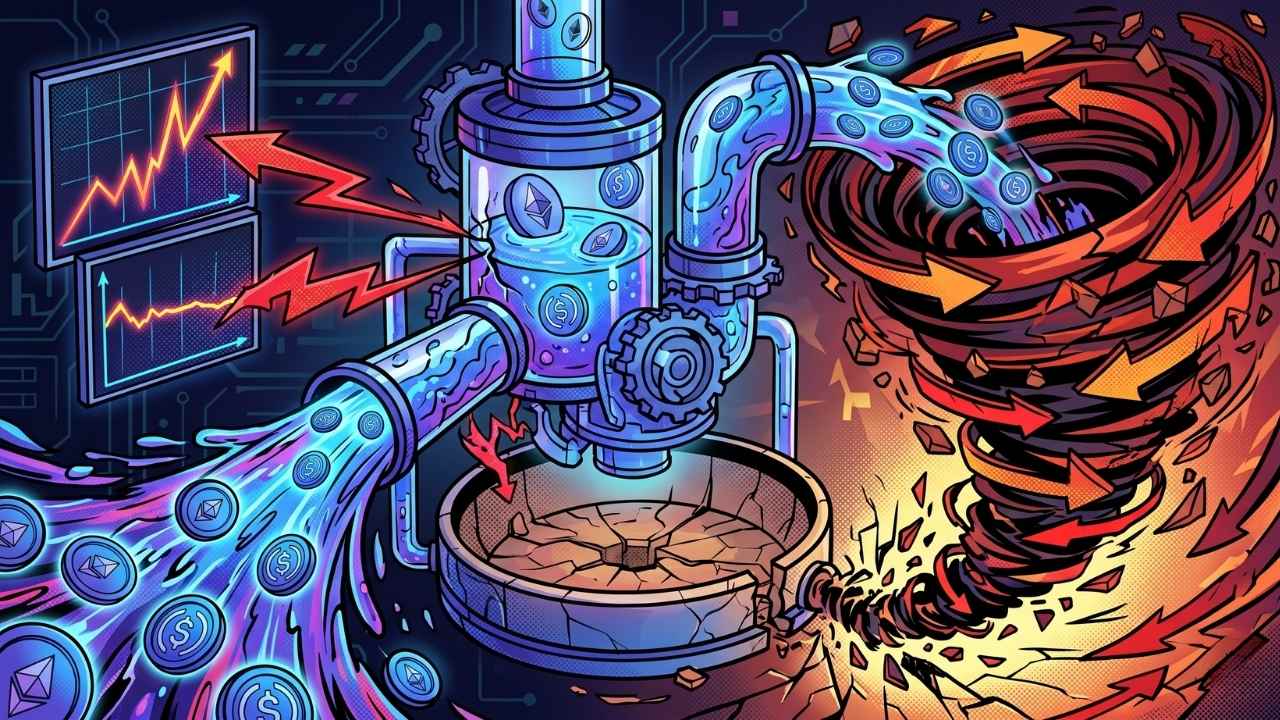
Impermanent loss (IL) has ceased to be a mere operational cost for liquidity providers (LPs) and has become a critical factor in systemic instability. When the volatility of underlying assets spikes, IL as hidden systemic risk alters the incentive structure of participants, forcing massive capital outflows that erode market stability.
This withdrawal dynamic occurs precisely when protocols most need liquidity to buffer price fluctuations. The massive withdrawal of liquidity providers intensifies price slippage, creating an environment where arbitrage is no longer profitable but destructive to the financial integrity of the reserves deposited in Automated Market Makers (AMMs).
The mathematical relationship between price divergence and relative loss of value is detailed in the mathematical model of liquidity, which demonstrates that IL is not linear. In high-volatility scenarios, the actual loss can far exceed the fee rewards generated by the pool’s transaction volume.
Liquidity providers act under strict economic rationality. If the opportunity cost and divergence loss exceed the expected annualized yield, the natural incentive is the immediate withdrawal of funds. This individual behavior, although logical, collectively and rapidly triggers a critical market depth deterioration across the platform.
According to the analysis of risks in DeFi published by the Bank for International Settlements, the lack of depth exacerbates volatility in a negative feedback loop. The less liquidity available in the smart contract, the greater the impact of each individual trade on the final price of the asset.
This phenomenon was clearly observed during the decoupling events of algorithmic stablecoins in 2022. The drop in the value of collateral assets triggered impermanent loss, causing LPs to withdraw their funds to avoid total exposure to a depreciating asset, leaving the market without absorption capacity.
The resulting inefficiency not only affects traders but limits the scalability of the entire sector. It is essential to understand why DeFi overcollateralization remains a structural barrier to global capital efficiency in this context. Lack of capital flexibility prevents protocols from developing more dynamic defense mechanisms.
Historically, traditional markets rely on institutional market makers who operate under contractual obligations to provide liquidity. In DeFi, capital provision is voluntary and highly risk-sensitive. The rational economic exit incentive dominates retail user behavior when IL metrics become unsustainable for the average participant.
Withdrawal dynamics and negative feedback
Increased slippage due to low pool depth attracts aggressive arbitrage bots that extract value from the remaining LPs. According to the Uniswap V3 Whitepaper, liquidity concentration seeks to mitigate this, but in high-volatility crises, capital quickly moves out of active price ranges.
When liquidity shifts out of range, the protocol stops processing exchanges efficiently, resulting in a de facto operational paralysis. This scenario turns impermanent loss into a technical exit barrier that, paradoxically, accelerates the flight of capital toward lower-risk assets or fiat currency.
It should not be ignored that impermanent loss is an intrinsic risk of constant product-based systems (x*y=k). On-chain metrics suggest that in periods of stress, 50% of LPs in high-volatility pools end up with negative returns if they do not actively manage their positions.
Contrary views argue that IL is simply a necessary price for decentralization. Proponents of this viewpoint maintain that second-generation protocols, through the use of oracles and weighted pools, have managed to significantly mitigate the impact of price divergence on long-term providers.
This perspective is valid in bull markets or low-volatility environments, where commission volume compensates for inventory risk. However, in “black swan” events, mitigation mechanisms often fail because they rely on asset correlations that, in a crisis, tend to move in the same downward direction.
The thesis that IL is a crisis catalyst would be invalidated if protocols managed to implement effective liquidity insurance. If a third party guaranteed coverage for the price differential, LPs would have no reason to withdraw capital during an abrupt market drop, thus maintaining the necessary depth.
Risk mitigation and capital efficiency
Currently, the impact on DeFi ecosystem stability depends on the maturation of hedging instruments, such as volatility options. However, the adoption of these financial derivatives is low among retail liquidity providers, who are often the first to capitulate when risk suddenly increases.
Economic literature suggests that market stability depends on its capacity to absorb external shocks without drastic price changes. A Federal Reserve study indicates that liquidity fragmentation across multiple pools worsens systemic resilience against impermanent loss and other decentralized vulnerabilities.
Fragmentation forces LPs to constantly monitor multiple fronts, increasing operational fatigue. When in doubt, capital prefers the safety of overcollateralized lending protocols, even if this limits the velocity of money within the decentralized ecosystem and reduces overall yield opportunities for the broader market.
It is possible that the evolution of AMMs toward “directed liquidity” models powered by artificial intelligence will reduce IL exposure. These systems could automatically adjust concentration ranges based on implied volatility indicators, proactively protecting provider capital before damage becomes irreversible for the treasury.
Without proper management, impermanent loss will remain the Achilles’ heel of decentralized liquidity. The interconnectivity of protocols means that a liquidity failure in a major pool can quickly spread through aggregators and yield farming protocols, generating an uncontrollable domino effect across chains.
Transparency of on-chain data allows analysts to observe these capital outflows in real time. However, the execution speed of smart contracts often exceeds the reaction capacity of human users, leaving liquidity providers at a structural disadvantage during extreme market events.
If the average volatility of major crypto-assets remains above 80% annualized and protection mechanisms against impermanent loss are not integrated into AMM base codes, the depth of decentralized markets will likely suffer severe contractions during the next global deleveraging cycle, limiting DeFi’s utility for large-volume institutional transactions.
This article is for informational purposes and does not constitute financial advice.