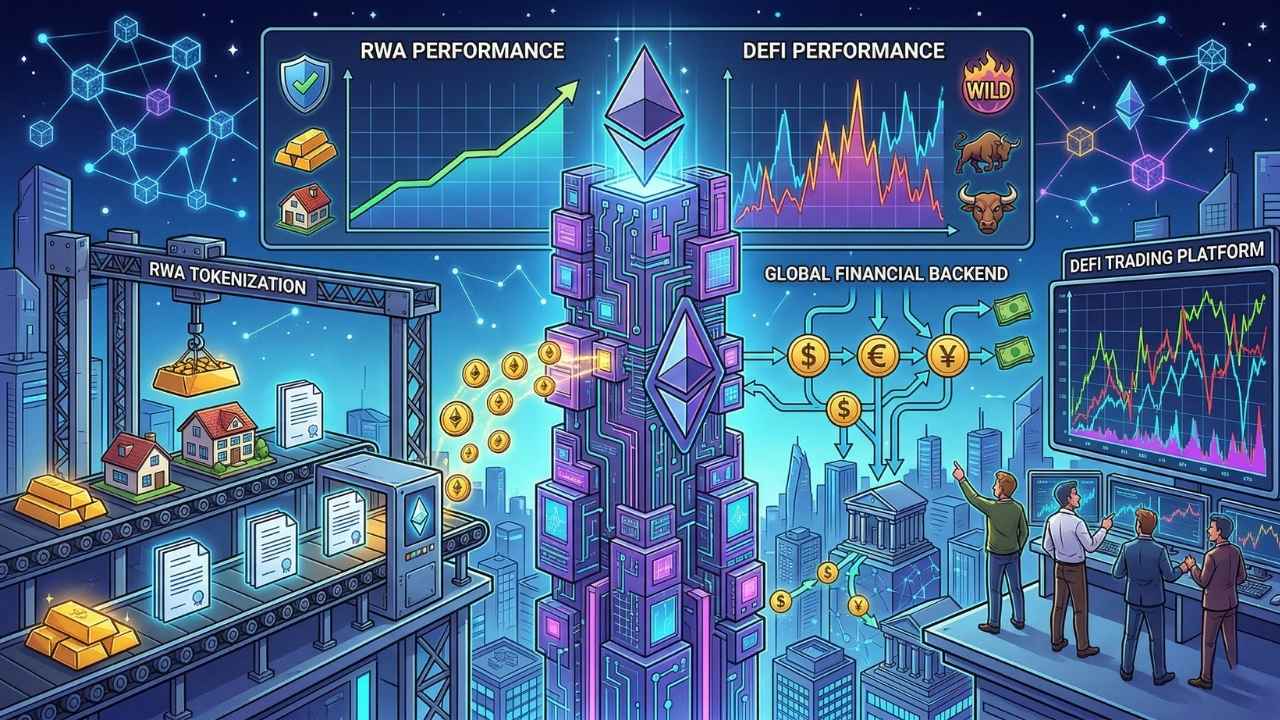
The traditional financial architecture is undergoing an unprecedented transformation driven by rwa tokenization. This process is not a simple technological trend, but a structural change that positions Ethereum as the predominant settlement layer for global assets in the coming years, regarding the future of digital money.
Despite regulatory skepticism, major financial institutions are migrating critical operations toward public networks. This transition suggests that the decentralized ecosystem possesses the necessary technical capacity to absorb trillions of dollars in institutional capital transparently, redefining the financial system as we know it today in the modern world.
Institutional convergence through rwa tokenization
The integration of real-world assets into the blockchain represents a fundamental milestone for the modern digital economy. When observing the Ethereum Whitepaper, it is clear that its original design sought to enable complex and programmable financial applications without centralized intermediaries that slow down capital flow in global markets during the present day.
Today, firms like BlackRock have validated this potential by launching their BlackRock BUIDL Fund, which uses the network to manage treasury assets. This rwa tokenization allows for instantaneous settlement that traditional clearing systems cannot currently match, optimizing institutional liquidity in a massive and unprecedented way for the global investment sector.
Such efficiency drastically reduces operational costs for international fund managers. When global capital moves toward digital rails, Ethereum’s infrastructure acts as the universal technical standard that facilitates interoperability between different financial markets and complex regulatory jurisdictions throughout the entire international financial territory during the digital transformation.
The adoption of this technology is not limited to simple securities. Cutting-edge projects demonstrate that property tokenization is the next logical step toward total liquidity for traditionally illiquid and hard-to-access assets for the average global investor in today’s increasingly connected and digital world.
Operational efficiency versus banking legacy
The current banking system operates on fragmented databases that require constant and costly reconciliation processes. Under this lens, rwa tokenization offers a shared single truth that eliminates discrepancies between institutional balances, improving transparency in every transaction performed and reducing operational risk for traditional financial entities that manage global funds.
Smart contract architecture automates regulatory compliance directly within the asset’s code. Consequently, regulatory oversight is automated, allowing authorities to verify fund flows in real-time without interfering with the normal operations of private financial entities that operate actively in financial markets across the globe during the year.
Far from being a coincidence, the interest in rwa yield vs defi yield reflects the search for more stable and predictable economic models. While purely digital protocols suffer from extreme volatility, assets backed by physical collateral provide much-needed structural solidity for the development of modern digital financial products today.
In other words, the transition toward Ethereum does not seek to replace banks, but to update their internal engine. Institutions that do not integrate rwa tokenization into their workflows will face technological obsolescence compared to competitors operating with fewer transactional frictions and greater agility in managing global financial assets in real-time.
Ethereum as a universal settlement standard
Ethereum’s hegemony is based on its immense liquidity and the proven security of its decentralized network. Analyzing the Federal Reserve Report on digital assets, programmability is recognized as an essential competitive advantage for the future of modern money and the global payment infrastructure that requires high technical availability.
While it is true that other faster networks exist, Ethereum’s decentralization ensures a resistance to censorship that global finance demands. In parallel, the network’s security attracts developers who build institutional-grade infrastructure for asset custody that requires the highest standards of international cryptographic protection in the decentralized financial ecosystem.
The consolidation of rwa tokenization requires an environment where transaction finality is absolute and immutable. Ethereum has shown, after its transition to proof of stake, that it can scale its settlement capacity while maintaining a predictable and highly sustainable policy for large institutional investors over time in the global financial market.
Historically, financial standards have taken decades to establish themselves globally. However, the speed of adoption of open-source protocols suggests that the settlement standard could consolidate much sooner than predicted by the most conservative analysts in the traditional banking sector who cautiously observe this technological advancement in the sector.
In the 2017 cycle, the market focused on the speculation of assets without real intrinsic value. However, the current environment of 2026 shows a radical shift where the J.P. Morgan Onyx Platform processes multi-million dollar transactions using shared ledger principles that redefine financial trust among the banking entities participating in the system.
The challenge of global financial interoperability
One of the most persistent obstacles to full adoption is the fragmentation of liquidity across networks. For rwa tokenization to reach its full potential, it is crucial that assets can flow frictionlessly between different layer-two protocols and the Ethereum mainnet using standard communication protocols between the various blockchain networks available.
Creating secure bridges and cross-chain solutions is a priority for the current technological ecosystem. If interoperability is standardized, Ethereum will be able to function as the gravitational center of an interconnected global financial system, where value is transferred at the speed of digital information in real-time without geographical borders.
Franklin Templeton is already exploring these frontiers with its Franklin Templeton BENJI Fund, demonstrating that coexistence between traditional finance and public networks is possible. This hybrid model leverages institutional trust with the technical agility of decentralized finance, creating a financial ecosystem much more robust than traditional banking models.
The comparison with the rise of the Internet in the 1990s is inevitable and quite enlightening. Just as the TCP/IP protocol unified communications, rwa tokenization is unifying the language of value, allowing any asset to be traded in global markets operating twenty-four hours a day without technical interruptions or administrative closures.
The sustainability of on-chain yields
Critics argue that the volatility of gas fees on Ethereum could hinder its mass use. Under this scenario, if scalability solutions fail to significantly reduce transaction costs, institutions might opt for private ledgers that limit financial transparency and reduce the resilience of the shared public infrastructure that the network provides today.
Other experts suggest that regulatory risk remains an insurmountable barrier for many conservative investors. However, the legal framework evolves rapidly to accommodate technological innovation, providing the necessary clarity for institutional capital to enter the decentralized digital ecosystem which promises higher efficiency in global resource allocation and management for investors.
If the daily volume of tokenized assets consistently exceeds ten billion dollars, Ethereum’s infrastructure will be validated as the ultimate backend. This situation would force a massive migration of debt and capital markets toward systems based on smart contracts, consolidating a new paradigm financial based on transparency and decentralized security for all.
Such transformation will only occur if institutional capital flows maintain their current growth rate over the next three years. rwa tokenization is not just a technical option, but the logical path toward a more efficient, equitable, and connected global economy that will replace the old rails of the traditional banking financial system.