
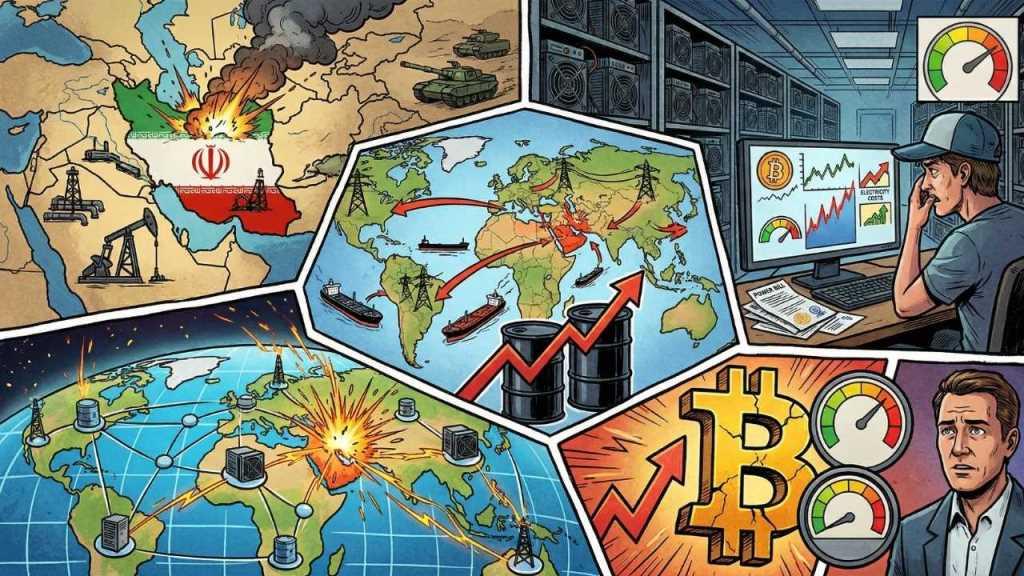
The military escalation in the Middle East has ceased to be an external variable to become the axis of digital profitability. The conflict in Iran directly impacts global energy stability, redefining crypto mining costs in a current scenario of high geopolitical volatility.
While the market focuses on asset prices, the real change is occurring in the physical support infrastructure. Everything points to the interruption of energy supplies permanently raising crypto mining costs, forcing a restructuring of the global industry.
The energy crisis and the price per kilowatt
The outbreak of the armed conflict has triggered an immediate reaction in the commodities markets. Since power generation depends on hydrocarbons, the increase in crude oil prices translates directly into the bills paid by industrial farms, increasing crypto mining costs.
Under this prism, miners operating in regions with a high dependence on fossil fuels face a critical situation. The profitability of older generation machines evaporates quickly, leaving operators with minimal gross profit margins due to the new international electricity rates.
Far from being a transitory phenomenon, the pressure on supplies seems to be structural. Companies must provision additional capital to cover these unforeseen operating expenses. Consequently, the current scenario suggests that crypto mining costs will maintain an upward trend throughout fiscal year 2026.
The displacement of global computing power
Iran has traditionally been a haven for data processing thanks to its subsidized energy. However, current instability has caused a massive disconnection of equipment, altering the global mining map and sending hash rate toward jurisdictions that are much more expensive to operate in.
This forced migratory movement implies that computing power must now compete for resources in more regulated markets. In these new destinations, the absence of state subsidies drastically raises crypto mining costs, eliminating the competitive advantage that Iranian territory previously offered.
At the same time, the saturation of power grids in host countries generates political friction. Local governments are implementing specific taxes for mining activity, which adds an extra layer of expense. In other words, physical security inevitably makes crypto mining costs more expensive.
Technological efficiency in the face of scarcity
Faced with the rising cost of resources, the industry is forced to accelerate its hardware renewal cycle. Only the latest generation equipment can maintain operability when energy prices rise, attempting to offset high crypto mining costs with greater efficiency.
Semiconductor manufacturers have adjusted their roadmaps to prioritize energy savings. According to the latest institutional mining reports, investing in 3-nanometer chips is now the only viable defense. This upgrade requires large capital investment flows that not all miners possess.
While technology advances, the distribution logistics of this new equipment also suffer due to the conflict. Blockades in trade routes in the Middle East delay the arrival of efficient hardware. This prolongs the agony of farms still dealing with unsustainable crypto mining costs.
Lessons from the 2021 and 2022 crises
The current panorama is vividly reminiscent of the mining ban in China during 2021. At that time, the massive displacement of machines caused a historical difficulty adjustment that temporarily relieved the network. However, the current crisis in Iran adds the component of global high energy prices.
Comparing this event to the gas crisis in Europe after the start of the conflict in Ukraine, we observe a clear pattern. Cheap energy is an extinct resource during periods of war. Those events proved that mining operation reports often reflect severe operational losses during geopolitical shocks.
Such previous experience indicates that the resilience of the Bitcoin network is total, but that of the miners is limited. History confirms that only operators with fixed energy contracts survive these cycles. Those exposed to the spot market succumb to today’s explosive crypto mining costs.
The argument for isolated renewable mining
There is a sector of the industry that maintains that renewable energy will mitigate this impact. They argue that using solar or wind sources, by not depending on Iranian hydrocarbons, will stabilize the scenario. Under this thesis, crypto mining costs could decouple from traditional geopolitics.
Despite this optimistic view, the infrastructure to process these energies remains linked to expensive industrial components. The manufacturing of panels and turbines also consumes fossil energy, maintaining an indirect link with international prices. Therefore, crypto mining costs remains vulnerable.
At the same time, the intermittency of renewables requires battery systems whose production is also at risk. While it is true that the transition is necessary, the scenario suggests that it is not an immediate solution. The sector remains trapped in a web of rising operating expenses for now.
Conclusion and projections for the 2026 cycle
The viability of the mining business during the current year will depend exclusively on energy risk management. If crude oil flows remain interrupted for more than a quarter, we will see a massive capitulation of medium-sized miners. The industry will face record crypto mining costs.
It is essential to closely follow the world energy outlook to adjust hedging strategies. Geographic diversification is no longer enough if all global energy becomes more expensive simultaneously. Operational efficiency will be the only real survival filter against crypto mining costs.
Ultimately, the conflict in Iran acts as a market purifier. Only corporations with access to cheap capital and sovereign energy will be able to prosper. The new ceiling for crypto mining costs is here to stay, forcing a total professionalization of the sector.

