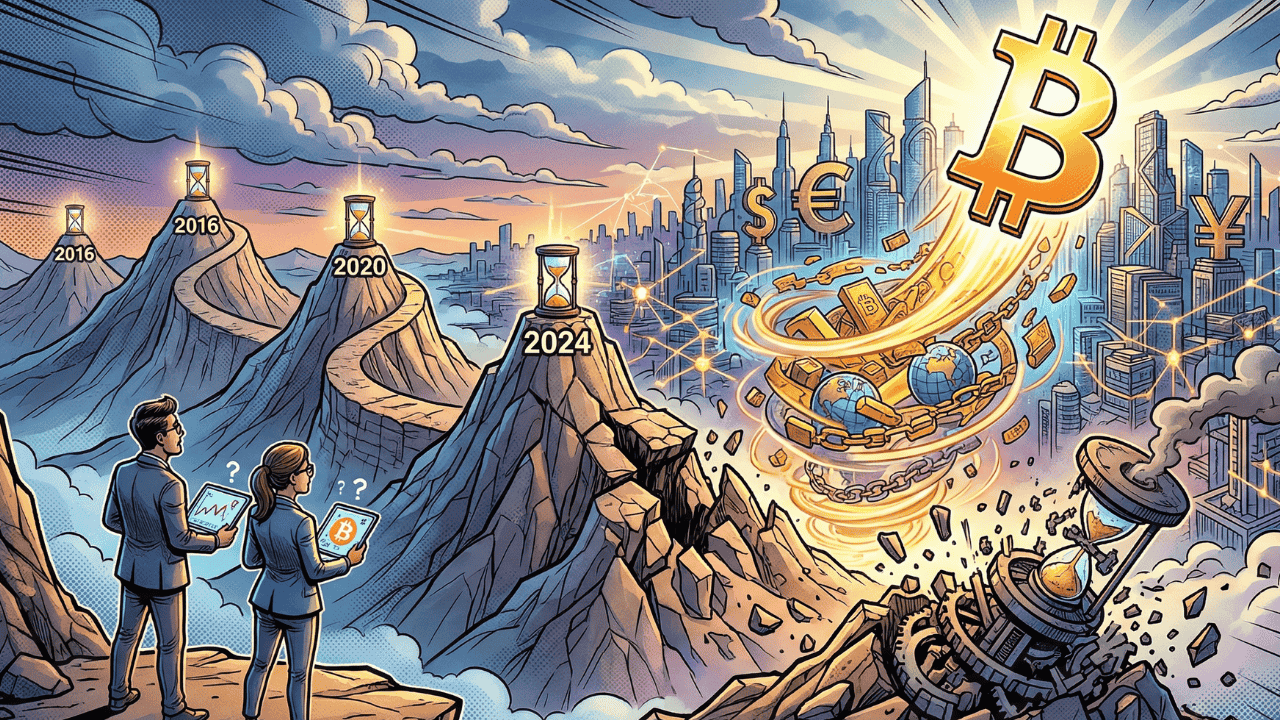
The digital asset industry is at a turning point where the ecosystem’s most sacred metric, the four-year cycle, seems to have collapsed under the weight of institutional maturity. For a decade, the market moved with the precision of a metronome dictated by the halving, creating a narrative of predictability that allowed investors to anticipate peaks and valleys with almost religious confidence. However, the underlying reality of 2025 and the beginning of 2026 suggests that this model has been replaced by a much more complex dynamics, synchronized with global capital.
The prevailing thesis until 2024 held that the reduction of the mined supply was the primary driver of price appreciation. However, the market’s behavior following the October 2025 peak at $126,200 has shattered traditional patterns. What was once a movement driven by technical scarcity has transformed into a dance to the rhythm of central bank liquidity and etf flows. Under this new paradigm, the cycle hasn’t died, but has mutated into a structure where the mining calendar is secondary to Federal Reserve decisions.
The Collapse of Prophecy: The 2025 Peak Data
The evidence that something has deeply changed lies in the timing of the movements. Historically, Bitcoin reached its absolute maximum between 12 and 18 months after the halving. While the late 2025 peak fits chronologically, the structure of the rise lacked the classic euphoric blow-off top that characterized 2017 and 2021. According to year-end data, Bitcoin lost 28% of its value in the final quarter of 2025, a statistical anomaly that defied the historical bullish trend of year-ends following the reward reduction event.
This shift in behavior is explained by the entry of a new player: massive institutional capital. With over $115 billion dollars managed by exchange-traded products as detailed in the Grayscale Research report, extreme volatility has been replaced by more sophisticated selling pressure and portfolio rebalancing algorithms. The underlying reality suggests that large funds don’t buy the halving; they buy the correlation with the m2 money supply and protection against monetary devaluation, stripping the cycle of its purely cryptographic mystique.
From Technical Scarcity to Macroeconomic Liquidity
Far from a coincidence, Bitcoin’s correlation with equity markets has reached levels that invalidate the theory of the decoupled asset. Analysis from Fidelity on cycles indicates that the miner’s influence has drastically diminished. With more than 94% of total supply already in circulation, the impact of reducing daily issuance from 450 to 225 BTC is, in market terms, insignificant compared to the billions flowing through derivatives markets and pension funds.
Under this prism, the “halving metronome” has been replaced by the “liquidity barometer.” It no longer matters when the supply shock occurs if there is no monetary expansion to support it. Consequently, cycles no longer last four years because Bitcoin “must,” but rather expand or contract according to the duration of interest rate cycles. The market is learning, painfully, that decentralization does not grant immunity to the macroeconomic forces that govern the rest of the global risk assets.
The Supercycle Mirage vs. Market Maturity
In other words, the disappearance of 80% corrections—so-called crypto winters—is not necessarily the sign of an infinite supercycle, but of institutional dampening. While many analysts at Davos in early 2026 proclaimed the end of cycles, the reality is that the market has simply become more efficient at absorbing shocks. The drop below $70,000 in February 2026 proved that gravity still exists, although it now manifests as a steady “drip” of deleveraging rather than a sudden systemic collapse.
Parallelly, Bitcoin’s adoption as a corporate reserve asset by over 5% of S&P 500 companies has created a support floor that did not exist before. This institutionalization of the corporate balance sheet acts as an anchor preventing the massive retail capitulations that defined the 2014 and 2018 cycles. However, this same anchor limits parabolic potential, as investment committees often execute automatic profit-taking upon rapid appreciation, flattening the growth curve that was once exponential.
The Trap of Historical Comparison with 2018 and 2022
It is mandatory to compare this scenario with the events of 2018 and 2022 to understand the magnitude of the rupture. In those years, the market collapsed due to endogenous failures: the exhaustion of ICOs or the implosion of centralized entities like FTX. In 2026, the weakness comes from exogenous factors: the contraction of global liquidity and geopolitical uncertainty. Analyzing SEC investment warnings on speculative schemes, we see that the regulator no longer focuses only on fraud, but on the systemic integration of these assets into the traditional market.
While it is true that the “peak every four years” pattern barely held in October 2025, the nature of the current correction suggests that the next “bottom” will look nothing like previous ones. We are not facing a three-year accumulation phase, but a dynamic adjustment. The risk of using logarithmic regression models based on data from when Bitcoin was a niche asset is that they ignore the structural change of the market. History doesn’t repeat itself, but it rhymes with a different frequency in the era of volatile interest rates.
The Invalidation Scenario: What if the Cycle Persists?
For the thesis of total rupture to be valid, Bitcoin must demonstrate that it can decouple from halving seasonality over the next 18 months. If the price managed to reclaim $100,000 without a massive expansion of global liquidity, the “macro barometer” theory would be invalidated, confirming that intrinsic scarcity remains the dominant driver. Nevertheless, current evidence points to etf inflows being the only real support maintaining the long-term bullish structure.
Therefore, if capital flows into regulated products remain negative for more than two consecutive quarters, the most likely scenario is not a traditional bear market, but an exhaustive lateralization for years. This “death by boredom” would be the final proof that the four-year cycle has been hacked by institutional efficiency. Volatility, once the investor’s greatest enemy, is being tamed, and with it, the possibility of generating life-or-death returns in short periods of time.
If the critical support of $74,500 holds during the first half of 2026 while global liquidity begins to expand again, we will be witnessing the birth of a hybrid cycle. The underlying reality suggests that we no longer live in Satoshi’s world, but in the world of central banks with digital collateral. The cycle hasn’t died; it has simply stopped belonging to us and started belonging to Wall Street.