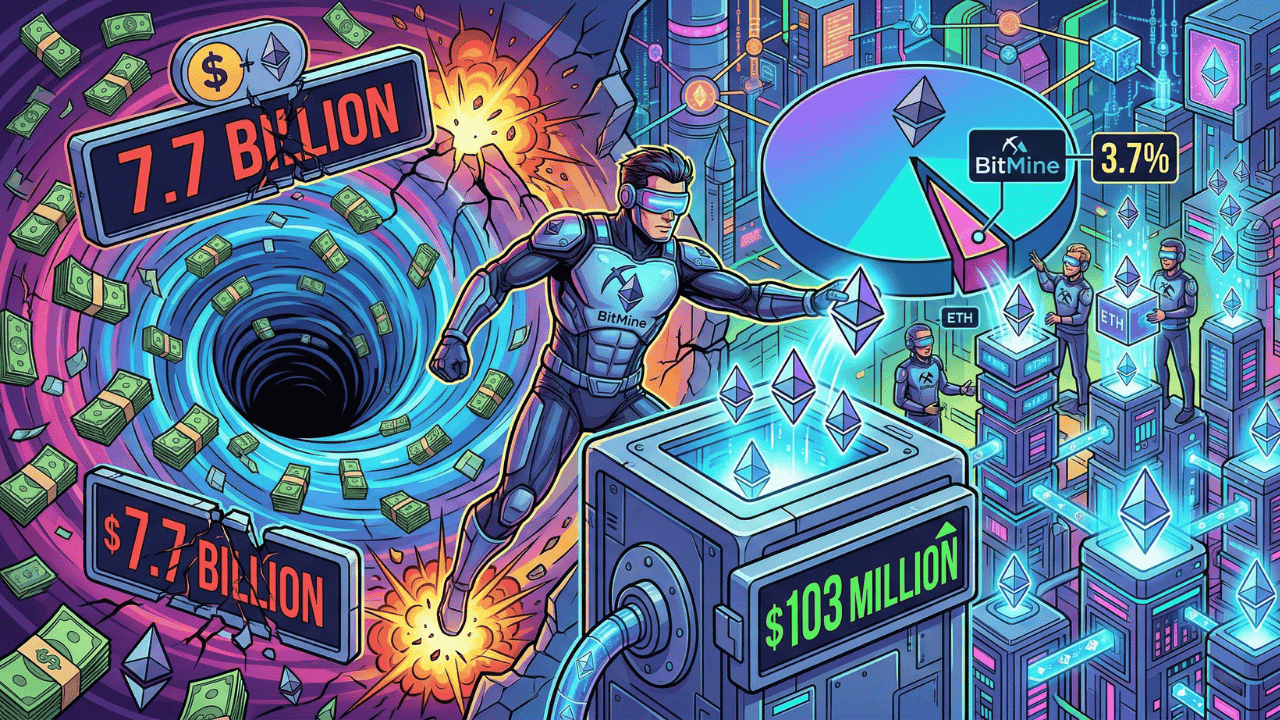
BitMine Immersion Technologies purchased 50,928 ETH for $103 million last week, according to its latest institutional treasury report. This acquisition raises its holdings to 3.71% of the total supply, consolidating institutional investment in Ethereum despite the $7.7 billion in unrealized losses recently reported by the American firm.
Tom Lee, the company’s chairman, maintains that recent weakness represents a strategic opportunity to accumulate fundamental assets at discounted prices. Although the price has fallen by 22% over the last month, the firm’s shares rebounded by 8.4% this Monday, reflecting renewed shareholder confidence in the solvency of the corporate model.
This financial maneuver mimics the institutional accumulation cycles of 2022, where large corporations took advantage of retail capitulation to strengthen their balance sheets. The firm now custodies 4.47 million ETH, a milestone that positions BitMine as the largest corporate holder of the asset, surpassing diversification metrics of traditional funds currently operating on Wall Street.
Institutional accumulation strategy against secondary market volatility
The core of BitMine’s profitability does not depend exclusively on the spot price, but on its aggressive policy of generating passive yields through staking. Currently, the company holds 3 million ETH locked in smart contracts, which generates estimated annual revenues of $172 million, acting as a necessary financial cushion against market volatility.
The transition toward its own technical infrastructure, named the Made in America Validator Network, seeks to optimize operating margins through proprietary nodes by 2026. According to Ethereum specifications, direct control over validators reduces fees paid to third parties, allowing staking revenues to rise to $253 million annually under stable network conditions.
Analyzing the structural impact, the absorption of 3.71% of the circulating supply by a single entity could trigger a massive supply shock in the medium term. Since a large portion of these assets is destined for long-term staking, available liquidity on exchanges is drastically decreasing, which has historically served as a precursor to explosive bullish movements when institutional demand normalizes.
Can the corporate treasury model survive current inflationary pressures?
The comparison with MicroStrategy’s Bitcoin strategy is inevitable, although BitMine introduces the native yield component as a key differentiator in its business model. While other companies only hold the asset passively, this firm operates as an industrial validator, transforming its balance sheet into a source of operating cash flow that mitigates nominal losses.
It is essential to consider that the $7.7 billion in unrealized losses represents an accounting challenge under current regulations for corporate financial reporting. However, the resilience shown by the board indicates that the investment horizon exceeds five years, prioritizing value capture in the global settlement layer that the smart contract network represents today.
Aggregate data in the CoinShares report confirms that the concentration of validation power in corporate hands is an upward trend. Nevertheless, technical decentralization remains intact due to the geographic distribution of nodes, allowing this cryptocurrency to maintain its appeal as a neutral financial infrastructure against highly centralized traditional banking systems.
Official metrics provided by staking data validate that BitMine’s success will depend on the execution of its MAVAN network. Investors should closely monitor upcoming quarterly reports to confirm if validation revenues manage to offset secondary market volatility, thereby setting a new standard for digital treasuries in the next decade.