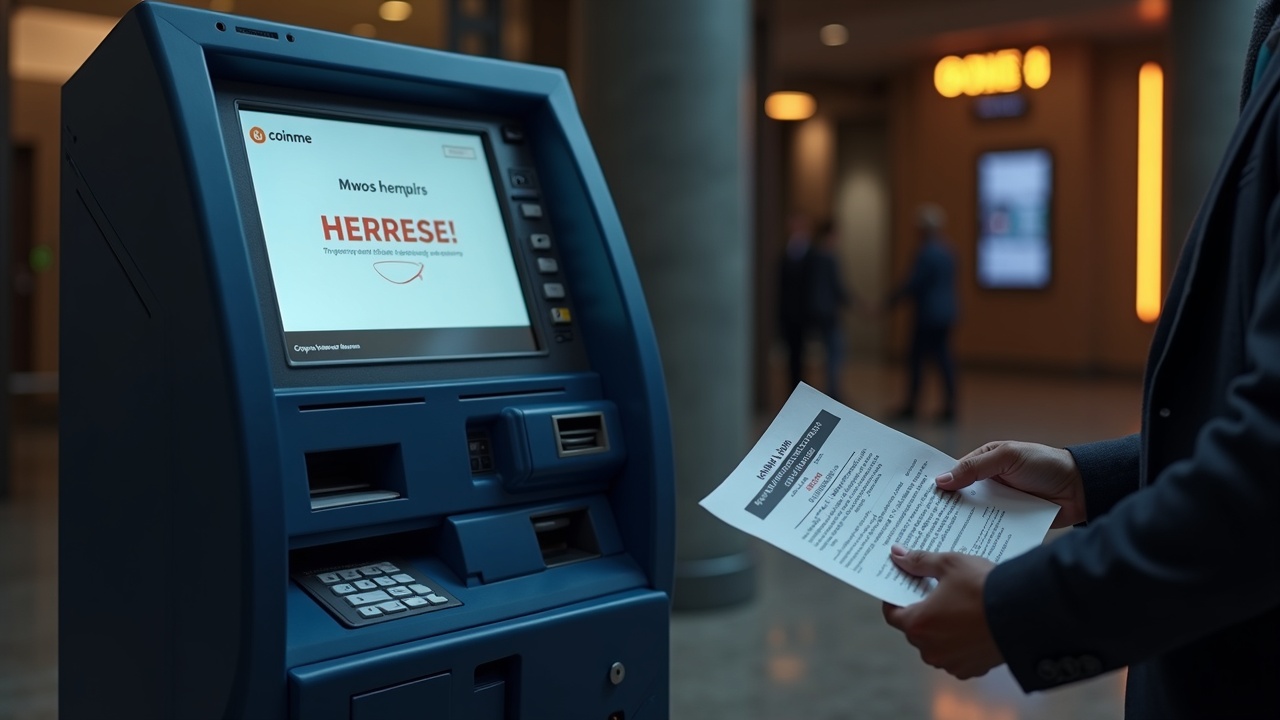
The Washington State Department of Financial Institutions (DFI) has issued a forceful cease and desist order against kiosk operator Coinme, compelling the firm to halt all its money transmission services. The measure, dated December 1, 2025, demands the repayment of over 8 million dollars to affected customers, alleging that the Seattle-based company illegally converted funds from unredeemed vouchers into corporate revenue.
According to the official investigation, the company’s operating model required users to purchase paper vouchers at physical kiosks to then redeem them online. The DFI maintains that when these vouchers were not claimed within a specific timeframe, the company appropriated the outstanding balances by recording them as its own income, a practice that flagrantly violates the state’s Uniform Money Services Act.
Charlie Clark, DFI Director, emphasized that money transmission laws exist to protect consumers who rely on licensed companies, underscoring that serious violations will have direct consequences. In addition to restitution, the firm faces the potential revocation of its license, a 300,000 dollar fine, and a 10-year ban for its CEO, Neil Bergquist, if they fail to defend themselves at the administrative hearing.
For his part, Ben Enea, the company’s Chief Compliance Officer, stated that they are cooperating fully with regulators to resolve the situation. However, the charges detail a systemic failure to maintain tangible net worth legally required between 2020 and 2025, in addition to the submission of inaccurate reports and a lack of transparency regarding redemption timeframes. This case highlights the growing pressure on Bitcoin ATM regulation, where authorities seek to eliminate operational gray areas that allow discretionary handling of user assets.
Can the crypto ATM sector survive this new compliance standard?
This incident marks a significant escalation in the oversight of crypto-to-fiat gateways, sending a clear message to the entire industry regarding the treatment of unclaimed funds. For institutional investors and operators, the risk no longer lies solely in the solvency of an individual operator, but in the legal precedent that reclassifies dormant customer assets as callable liabilities and not as miscellaneous income or “breakage.” Regulators are signaling an end to tolerance for lax accounting practices, which will force all companies in the sector to tighten their disclosure and escheatment policies.
The impact of this measure could compress profit margins across the entire consumer-facing crypto services ecosystem, introducing new regulatory compliance costs. As Coinme has 20 days to request a hearing before the order becomes permanent, the market is watching closely. The outcome of this conflict will likely define new operational and accounting standards, forcing a necessary but painful maturation for physical cryptocurrency exchange infrastructures in the United States.