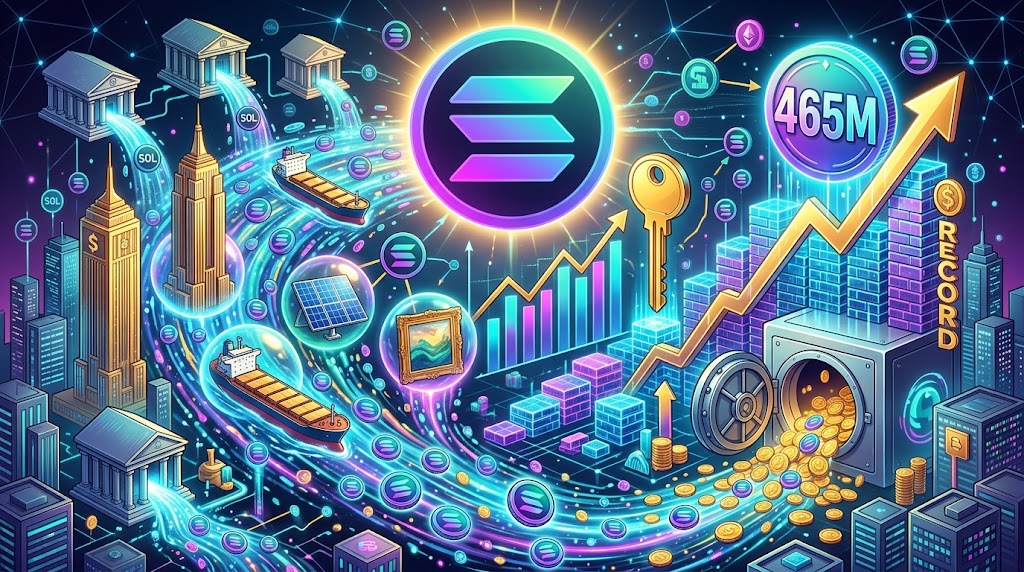
On August 20, 2026, the tokenized equities supply on Solana surpassed 465 million dollars, setting a new weekly all-time high in the issuance of traditional corporate shares and real-world assets onchain.https://twitter.com/solana/status/2090355764103950590?s=20
This milestone occurred alongside institutional activity from regulated digital asset exchanges such as Bullish, which completed landmark trades involving equity shares tokenized directly on the Solana blockchain network.
The expansion aligns with the wider growth of tokenized cash across the network. Stablecoin circulation and tokenized treasury bills have provided the liquid settlement layer required for secondary equity trading.
Institutional Real World Asset Inflow Dynamics
. @kashdhanda reveals @Solana recently pulled in $700 million in real-world assets – more than every other chain combined
"Anyone who's in the industry and understands what's actually happening on Solana right now is ridiculously bullish. Alpenglow is coming, which is going to… pic.twitter.com/9rxqWT4wDq
— MR SHIFT 🦁 (@KevinWSHPod) August 19, 2026
During an appearance on the When Shift Happens podcast, recent statements from Kash Dhanda indicated that Solana attracted 700 million dollars in RWA in recent days, exceeding total inflows recorded across competing blockchains.
Dhanda explained that approximately 98% of tokenized equities trading on decentralized networks is currently executed on Solana. He noted that this volume reflects both capital migrating from other networks and net new institutional liquidity.
Unlike modular blockchain ecosystems that depend on fragmented layer-2 rollups, Solana maintains a single global ledger state. This unified liquidity pool prevents order book fragmentation and enables automated market makers to quote tighter spreads.
Trading demand has centered heavily on tokenized shares linked to technological and artificial intelligence companies. Deep liquidity in dollar-pegged stablecoins allows institutional and retail market participants to trade equity assets without leaving the blockchain ecosystem.
Technical Upgrades and Alpenglow Consensus Architecture
Network throughput and settlement speed are scheduled to advance further with Alpenglow, a protocol consensus overhaul engineered to reduce finality latency from 12.8 seconds to 100 to 150 milliseconds.
Alpenglow replaces the legacy Proof-of-History and TowerBFT consensus architecture with two specialized components named Votor and Rotor. Votor coordinates offchain validator voting rounds to achieve block finalization in minimal confirmation steps.
Rotor optimizes block propagation across the network using stake-weighted relay paths. Technical network simulations indicate that block propagation under standard bandwidth conditions can be accomplished in as little as 18 milliseconds.
The new architecture integrates a 20+20 fault tolerance model, allowing the ledger to remain operational even if 20% of validators go offline and another 20% act adversarially. Validator admission tickets also eliminate onchain vote transaction fees.
Furthermore, Alpenglow expands block capacity to 100 million compute units. This throughput brings onchain execution latency within range of centralized exchanges, supporting high-frequency market makers and institutional order routing.
Compliance Frameworks and Custody Verification
The growth of tokenized equities develops in parallel with initiatives establishing clear digital asset regulation for institutional market participants. Regulatory clarity aims to protect asset issuers, broker-dealers, and qualified custody providers handling tokenized shares.
To satisfy regulatory standards, token issuers connect onchain asset transfers to offchain legal shareholder registries. This structure ensures that each digital security token maintains legally enforceable ownership rights backed by audited custodial reserves.
The production deployment of Alpenglow on mainnet and forthcoming quarterly reserve audit reports represent the documented operational milestones that will determine the scalability of tokenized equity markets throughout 2026.
This article is for informational purposes only and does not constitute financial advice.