

DeFi platforms are expanding their lending facilities using tokenized stocks. On October 13, the Aave DAO voted to provide incentives to eligible users who use Coinbase’s tokenized equities on the Base blockchain.
Aave V4’s Equities Hub received more than $4.9 million worth of tokenized stocks as collateral during its first 17 days after launch. Eligible users can borrow USDC against these tokenized stocks without selling their positions. The reported figure reflects the value of collateral deposited, although the precise reporting date and metric should be confirmed against the original source.
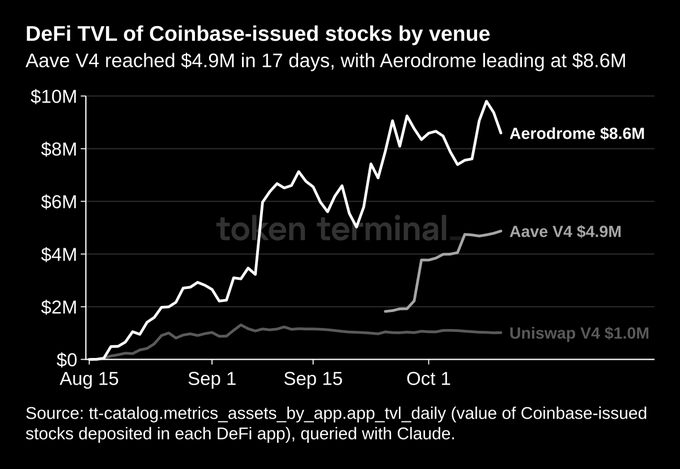
Source: X
What Risks Do Tokenized Assets Pose to DeFi?
Aave integrated its market on the Base blockchain with tokenized U.S. technology stocks from Coinbase, allowing them to serve as collateral for USDC loans. The supported stocks include Apple, Amazon, Alphabet, Meta, Microsoft, Nvidia, and Tesla.
Chainlink provides the equity price feeds used by the lending market to value these tokens. Each stock token has its own collateral factor, which determines how much users can borrow against it.
According to a post on X, the Aave community voted to reward eligible users who deposited these tokens. The incentive program applies to eligible users outside the United States and does not make the stock tokens themselves borrowable. The DAO’s vote and the program’s actual implementation are separate steps, so the applicable terms and launch status should be understood from the relevant announcement.
Loans secured by collateral carry a basic risk: the value of the collateral can fall while the outstanding loan remains unchanged. This increases the loan-to-value (LTV) ratio and reduces the buffer protecting lenders. If a position breaches its liquidation threshold, the protocol can liquidate some or all of the collateral to help cover the outstanding debt.
Aave DAO has approved incentives for the Coinbase Tokenized Stocks market on @base.
Tokenized stocks are only available in eligible jurisdictions outside of the U.S. pic.twitter.com/Q58knFfZUJ
— Aave (@aave) October 13, 2026
At launch, the market reportedly had around $29.3 million in collateral capacity, $32 million in USDC supply capacity, and $21 million in borrowing capacity. These limits help constrain exposure, but they do not guarantee that collateral can be sold at its reference price during volatile market conditions or periods of reduced liquidity.
How Do Market Closures Affect Tokenized Assets?
Blockchains can process transactions 24/7, whereas traditional stock exchanges operate during designated trading hours. As a result, a tokenized stock may remain transferable or tradeable when its underlying exchange is closed, depending on the platform and market arrangements.
Aave’s Equities Hub illustrates the distinction between blockchain availability and the availability of fresh market prices. According to its specifications, the market operates 24/7, while Chainlink’s equity price feeds are available from 8 p.m. ET on Sunday to 8 p.m. ET on Friday. During weekends and U.S. market holidays, the feeds retain their last published prices.
Those prices may therefore become stale while the underlying stock market is closed. A token can remain transferable even when its reference price no longer reflects current market conditions or the price at which the token could actually be sold. This difference matters when the price feed is used to assess collateral and determine whether a position can be liquidated safely.
Liquidity Shortages Could Complicate Liquidations
Collateral valuation is only one part of the lending process. When a borrowing position breaches its liquidation threshold, the protocol relies on liquidators to repay debt in exchange for a discounted amount of collateral.
Liquidators then need to sell, hedge, or otherwise use the assets they receive. If there are few buyers, spreads widen, or prices move sharply, the value they recover may be lower than expected. This can complicate liquidations and increase the risk that the collateral will not fully cover the outstanding debt.
Galaxy Research’s October 6 analysis examines automated market makers (AMMs) that use pools of tokenized stocks. According to the analysis, an S&P 500 liquidity pool would have underperformed a portfolio holding the same stocks by about 3% year to date. The difference reflects how variations in the returns of individual stocks affect liquidity providers in a pooled market.
AMM performance and lending liquidations are different mechanisms. The reported 3% gap does not measure Aave’s liquidation risk directly. However, both systems depend on asset prices and market liquidity, which can become more difficult to manage when trading conditions deteriorate.
Private credit introduces a related but distinct liquidity challenge because repayments or redemptions may take longer to complete. Collateral can provide limited protection if a debt becomes due before the underlying asset can be converted into cash. The extent of this risk depends on the asset’s liquidity, redemption terms, and the timing of the liabilities.
Why Are Risk Controls Important for DeFi?
Aave’s Equities Hub uses separate liquidity provisions and risk parameters to manage exposure. According to Aave’s announcement, each supported stock has its own collateral ratio, while supply and borrowing limits help constrain the amount of risk the market can take on.
Risk management also requires reliable price feeds, safeguards against stale valuations, and sufficient collateral buffers. Protocols need to consider whether liquidators can sell tokenized stocks during periods of volatility and whether the market can absorb several liquidations at once without a sharp deterioration in prices.
Tokenized stocks offer another way for investors to access stablecoin liquidity while maintaining exposure to assets linked to conventional shares. However, the long-term viability of this model depends on reliable pricing, prudent collateral management, adequate liquidity, and effective liquidation procedures. Weaknesses in any of these areas could limit adoption or increase losses during market stress.