

Crypto security is becoming a financial stability issue as stablecoins connect blockchain networks, exchanges, and traditional financial institutions. The FSB warned that global stablecoins pose cross-border risks requiring stronger oversight and cooperation. Cyberattacks, custody failures, and disruptions to essential services could spread beyond individual platforms.
These risks are substantial due to the fact that the stablecoin project itself is multilateral and operates in many jurisdictions. Global stablecoins could become systemically important in one or more countries. It will be hard for the regulator to evaluate all risks involved.
Why Does Stablecoin Growth Raise Regulatory Concerns?
The global market of stablecoins stands at about $300 billion, 90% of which is associated with the US dollar. Despite the growth of the market, the regulation of stablecoins and their supervision still lacks a unified framework. According to a report, FSB found that only 39%, or 11 out of 28 surveyed countries, have developed regulatory frameworks for stablecoins.
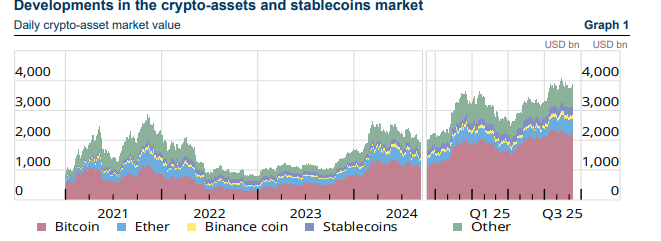
Source: Financial Stability Board
However, Global Stablecoin Arrangements, Cross-border Vulnerabilities, and Financial Stability Monitoring, FSB, outline how cross-border vulnerabilities arise and describe data that is necessary for monitoring.
The report notes that stablecoin operations can involve multiple parties across different countries. This makes supervision difficult during market turmoil.
These gaps matter because stablecoins support trading, payments, DeFi lending, and transfers between exchanges. In case of an operational problem with one of the issuers or service providers of stablecoins, users may face delayed transactions or an inability to redeem tokens.
How Can Custody Failures Disrupt Financial Markets?
One key aspect where issues arise is custody management since there will be a need for institutions that would take care of assets while maintaining accurate records. In the event of a cyber attack, insolvency, or any other mistake, the ability to withdraw funds from the reserve could be affected.
Multi-issuer models pose another challenge due to the fact that the reserves and operations often fall under different jurisdictions. The high demands for redemptions in one jurisdiction take place while the reserves are somewhere else. This makes the situation complicated and more uncertain if the authorities cannot work together in a coordinated manner.
The large-scale withdrawals also impact the normal financial markets. The issuer may have to sell off reserve assets or transfer money between financial institutions to satisfy these withdrawals. Any sudden liquidations would put pressure on the short-term financial market.
Why Is Shared Infrastructure Vulnerable to Cyberattacks?
The stablecoin frameworks depend on exchanges, custodians, blockchains, wallets, cloud services, and other infrastructure components. If an attack is launched against one of the frequently utilized services, several platforms will be affected simultaneously.
An exchange may suspend withdrawals, or a blockchain service may stop working. Users then lose access to their funds despite the underlying assets still being available.
The DeFi platforms will have more exposure to the issue since the smart contracts will be able to execute collateral liquidations and transfers automatically. The compromised price oracle provides erroneous market information and forces the liquidation of the collateral or incorrect collateral valuation. Issues with the bridging or settlement services often prevent the transfer of assets between networks.
AI adds another dimension to the threat. FSB Chair Andrew Bailey, in his letter to the G20 finance ministers and central bankers, said AI-related dangers also pose a certain risk to the financial stability and require close attention.
How Does Global Cooperation Strengthen Stablecoin Oversight?
This will include improved cybersecurity, reserves reporting, validation, and tests for recovery systems. There should be incident response planning for issuers and custodians of the stablecoins. However, for exchanges and DeFi, there is a need for protection from any form of unauthorized access and infrastructure attacks.
The regulators will require improved information exchange across jurisdictions and the responsibility of the stablecoins that operate in more than one jurisdiction. According to the FSB, international cooperation is necessary in the regulation of stablecoins.
Stablecoin facilitates the faster payment system and use of blockchain financial services. Increased adoption of the stablecoin implies the need for increased safeguards as the digital assets are becoming more integrated into the conventional financial systems.