
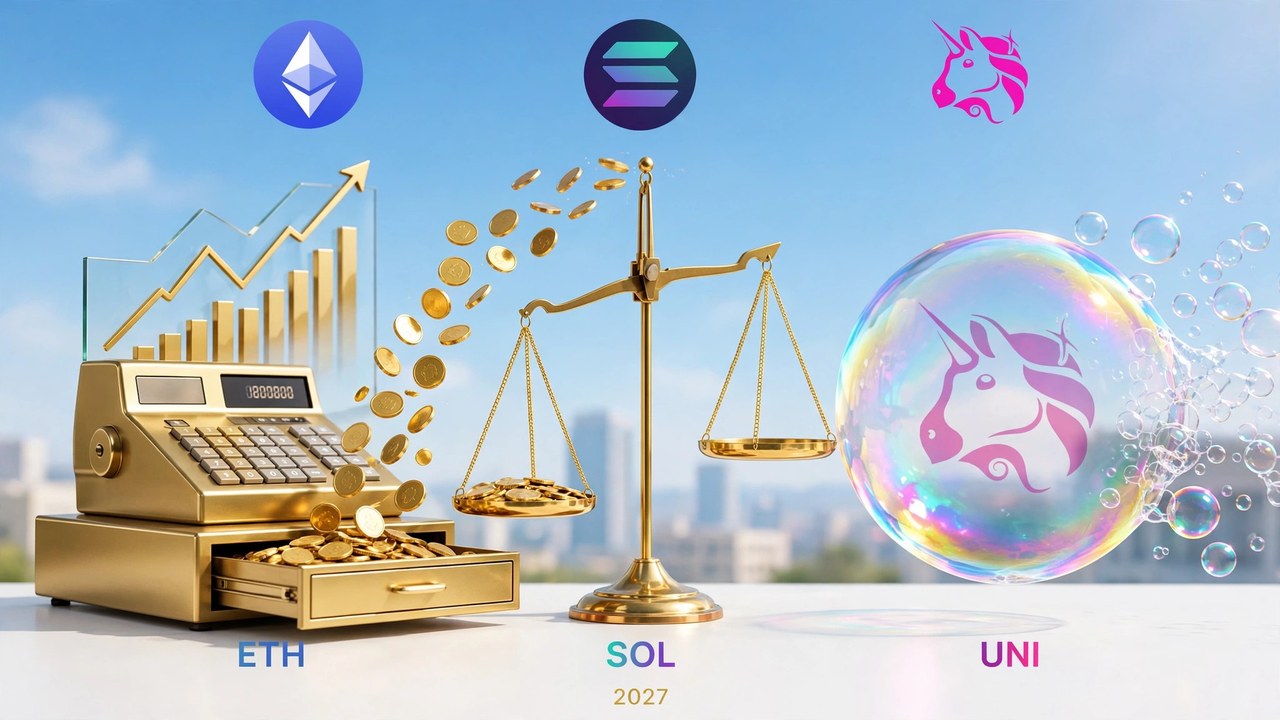
Public metrics from DefiLlama cumulative protocol fees show that a narrow group of decentralized applications captures the overwhelming share of real economic activity across the sector. Heading into 2027, the crypto market is positioned to reward verifiable cash generation over speculative storytelling.
During earlier cycles, attaching a token to an emerging technical label was often enough to attract indiscriminate capital without operating cash flows. That playbook is losing effectiveness because institutional capital demands measurable fundamentals before committing multi-year allocations to digital assets.
To evaluate this shift rigorously, we must separate observable market facts from forward-looking interpretation. The verifiable fact is that the selective liquidity regime established throughout 2026 curtailed investor tolerance for dilutive token emissions lacking organic user demand.
The structural interpretation follows directly: when capital carries a real opportunity cost, allocators stop subsidizing cash-burning protocols. In 2027, token durability will hinge on capturing transaction fees and routing verifiable economic value back to holders.
Standardized financial statements tracked on Token Terminal now allow analysts to benchmark blockchain applications alongside traditional software businesses. Price-to-sales and price-to-fees ratios expose stark valuation gaps between fee-generating platforms and networks sustained purely by inflationary rewards.
This accounting clarity is already reshaping token design across leading decentralized venues. Instead of issuing governance tokens detached from protocol cash flows, developers are implementing explicit buyback programs, programmatic burns, or direct fee distributions denominated in liquid assets.
A concrete illustration of this transition emerged recently across decentralized derivatives and token launch infrastructure. The move toward record $638 million token buybacks demonstrates how operating revenues can convert directly into persistent secondary-market demand.
From Monetary Expansion to Cash-Flow Discipline
Market history offers an instructive contrast in how valuation frameworks shift across liquidity regimes. Between 2020 and 2021, global monetary expansion fueled multibillion-dollar valuations for protocols whose trading volumes relied almost entirely on temporary liquidity mining subsidies.
Once those emissions expired in 2022, over 80% of decentralized finance tokens suffered severe drawdowns because few users remained willing to pay unsubsidized fees. The sector learned firsthand that subsidized volume never guarantees durability once incentives fade.
Empirical findings published in the a16z State of Crypto report reinforce this pivot toward measurable utility. The research highlights how applications demonstrating sustained user retention are those facilitating payments, spot trading, and settlement at competitive fee tiers.
Alongside technical maturation, regulated investment vehicles are reshaping capital allocation standards. Research distributed by Grayscale Research indicates that professional asset allocators increasingly screen for net fee capture when evaluating exposure beyond Bitcoin and Ether.
This analytical rigor is creating a visible split across the digital asset landscape. On one side stand applications and infrastructures with auditable treasuries funding self-sustaining operations; on the other sit dozens of layer-one and layer-two networks exhibiting artificial activity and negligible fee generation.
In 2027, that divergence will move from an analytical talking point to the primary driver of return dispersion. Fiduciary allocators will favor instruments where economic activity backs token valuation over governance assets whose sole function involves voting on non-binding proposals.
Counterpoint: Could Market Narratives Dominate Again?
Critics of a cash-flow-first framework argue that crypto markets operate through reflexive cycles driven by attention and speculative liquidity. From their standpoint, applying conventional valuation multiples ignores the asymmetric upside of early-stage network infrastructure.
This counterargument carries legitimate weight because historical precedents support it. Several foundational blockchain networks operated for years with minimal fee revenue before achieving critical adoption, and strict cash-flow screens would have excluded them early on.
Furthermore, an unexpected wave of monetary easing across major economies could revive risk appetite across speculative segments. Under abundant dollar liquidity, momentum capital frequently rotates into low-revenue tokens seeking rapid multiple expansion.
Accordingly, our thesis regarding fundamental outperformance in 2027 would be falsified under a specific observable condition. If zero-fee or narrative-driven tokens outperform the top ten revenue-generating protocols on DefiLlama by more than 40% over the first two quarters of 2027, this thesis fails.
Such an outcome would prove that market participants still prize expectation expansion above tangible value capture. Yet as long as institutional allocation discipline holds, verifiable revenue distribution mechanisms will continue gaining ground over promotional narratives.
For protocol teams, the strategic takeaway is unambiguous. Architecting token models where usage growth translates directly into measurable economic value is no longer optional for attracting durable capital.
If the top ten fee-generating decentralized protocols sustain annualized buyback or distribution yields above 5% of circulating market capitalization throughout the first half of 2027, their tokens will experience average drawdowns at least 25% smaller than the broader altcoin index during quarterly market pullbacks.
This article is for informational purposes only and does not constitute financial advice.