
Key Insights:
- Data availability now determines whether blockchain scaling remains fully verifiable.
- Rollups cut costs and expand capacity, yet accessible records still secure exits.
- Modular networks gain efficiency while adding deeper layers of technical reliance.
Blockchain scaling has reached a point where transaction speed alone no longer defines progress. As rollups process growing amounts of value offchain, the market increasingly depends on whether transaction data remains available for independent verification. Without that access, users may be unable to confirm balances, challenge invalid state updates, or safely withdraw assets, even if the network continues processing transactions.
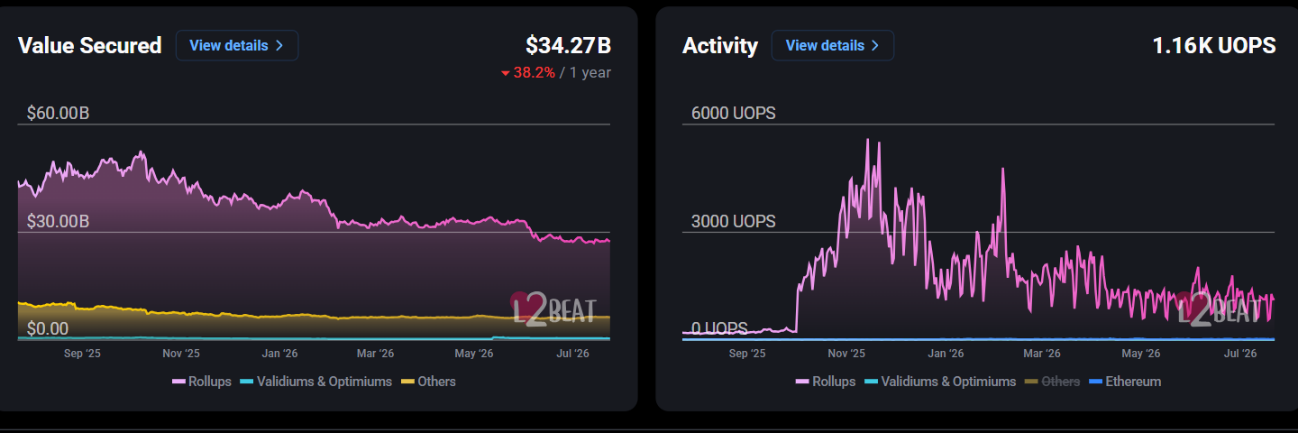
The challenge is comparable to building a faster highway while removing the map needed to verify where every road leads. As of July 2026, L2Beat tracked approximately $34.58 billion across blockchain scaling systems, including $27.68 billion secured through rollups. Those networks processed about 1,140 user operations per second, roughly 36 times Ethereum’s throughput, making data availability a central component of blockchain infrastructure rather than a purely technical optimization.
Data Availability Becomes the Verification Layer
Data availability describes whether users and validators can obtain the information needed to reconstruct a blockchain’s state. It does not require every record to remain stored forever. Instead, the protocol must keep relevant data accessible for verification, disputes, and safe withdrawals.
Rollups execute transactions offchain, compress the results, and publish commitments for settlement. This design increases throughput, but it shifts part of the security burden from computation to data access. A correct-looking commitment cannot protect users when transaction history is missing.
Ethereum’s technical documentation states, “Data availability is critical because without access to state data, challengers cannot construct fraud proofs.” Optimistic rollups provide a challenge period of about seven days. During that period, verifiers need transaction data to detect incorrect state changes and submit disputes.
Validity-proof systems reduce the need to recheck every computation, yet they do not remove the need for state data. Users still require that information to confirm balances, reconstruct accounts, and prepare withdrawals.
Market Growth Raises the Cost of Missing Data
The importance of data availability now extends well beyond experimental scaling networks. As of July 23, 2026, DefiLlama estimated the stablecoin market at approximately $311.02 billion, while decentralized finance held about $76.95 billion in total value locked. Lending protocols, decentralized exchanges, payment systems, and tokenized asset platforms all depend on reliable state data to verify balances, collateral positions, and asset ownership.
When data becomes unavailable, damage can spread through applications. Lending protocols may struggle to verify collateral. Bridges may lose reliable information about locked or released assets. Exchanges and payment systems may face delays when they cannot confirm the latest state.
Data publication also shapes transaction fees. Rollups must pay to place enough information where independent parties can retrieve it. Ethereum’s PeerDAS proposal calls layer-one data availability the “dominant bottleneck” for rollups. Greater capacity can reduce costs, while limited capacity can push systems toward weaker guarantees.
That trade-off has created a broad security spectrum. Some systems post transaction data directly to a base layer. Others store it off-chain through committees or bonded validators. Ethereum describes data availability committees as trusted parties whose guarantees depend on their design and membership.
Modular Networks Add New Points of Dependence
Modular blockchain architecture separates execution, settlement, consensus, and data availability. This allows each layer to specialize, but one transaction may depend on several systems. Wallet interfaces rarely show those dependencies, although each one can affect finality, withdrawals, and recovery.
The Bank for International Settlements linked these design choices to “fragmentation of infrastructure, liquidity, and assets across and within chains.” Its July 2026 bulletin said bridges and multi-chain issuance can reduce friction. Yet they also create trust, governance, and operational dependencies.
Data availability sampling offers a technical response. Instead of downloading every byte, nodes sample random portions of encoded data. When enough nodes sample different portions, the network gains strong evidence that the dataset exists and can be reconstructed.
Erasure coding strengthens that process by adding redundant pieces before distribution. If a producer withholds enough information to prevent reconstruction, the missing sections become easier to detect statistically. Research on fraud proofs and data availability proofs showed that sampling can help light clients slightly, while still not asking them to download every single block.
Bitcoin and Ethereum illustrate two different approaches to data availability. Bitcoin relies on full nodes downloading and verifying complete blocks from end to end. Ethereum, by contrast, introduced temporary blob storage through EIP-4844, where transaction data remains available for a limited period—roughly 18 days—before being pruned. The two models reflect different trade-offs between scalability, storage efficiency, and long-term data accessibility rather than competing definitions of security.
Across the crypto landscape, data availability affects transaction costs, validator rewards, bridge safety, custody work, liquidations, and even institutional settlement. At this point, developers are trying to boost data capacity, but they also want users to verify things on their own, independently, as rollups take up a larger share of block activity.
Conclusion
Blockchain data availability has become a foundational layer of modern blockchain infrastructure because network security ultimately depends on users being able to verify what occurs onchain. As rollups, stablecoins, decentralized finance, and tokenized assets continue expanding, reliable access to transaction data becomes essential for fraud detection, withdrawals, and independent verification. Scaling therefore depends not only on processing more transactions, but also on ensuring that the information needed to validate those transactions remains available whenever users need it.