
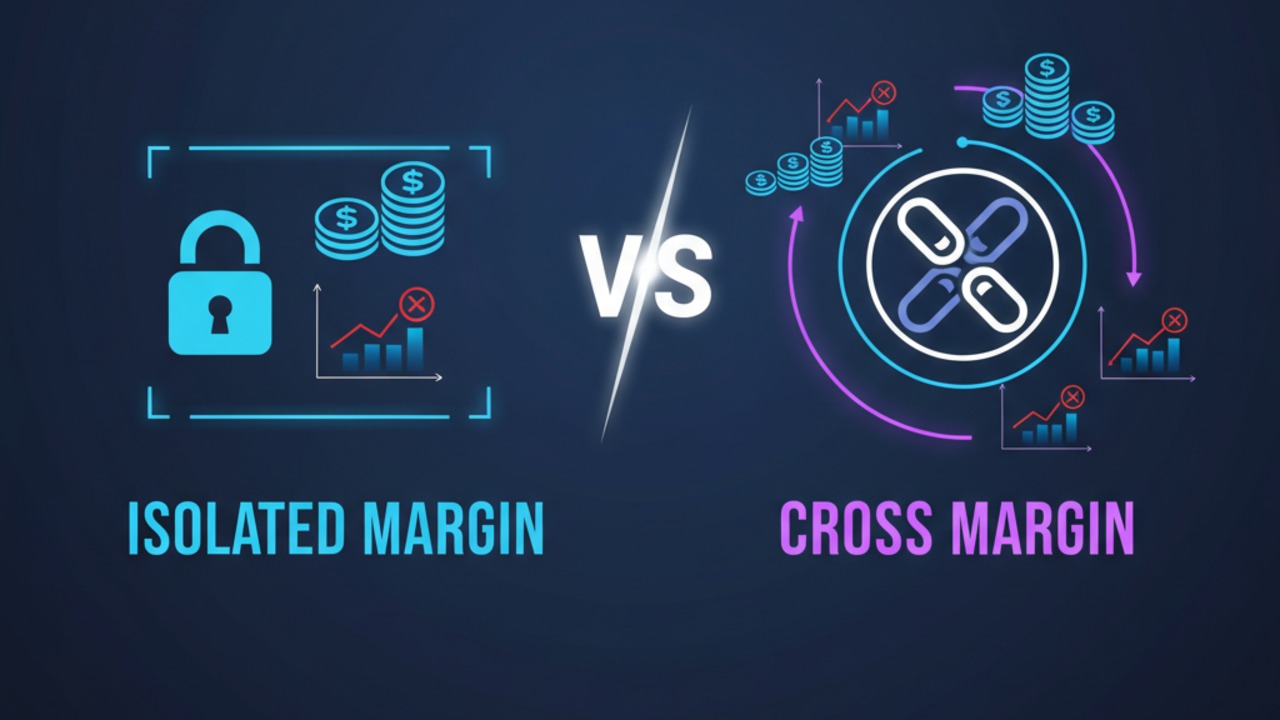
In crypto derivatives trading, particularly perpetual swaps on DEXs, the choice between cross-margin and isolated margin is not a minor operational preference: it’s a structural risk management decision that defines capital survival in high-volatility environments.
Cross-margin maximizes capital efficiency but amplifies systemic account risk, while isolated margin reduces the risk of total ruin at the cost of reduced operational flexibility. In crypto markets, where tail events are frequent, this difference is critical.
The Illusion of Efficiency in Leverage
In the ecosystem of decentralized perpetual exchanges (Perp DEXs), the choice of margin model is not simply an interface preference; it is the structural decision that separates capital survival from total ruin. The thesis of this analysis is straightforward: while cross-margin is touted as the pinnacle of capital efficiency, it actually acts as a vector of systemic risk for the retail trader. In contrast, isolated margin stands out as the only architecture capable of compartmentalizing losses in a market defined by its high correlation and fat-tail events.
The dominant narrative in trading forums and DeFi communities maintains that cross-margin is superior because it “prevents accidental liquidations” by sharing collateral. However, this premise ignores that, in events of extreme volatility, the correlation of crypto assets tends towards 1, transforming that supposed safety net into a noose that suffocates the entire account simultaneously.
Anatomy of Risk: two opposing philosophies
To understand the structural implications, we must break down the internal mechanics of each model:
- Cross-Margin: Uses all available capital in the account as collateral for each open position. If a trade incurs a loss, it uses the balance of other successful positions or the free balance to avoid liquidation.
- Isolated Margin: Allocates a specific and finite amount of collateral to an individual position. The maximum loss is strictly limited to the margin deposited for that specific trade, protecting the rest of the portfolio from a “contagion effect.”
From a technical perspective, cross-margin is an interconnected system, which in financial engineering translates to a system fragile in the face of external shocks. Isolated margin, on the other hand, is a modular system, where the failure of one component does not compromise the integrity of the whole.
On-Chain Metrics
According to aggregated liquidation metrics from platforms like Coinglass and volatility reports from Glassnode, market behavior is not linear:
- Liquidation Cascades: More than 85% of liquidations on perpetual DEXs occur in blocks of less than 10 minutes, preventing traders from manually adding collateral to cross-margin models.
- Stress Correlation: During corrections exceeding 10% in Bitcoin, the correlation of the Top 50 altcoins rises to levels of 0.95. This invalidates the argument that holding multiple cross-margin positions “compensates” for risk, as all positions fall in unison.
- Open Interest Growth: Open interest in Perp DEXs has grown 40% year-on-year, but market depth (liquidity in the order book) has not grown at the same rate, increasing the risk of slippage and forced liquidations.
Lessons not learned from 2020 and 2021
To validate this position, we must look at previous structural events. The “Black Thursday” of March 2020 is the definitive example of the failure of cross-margin trading. In that event, Bitcoin lost nearly 50% of its value in less than 24 hours. Those users who employed cross-margin saw their positions in Ethereum or LINK, which were perhaps not as overleveraged, liquidated simply because their shared collateral (BTC) evaporated.
Unlike the CEXs (centralized exchanges) of that era, today’s Perp DEXs operate with automatic liquidations via smart contracts. This means there is no robust “insurance engine” or possibility of manual intervention; liquidation is mathematical and ruthless. The current market structure, with the introduction of ETFs and the influx of institutional funds, has shifted the narrative from one of “momentum” to one driven by macro liquidity.
When is Cross-Margin valid?
To maintain analytical authority, we must recognize that cross-margin is not inherently “bad,” but rather is often misused by retail traders. It is a valid and superior model in the following scenarios:
- Delta-Neutral Strategies: When a trader executes a basis trade (long in spot, short in perpetual), cross-margin allows the profits from one leg to cover the losses from the other without real risk of liquidation.
- Institutional Arbitrage: Market makers need the flexibility of shared collateral to manage hundreds of simultaneous positions with capital efficiency.
If Perp DEXs were able to implement intelligent “portfolio margin” systems that recognize true hedging and reduce margin requirements on opposing positions, the systemic risk of cross-margin would be drastically reduced.
Fragility in the Current Macroeconomic Environment
We cannot ignore the macroeconomic context. We are in a cycle of restrictive interest rates and global liquidity that, although showing signs of recovery, remains fragmented. In this context, leverage is an expensive and dangerous luxury. Cross-margin, by maximizing the use of every dollar in the account, leaves the trader without a buffer against volatility shocks induced by inflation data or Fed decisions, which instantly impact the price of digital assets.
Conclusion
The transition from a “profit maximization” narrative to one of “capital preservation” is essential for the maturity of the DeFi sector. The indiscriminate use of cross-margin is a vestige of an era of easy money and predictable volatility that no longer exists.
If realized volatility in the crypto market exceeds 4% daily for three consecutive sessions, the liquidation rate for cross-margin accounts will be at least 2.5 times higher than for accounts trading exclusively with isolated margin, due to the breach of maintenance thresholds based on asset correlation.
DEX trading is not a sprint, but a marathon. Isolated margin is the tool for those who plan to keep trading tomorrow.

